Yoon's case assigned to Second Division with Justice Kim Sung-su as presiding judge; Oh's panel yet to be designated after appellate acquittal
Cases against former President Yoon Suk Yeol, first lady Kim Keon Hee and Seoul Mayor Oh Se-hoon — each indicted on allegations tied to political broker Myung Tae-gyun's polling activities — have all reached the Supreme Court. The three cases share a common thread: whether payments related to Myung's surveys violated the Political Funds Act. Lower courts, however, reached conflicting conclusions on the legal character of the polling services and the credibility of Myung's testimony, making the Supreme Court's eventual ruling a matter of wide attention.
The Supreme Court assigned Yoon's Political Funds Act case to its Second Division on Monday, designating Justice Kim Sung-su as the presiding judge, according to legal sources. The move follows the earlier referral of Kim Keon Hee's so-called "three allegations" — involving Deutsch Motors share-price manipulation, alleged cash receipts from the Unification Church, and the free provision of Myung's polling services — to the full bench. Oh's Political Funds Act case has also been filed with the Supreme Court, but a panel assignment has yet to be made.
All three cases center on whether conduct related to Myung's surveys constituted illegal political fundraising. Yoon and Kim Keon Hee are accused of receiving polling services from Myung free of charge, while Oh is accused of arranging for a third party to cover the cost of surveys Myung conducted on his behalf. Although the specific charges and the structure of the alleged payments differ, the central questions in each case are the same: how much weight to give Myung's testimony, and whether objective evidence is sufficient to support it.
Lower courts split on guilt. In Yoon's case, the first instance court found him guilty, but the appellate court acquitted him. Kim Keon Hee, by contrast, was acquitted at both the first and second instance on the charge of receiving Myung's polling services without payment.
Both lower courts in Kim Keon Hee's case found that Myung had provided the surveys to expand his own political influence and ruled accordingly in her favor. In Yoon's case, however, the first instance court found that for some of the surveys there had been a mutual agreement between Yoon and his wife and Myung to exchange political funds. The appellate court then reversed that finding, ruling that polling services were difficult to classify as a financial benefit under the Political Funds Act and that evidence of any mutual agreement on free provision was insufficient.
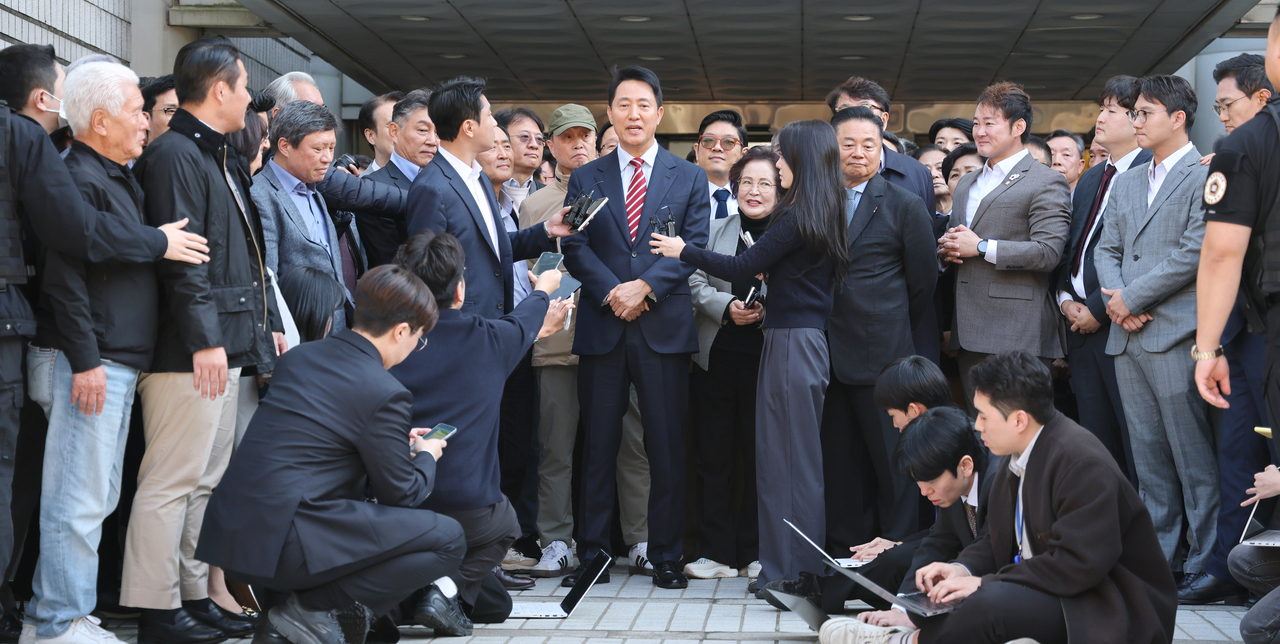
Oh's case, which differs in substance from those of Yoon and Kim Keon Hee, also produced conflicting verdicts at the two lower court levels. Oh was indicted on charges of commissioning surveys from Myung ahead of the 2021 Seoul mayoral by-election and arranging for supporter Kim Han-jeong to pay the 33 million won ($24,300) cost on his behalf.
The first instance court found parts of Myung's testimony credible and sentenced Oh to a fine of 10 million won. A conviction carrying a fine of 1 million won or more, once final, would strip Oh of the mayoral post and bar him from public office for five years — effectively ending any bid for the next presidential election. The first instance ruling therefore amounted to a sentence that would have cost Oh his position. The appellate court reversed it on Oct. 23, ruling that Myung's testimony could not be taken at face value and that corroborating objective evidence was lacking.
Because Kim Keon Hee's case is already before the full bench, the possibility that Yoon's case could be heard alongside it has been raised. The Supreme Court had originally planned to hand down its ruling in Kim Keon Hee's case in July, but after guilty verdicts were issued at the first instance level in both Yoon's and Oh's cases in quick succession, it postponed the sentencing date and referred the matter to the full bench. The full bench held its first session in September, with the key question reported to be whether conducting a poll or providing its results constitutes a political fund contribution prohibited under the Political Funds Act.
Since Yoon's case involves the same allegation of receiving polling services free of charge, the full bench could take it up alongside Kim Keon Hee's case and examine the legal principles together. A case assigned to a smaller division can still be referred to the full bench if the need is recognized during deliberations.
Oh's case, however, differs from those of Yoon and Kim Keon Hee in its specific charges and legal issues. The central question in Yoon and Kim Keon Hee's cases is whether the free provision of polling services constitutes a financial benefit under the Political Funds Act, whereas Oh's case turns on whether there is sufficient evidence to establish that he commissioned the surveys and arranged for their costs to be paid by a third party, and whether that evidence was gathered through lawful procedures. Some observers say whether Oh's case is referred to the full bench should therefore be assessed separately from the cases involving Yoon and Kim Keon Hee. Others, however, note that the credibility of Myung's testimony is equally central to Oh's case, leaving open the possibility of a full bench referral there as well.
yg@heraldcorp.com