Samsung Heavy Industries signs SOFC deal with Japanese firm; HD Hyundai Heavy Industries commits 1.07 trillion won to land-based power engines and small modular reactors
South Korea's shipbuilding industry is moving beyond vessel construction to secure new long-term growth engines. With dry docks booked years in advance on the back of a global shipbuilding supercycle, major players are actively pursuing new businesses that rely less on dock capacity.
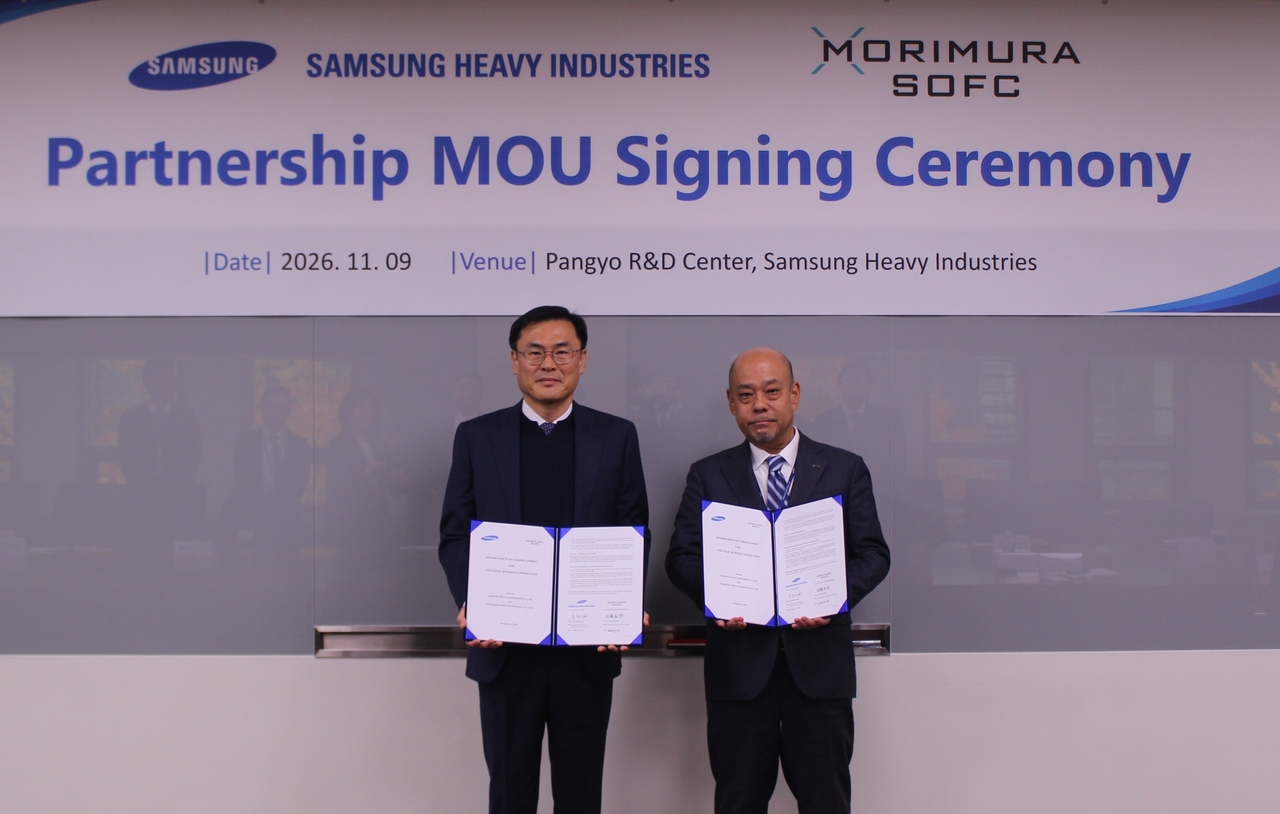
Samsung Heavy Industries signed an MOU with Japan's Morimura SOFC Technology on Monday to jointly develop and commercialize solid oxide fuel cells. SOFC technology generates electricity through a chemical reaction between fuel and oxygen using a ceramic solid electrolyte.
The two companies plan to co-develop large-capacity SOFC systems for use in ships and data centers by 2028. Samsung Heavy Industries will handle product engineering, system integration and commercialization, while Morimura will supply the cells and stacks that form the core components. Samsung Heavy Industries intends to deploy the technology aboard vessels to meet carbon emission regulations and to support electrification in unmanned autonomous ships.
The venture is still in its early stages, but industry observers note its significance as a shipbuilder's direct entry into power generation equipment development — not merely the integration of fuel cell systems into ships. HD Hyundai's hydrogen fuel cell affiliate HD Hydrogen has been active in the space, but a shipbuilder taking the lead role itself is considered unusual.
Attention is also turning to whether Samsung Heavy Industries will build out a dedicated organizational structure for the new business. Its Future Business Division previously established a task force for a floating data center project, and that TF has since been elevated to a full team.
Shipbuilders push into power engines and SMRs
Other major shipbuilders are also expanding into businesses anchored by separate production facilities and research hubs. Two areas drawing particular focus are land-based power engines for AI data centers and key components for small modular reactors. Demand for land-based power generation engines is growing as AI data centers drive a surge in electricity consumption, spurring the need for dedicated on-site generation capacity and backup power systems.
HD Hyundai Heavy Industries announced in September that it would invest a total of 1.07 trillion won ($791 million) to build a land-based power engine production base and a dedicated SMR primary equipment factory. It will spend 833.6 billion won constructing a new HiMSEN engine facility in Onsan-eup, Ulju-gun, Ulsan, with an annual capacity of 3 GW. Construction is set to begin in the first quarter of next year, with completion targeted for May 2028. The existing Ulsan factory will focus on marine engines, while the new plant and HD Hyundai Engine in Yeongam, South Jeolla Province, will produce HiMSEN engines for land-based power generation. The company plans to expand total HiMSEN engine production capacity to 7.2 GW per year by 2030.
HD Hyundai Heavy Industries will also invest 238.6 billion won in a dedicated factory for manufacturing SMR primary equipment, with the facility to be completed by the first half of 2029. SMRs are next-generation nuclear power plants characterized by smaller generation capacity and modular designs compared with conventional large reactors. Fabricating reactor primary equipment demands advanced welding, machining and quality-control expertise, so shipbuilders can draw on the manufacturing capabilities built through constructing large vessels and offshore plants.
Charting new energy transition markets ahead of the post-supercycle era
Shipbuilders are also broadening their reach into offshore wind substructures, offshore substations, and hydrogen and ammonia-related equipment. Offshore wind installations and marine energy structures let shipbuilders leverage their expertise in vessel and offshore plant design and large-scale steel fabrication. Hydrogen and ammonia projects similarly overlap with existing shipbuilding capabilities — from next-generation fuel storage and supply systems to fuel cells and related components. The push reflects an effort to capture markets being created by the global energy transition, beyond traditional vessel construction.
The moves are seen as a strategy not only to compensate for limited dry dock capacity but also to prepare for the period after the current supercycle ends. The shipbuilding industry, which once endured a prolonged slump, is prone to extreme volatility tied to the timing of vessel orders and deliveries, making portfolio diversification a necessity. "For US naval maintenance, repair and overhaul work — which has drawn attention through the MASGAR Korea-US shipbuilding cooperation project — dry dock constraints could limit the volume of contracts that can be taken on," one industry official said. "Finding new businesses that can make use of existing shipbuilding technology, beyond vessel construction itself, is becoming increasingly important."

keg@heraldcorp.com