Data submitted to lawmaker Kim Jae-seop shows repayment-conditional loans plunged at KB Kookmin Bank while rising at Woori, Hana and Shinhan banks
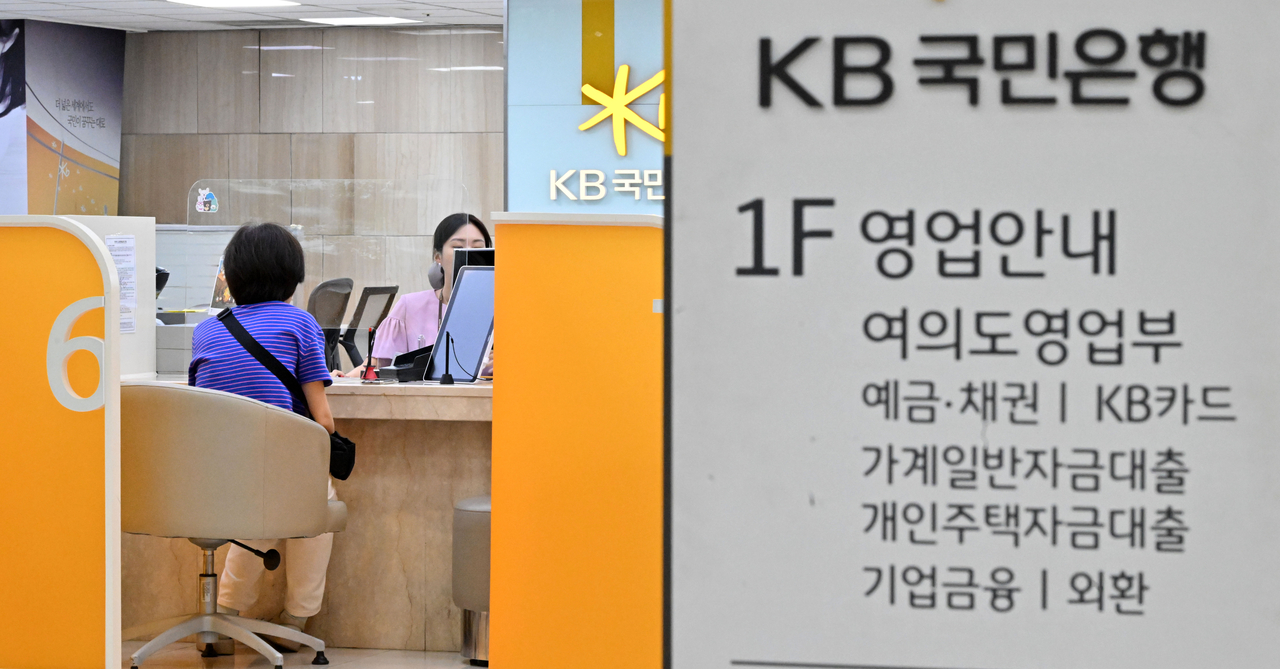
After KB Kookmin Bank tightened its mortgage lending limits, the share of repayment-conditional home loans at the bank plunged — while the same metric rose at other major commercial banks, revealing a classic balloon effect.
Experts say the persistent demand for housing loans, even amid the government's push to rein in household debt, calls for more targeted management that takes genuine homebuyers into account.
Data submitted to the National Assembly's Political Affairs Committee by the Financial Supervisory Service and analyzed by People Power Party lawmaker Kim Jae-seop showed that repayment-conditional loans as a share of KB Kookmin Bank's total mortgage portfolio plunged 14.5 percentage points — from 19.2 percent in June to 4.7 percent in September. Over the same period, Woori Bank, Hana Bank and Shinhan Bank each saw their shares rise by roughly 5 to 8 percentage points.
Repayment-conditional loans allow borrowers to have existing debts — such as jeonse loans or personal credit loans — excluded from the debt service ratio calculation when taking out a new mortgage, provided they commit to repaying those debts. This effectively raises the ceiling on how much a borrower can take out under a new home loan.
The divergence in each bank's share became pronounced from the point at which KB Kookmin Bank independently moved to cap its own lending.
The bank cut its maximum home-purchase loan limit from 600 million won ($443,000) to 300 million won starting July 10. KB Kookmin Bank's share of repayment-conditional loans had climbed from 14.8 percent in January to 19.2 percent in June, but then fell for three consecutive months — to 15.8 percent in July, 8.3 percent in August and 4.7 percent in September.
At other commercial banks, however, the share of repayment-conditional loans moved in the opposite direction. Woori Bank's share had eased from 31.3 percent in January to 27.3 percent in June, but rebounded to 35.4 percent in September — an increase of 8.1 percentage points from June. Hana Bank similarly rose from 31.4 percent in January and 29.3 percent in June to 34.6 percent in September, up 5.3 percentage points from June. Shinhan Bank recorded 27.8 percent in January, 26.8 percent in June and 32.6 percent in September, a gain of 5.8 percentage points over the same period.
Financial regulators say they are closely monitoring the situation. The Financial Supervisory Service said it is checking each bank's handling of repayment-conditional loans and whether borrowers' failure to repay has led to miscalculations of the debt service ratio, adding that it is directing banks to strengthen oversight where necessary.
Demand for mortgage loans continues to grow despite various regulations. According to the Bank of Korea's survey on lending behavior at financial institutions, the housing-loan demand index at domestic banks stood at 14 in the fourth quarter of this year, outpacing the overall loan demand composite index of 6. The housing-loan demand index rose steadily — from minus 8 in the first quarter to 11 in the second and 14 in the third — and held at 14 in the fourth quarter. A positive reading indicates that demand increased quarter-on-quarter.
"It's not that tightening bursts the balloon — it just moves it. When KB Kookmin Bank blocked the way, borrowers went to Woori, Hana and Shinhan," Kim said. "A policy that leaves demand untouched and simply shuts the lending window is not a solution — it is a game of hide-and-seek where the government is 'it' and the ones who tire out are the borrowers. The government must first abandon the complacency that squeezing loans alone is enough."

mp1256@heraldcorp.com