Individual ID, body scoring and feed-amount setting completed in under 5 seconds
Group-housing standards mandatory by end of 2029; farm trials set for next year
South Korea's Rural Development Administration has developed an AI system that automatically identifies individual sows in group-housing farms, assesses their body condition and delivers the appropriate amount of feed — cutting a task that once took about three minutes per animal to under five seconds. The system's impact on farm productivity and cost efficiency will be verified through field trials next year.
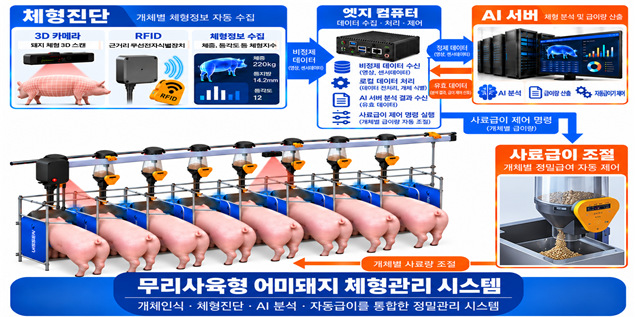
The National Institute of Animal Science under the Rural Development Administration announced Tuesday that it had developed an automated sow body condition management system for group housing, combining radio-frequency identification tags, 3D cameras and AI.
The technology was developed in anticipation of a mandatory shift to group housing for pregnant sows. Under the Livestock Industry Act's enforcement decree, farms already licensed for pig farming must meet group-housing space standards — allowing pregnant sows to lie down, stand up and move freely — by Dec. 31, 2029.
Under the conventional approach, sows were kept in individual gestation stalls, making it relatively straightforward to monitor each animal's body condition and adjust feed amounts. In group housing, where multiple animals share a space, identifying individuals and tailoring feed to each sow's condition is far more difficult.
In the new system, when a sow enters the feeding station, an RFID tag on its ear identifies it. A 3D camera then captures its body shape, and the AI analyzes body condition data including estimated weight and back-angle measurements. An automatic feeder dispenses the calculated ration for that individual, based on body condition scores accumulated over the previous week.
The entire process — body scoring and feed-amount setting — takes less than five seconds. The AI body-scoring model was trained on video footage and productivity records from 1,710 sows, and its accuracy against actual measured values exceeded 95 percent. Field performance in group-housing conditions, however, still requires additional verification.
The system can be adapted to existing farm infrastructure. It is compatible with both open-stall configurations, where the rear portion of each stall is partially opened, and free-entry setups, where a gate opens and closes automatically as each sow enters or exits.
An earlier stall-based version of the system has already demonstrated productivity gains. In a before-and-after comparison across three farms, the National Institute of Animal Science found that the average number of piglets born per sow per year rose by 1.3, while non-productive days — days when a sow contributes nothing to reproduction — fell by 6.4.
An economic analysis based on a farm of 300 sows estimated an annual management improvement effect of about 13.06 million won ($9,620). That figure reflects income gains of 41.79 million won from increased piglet production and labor cost savings of 1.25 million won, minus annual equipment costs of 30 million won. The institute cautioned, however, that these figures come from the stall-based system and do not imply the same results for the newly developed group-housing version.
The National Institute of Animal Science has introduced the stall-based system to a total of 32 farms this year. Next year, it plans to conduct field trials of the group-housing system to verify the stability of its individual identification, body scoring and automatic feeding functions. From 2028 through 2029, the institute aims to roll out the technology to 20 farms across 10 sites through a new-technology dissemination program.
"This technology makes precision management tailored to each sow's body condition possible even in group-housing environments," National Institute of Animal Science Director Jo Yong-min said. "We will continue to improve the technology's practical applicability through field trials and push for wider adoption to ease the labor burden on farms."
adastra@heraldcorp.com