'If the ministry's bill is enacted, the fallout will be enormous — major law firms could render the law toothless'
Democratic Party of Korea lawmaker Lee Hoon-ki (Incheon Namdong-eul) sharply criticized the Ministry of Economy and Finance's proposed revision to an inheritance and gift tax bill at a public forum held Monday at the National Assembly, saying the ministry's version would not prevent share price suppression but instead enable it. "If the ministry's bill passes, we could see a second leveraged ETF crisis," Lee warned, calling the proposal "a bad law that violates the constitutional principle of statutory taxation."
The forum, titled "Public Debate on Amendments to the Inheritance and Gift Tax Act to Prevent Share Price Suppression," was hosted by the Democratic Party's Korea Premium K-Capital Markets Special Committee, chaired by lawmaker Oh Ki-hyung, and held in Meeting Room 6 of the National Assembly Members' Office Building.
The event was organized to comprehensively review both the original bills — one by Lee Hoon-ki and one by lawmaker Lee So-young — alongside the Ministry of Economy and Finance's counterproposal, and to gather expert opinion in order to finalize effective legislation.
At the forum, Lee stressed that his bill's purpose was not to raise more tax revenue but to normalize an abnormally undervalued Korean capital market and to incentivize controlling shareholders to raise share prices and corporate value on their own.
Lee then said the ministry's bill had a fundamental flaw: it refused to acknowledge that the market price itself was abnormally suppressed, and instead insisted on using that distorted market price as the valuation benchmark. "Adding a 30 or 40 percent premium on top of an already suppressed share price cannot stop share price suppression," he said.
Kim Ji-yeol, a director at Quad Asset Management, also argued, citing the recently amended Article 165-4 of the Capital Markets Act, that requiring merger valuations to consider not only market price but also asset value and earnings value demonstrated that market price was not an absolute standard.
In practice, Quad Asset Management's analysis found that 121 listed companies had market capitalizations below their net cash holdings. Seoul Gas was cited as a representative example: its market capitalization stood at roughly 255.9 billion won ($188 million), while its cash and cash equivalents amounted to about 837.1 billion won and its net asset value reached approximately 1.09 trillion won.
Lee also rebuffed the ministry's claim that its revised bill reflected "80 to 90 percent" of the lawmakers' original proposals.
Under a hypothetical scenario in which a company has a net asset value of 1 trillion won and a market capitalization of 200 billion won, with the controlling shareholder holding a 50 percent stake and facing a 50 percent inheritance tax rate, the inheritance tax liability under Lee's bill would be 200 billion won. By contrast, the ministry's original proposal would yield 78 billion won — just 39 percent of that figure — while the revised version, which raises the premium rate from 30 to 40 percent, would produce 84 billion won, or 42 percent.
"The ministry claims it reflected 80 to 90 percent of the lawmakers' bill, but the 80 percent floor on net asset value valuation is conspicuously absent," Lee said. "The structure in which keeping share prices low reduces inheritance and gift tax burdens has been left entirely intact."
Lee also criticized the ministry's proposal to delegate the practical application of tax standards to the National Tax Service's valuation review committee, saying it violated the constitutional requirement for clear and specific tax criteria.
"What controlling shareholder would ever admit to intentionally suppressing share prices?" Lee said. "Controlling shareholders with enormous financial resources will focus not on raising corporate value but on mobilizing major law firms and accounting firms to secure a ruling that they had no intent to suppress share prices."
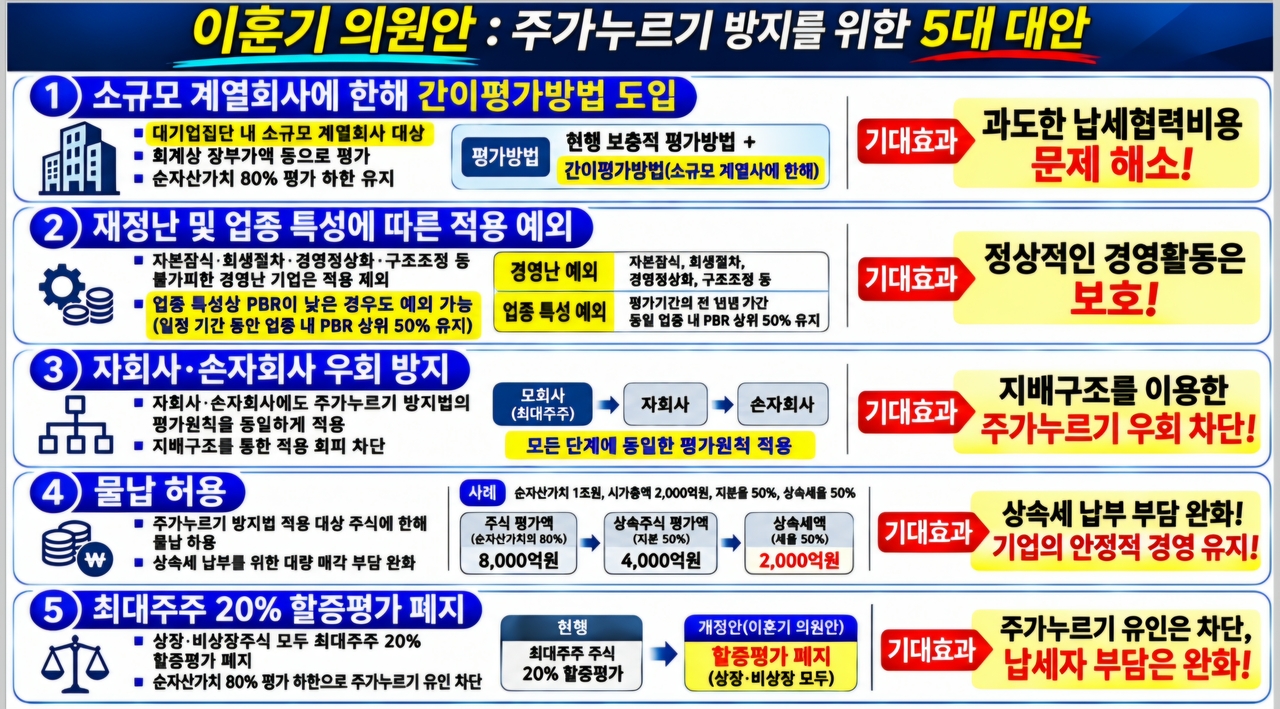
Lee presented five alternative proposals to his original bill, incorporating feedback raised during the debate: introducing a simplified valuation method for small affiliated companies; allowing exceptions based on financial hardship and industry characteristics; preventing circumvention through subsidiaries and sub-subsidiaries; permitting payment in kind limited to listed shares held by controlling shareholders subject to the anti-suppression law; and abolishing the 20 percent premium valuation applied to controlling shareholders.
Meanwhile, Lee raised concerns about the recent sharp decline in the stock market and the anxiety among retail investors, warning of severe consequences if the ministry's bill were pushed through. "Passing an ineffective ministry bill under these circumstances could shatter public trust in the capital markets and in our government and party," he said. "Would this not trigger a second leveraged ETF crisis?"
Lee added that the Ministry of Economy and Finance was clinging to its original valuation method despite President Lee Jae Myung's directive for a full review. "If it comes down to the ministry's bill, it would be better not to pass the law at all. If it is enacted, the fallout will be enormous," he said.
The Democratic Party's K-Capital Markets Special Committee is set to review the issues and legislative proposals raised at the forum in a closed-door meeting Tuesday. The committee plans to pursue passage at a plenary session of the National Assembly in December, following discussions in the Finance Committee during November.
bigroot@heraldcorp.com