Four-week joint operation with local governments runs Nov. 16 through Dec. 11 to halt nationwide spread of pine wilt disease
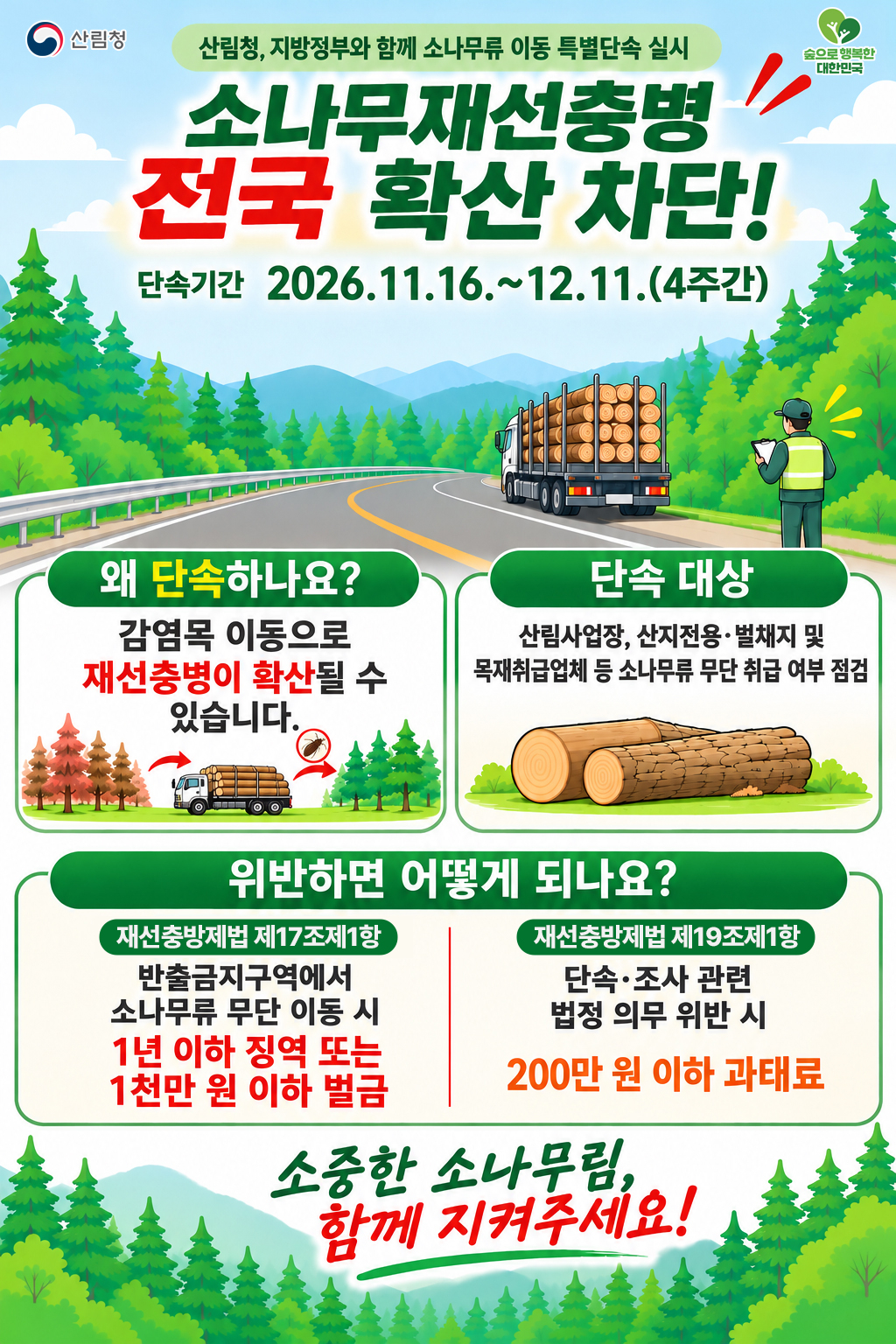
The unauthorized movement of pine trees will be banned for now as authorities move to stop pine wilt disease from spreading across the country.
The Korea Forest Service announced Monday that it will conduct a special four-week crackdown on pine tree movement from Nov. 16 through Dec. 11, in partnership with local governments and regional forest offices nationwide, to contain the spread of pine wilt disease and protect the country's pine forests.
Exceptions apply when trees are accompanied by proper documentation. Landscaping trees may be moved with a verification certificate from the relevant local government's primary diagnostic institution, such as a forest environment research institute, while logs must carry a pine production confirmation tag issued by the local government or a national forest management office.
Pine wilt disease can spread not only naturally through insect vectors but also over long distances through the human transport of infected trees, making containment efforts in affected areas alone insufficient. Because careless movement of pine trees can trigger new infections in previously unaffected regions, nationwide management of their movement and retail distribution is critical.
This year, new outbreaks and recurrences linked to the movement of infected landscaping trees, logs and firewood were confirmed in Dong-gu in Busan, Goesan-gun in North Chungcheong Province, Seongbuk-gu in Seoul and Pyeongchang-gun in Gangwon Province.
In response, the Korea Forest Service said it will focus its enforcement efforts on cutting off transport routes used to move infected trees out of affected areas and preventing the disease from reaching regions that have so far been spared.
"Removing damaged trees is important, but what matters most is preventing infected pine trees from being moved to other areas and causing new damage," said Lee Yong-gwon, the Korea Forest Service's forest disaster control officer. "Through this nationwide special crackdown, we will thoroughly block man-made transmission routes and do everything in our power, together with national and local governments, to protect the country's pine forests."
kwonhl@heraldcorp.com