City combines Daegot's green industry hub with Wolgot's logistics base in integrated economic zone bid
Investment letters of intent already exceed available land by 122%; zone designation expected to generate 2.45 trillion won in output
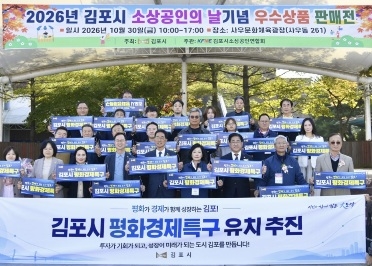
Gimpo City has entered Gyeonggi Province's second round of applications for a peace economy special zone, putting forward a combined 2.16 million-square-meter proposal that links the Daegot and Wolgot districts.
The city is positioning the bid as an "action-ready zone" — one capable of delivering immediate economic results while maximizing synergies if inter-Korean cooperation resumes.
According to the city, the application — covering 1.36 million square meters in the Daegot district and 800,000 square meters in the Wolgot district — will be submitted ahead of the Friday deadline for Gyeonggi Province's second call for peace economy special zone candidates.
At the heart of the proposal is an industry-and-tourism hybrid model that connects Daegot's future-industry and research-and-development functions with Wolgot's logistics and exchange functions via National Route 48, forming a single integrated economic zone.
The Daegot district will be developed within an environment-regeneration innovation complex being pursued by the Korea Water Resources Corporation, and will specialize in eco-friendly advanced manufacturing — including future mobility components, secondary batteries, hydrogen, AI and robotics, and the circular economy.
The Wolgot district, built on the foundation of the Wolgot General Industrial Complex, will be developed into a logistics and exchange hub by adding smart logistics, education and research, and inter-Korean exchange functions to its existing base of metalworking, machinery and electronic components manufacturers.
The Daegot district is already under public development, having cleared a preliminary feasibility review. The Wolgot district has also completed key administrative steps, including an environmental impact assessment and consultations on lifting agricultural promotion area restrictions.
The area's industrial infrastructure is equally strong, with more than 13,000 manufacturers concentrated in the region. The city has already secured about 180 letters of investment intent — equivalent to 122 percent of available land — demonstrating robust corporate demand.
The city cites its transport links as its greatest asset: both an airport and a seaport are within 40 minutes, and the area is served by three expressways — the Gyeyang-Ganghwa Expressway, the Seoul Metropolitan Area Second Beltway and the Seochang-Gimpo Expressway.
Rail connectivity is also being expanded, with projects underway to extend Seoul Subway Line 5 to the Gimpo-Geomdan area and to build a western metropolitan express railway.
Over the medium to long term, the city plans to highlight the historical and geographical significance of the Han River estuary and the Jogang River to develop a model for inter-Korean waterway links and cooperation with the Kaesong Industrial Complex.
The ultimate vision is to grow Gimpo into the Korean Peninsula's only global peace economy hub — one that links Kaesong's manufacturing capacity with Gimpo's research and development, logistics and international marketing functions.
Should the zone be designated, the city projects economic ripple effects of 2.45 trillion won ($1.83 billion) in induced production, 919.2 billion won in induced value-added, 11,301 jobs created and 11,346 permanent workers employed.
"Gimpo has sacrificed for national security as a divided border city for more than 70 years — it must now leap forward as a frontline base for a peace economy that opens a path to the world," Gimpo Mayor Lee Gi-hyeong said.
Meanwhile, Gyeonggi Province plans to announce its final peace economy special zone candidates in early December, following written and preliminary reviews and a presentation-based comprehensive evaluation after the application deadline closes.
gilbert@heraldcorp.com