Gangdong-gu, Yangcheon-gu and Jung-gu launch winter snow-removal operations Sunday, with Gangdong-gu securing more than 1,600 tons of de-icing agent and running a 24-hour emergency center; Yangcheon-gu expanding heated road sections to 42 sites and brine-spraying units to 14; and Jung-gu installing 825 meters of road heating cables at 8 locations this year
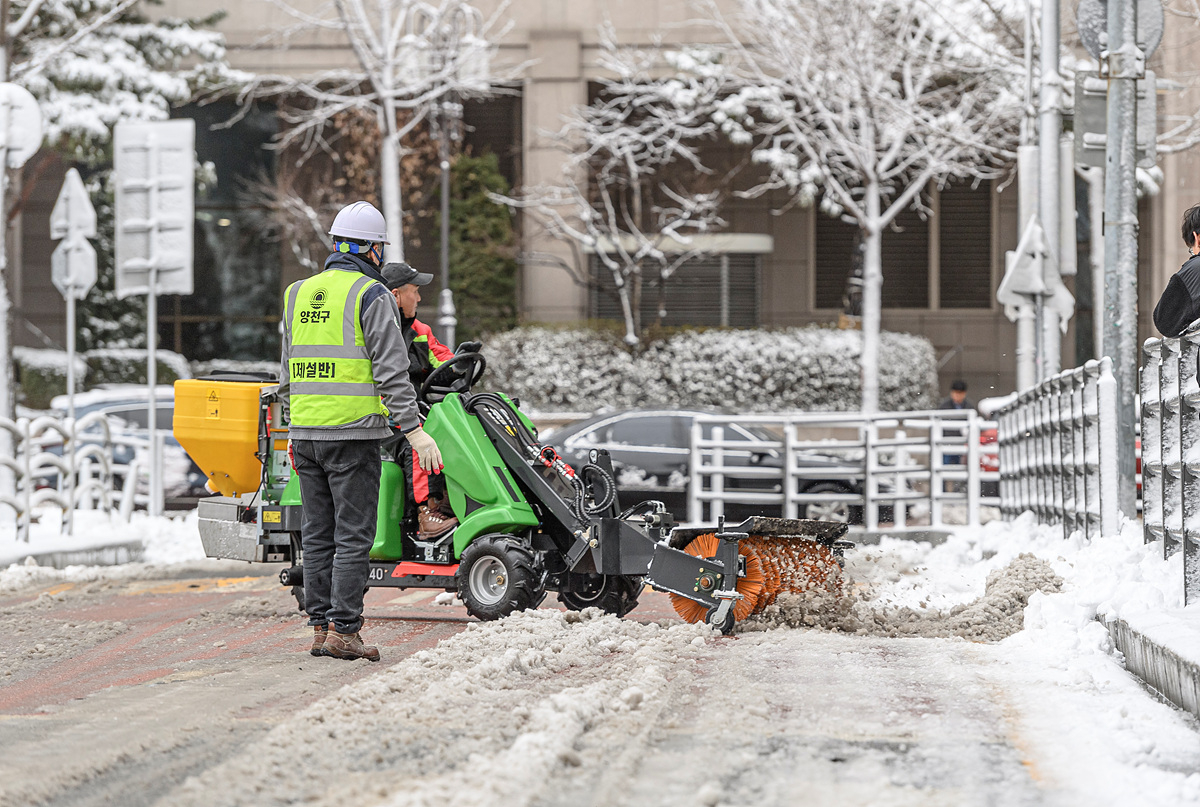
Seoul's autonomous districts are accelerating preparations for heavy snowfall and road icing this winter after the season's first snow arrived earlier than usual.
The districts are moving beyond clearing major arterial roads to managing slopes, back streets and pedestrian walkways — the spaces where residents actually live — while expanding smart snow-removal infrastructure such as road heating cables and automated brine-spraying systems.
Gangdong-gu, Yangcheon-gu and Jung-gu are among the districts launching full winter snow-removal operations around Sunday, maintaining round-the-clock emergency response systems as part of a proactive approach.
Gangdong-gu has designated the period from Sunday through March next year as its comprehensive winter preparedness period, during which it will pursue 14 detailed projects across four areas: cold-wave response, snow removal, safety and lifestyle services.
On the snow-removal front, the district will run a 24-hour snow-removal disaster safety headquarters and has secured more than 1,600 tons of de-icing agent. It is also expanding road heating cable installations at vulnerable sections — one site has already been completed and work is under way at a second.
To minimize traffic disruption during snowfall, the district has mapped out detour routes for five city bus lines. It plans to deploy snow-removal equipment and personnel quickly based on weather conditions and to strengthen on-site response through a dedicated traffic management team.
Cold-wave measures are also in place. The district will operate 117 warming shelters — including the district office, 19 community centers and 47 district-run senior centers — and will provide care services, emergency alert devices and free meals to roughly 2,700 elderly residents living alone.
Yangcheon-gu has underscored the expansion of smart snow-removal facilities and stronger snow clearance on residential roads.
From Sunday through March 15 next year, the district will maintain a 24-hour emergency response system centered on its snow-removal headquarters. It will operate a three-tier emergency duty system based on snowfall levels, deploying more than 700 personnel across 13 working teams and 18 community centers.
The district has secured a total of 307 pieces of snow-removal equipment and will conduct operations across 411 kilometers of roads — 154 kilometers of major arterial roads and 257 kilometers of residential back streets and alleys.
Particularly notable is the expansion of smart snow-removal infrastructure. Heated road sections will grow from 29 sites covering 3.8 kilometers to 42 sites covering 5.9 kilometers, while fixed brine-spraying units will increase from 8 sites covering 2.2 kilometers to 14 sites covering 4.8 kilometers.
The district has also introduced grooving pavement on 2.3 kilometers of ice-prone slopes — a technique that cuts fine grooves into the road surface to increase friction, improving vehicle braking and reducing skidding on roads made slippery by snow and rain.
Yangcheon-gu is also working to spread a culture of resident-led snow removal. Residential complexes that participate in clearing roads around their buildings will receive an incentive of up to 5 percent when being considered for housing support projects. A group application format will also be introduced for a snow-clearing photo certification event.
Jung-gu is focusing on intensive management of vulnerable areas, taking into account the district's topographical characteristics.
The district recently completed advance inspections of 45 disaster-prone locations, checking 8 ice-vulnerable sections and 37 snow-removal-vulnerable sections. It plans to install new snow-removal supply boxes at 8 sites, including Sindang Elementary School and Baekbeom Plaza.
Heating cables are being expanded on steep slopes and ice-prone roads. Installation of 375 meters of cables at five sites in the Dasan-dong and Jangchung-dong areas has been completed, and an additional 450 meters at three sites in Hoehyeon-dong are set to be installed by the end of this month.
This year's total installation covers 8 sites and 825 meters. The project cost is 882 million won ($657,000), comprising 450 million won in city funds and 432 million won in national government funds.
The district is paying particular attention to high-ground back streets that have long been difficult to clear — including a steep uphill road near Dasan Fortress Wall Library and residential areas densely packed with houses and villas in Jangchung-dong.
The system works by burying electric heating cables beneath the road surface to melt snow and ice, and is expected to prevent vehicles from skidding and pedestrians from falling on steep slopes.
Across the districts, winter snow-removal strategies are shifting from reactive clearance to proactive prevention — securing personnel and equipment for sudden heavy snowfall, expanding automated snow-removal facilities and building a community-based system in which residents play a direct role.
Expanding infrastructure such as road heating cables and brine-spraying systems alone cannot solve every snow-removal challenge, however. Given the limits of budgets and installation sites, the success of this winter's efforts will hinge on how accurately vulnerable areas are identified and how quickly districts can respond in the early stages of a snowfall.
seouldream01@heraldcorp.com