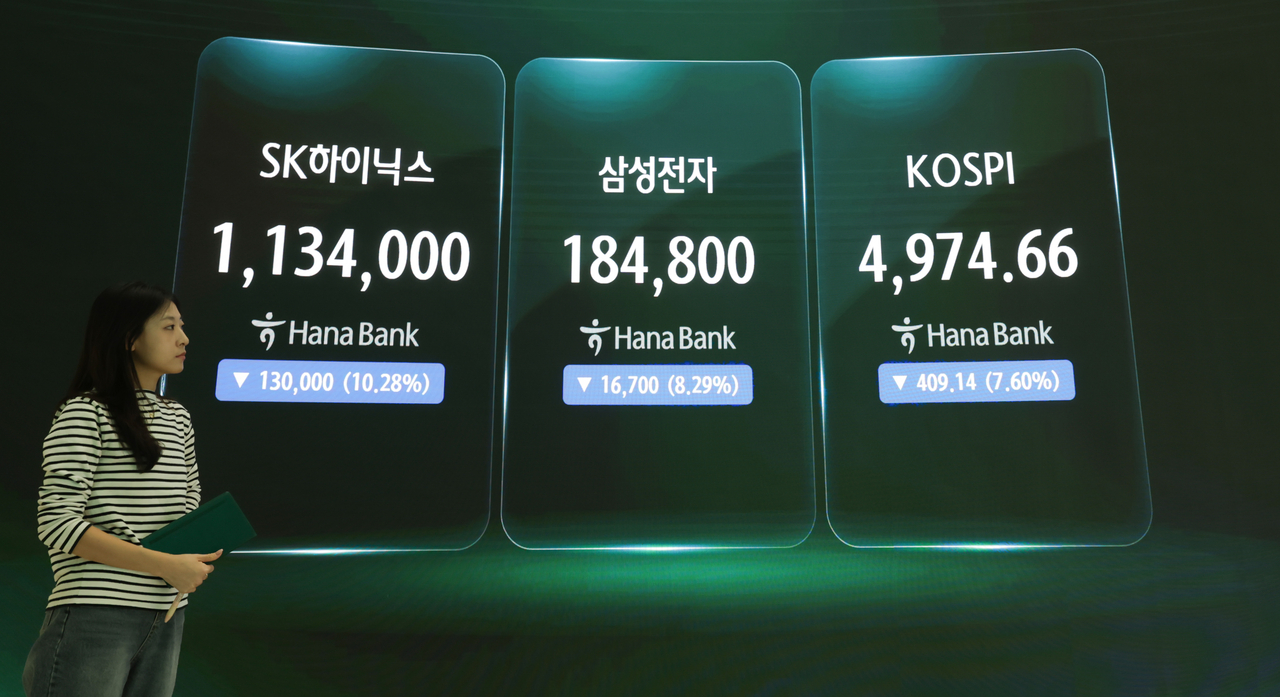
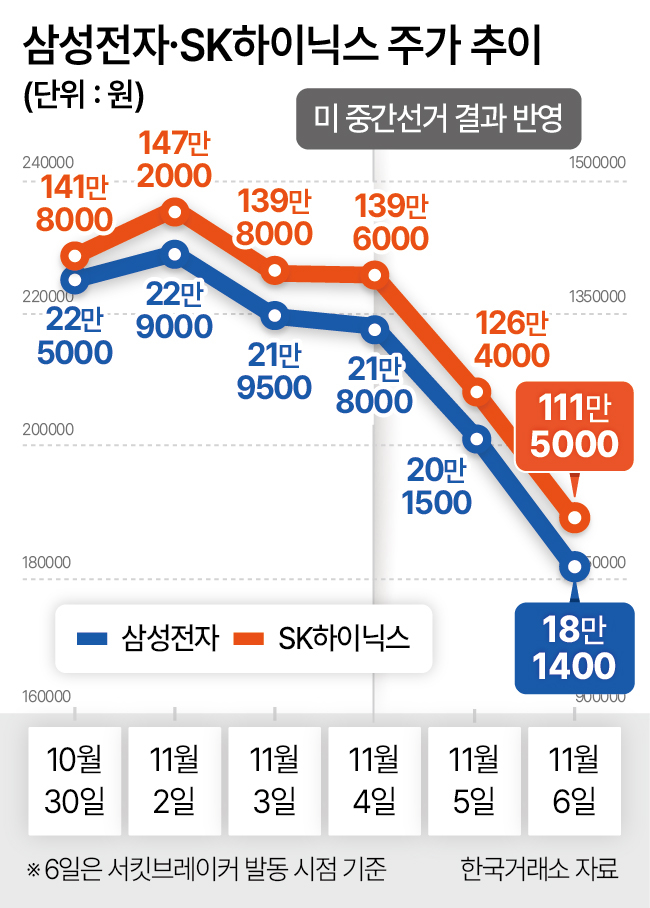
Fears of tightening US AI regulation and slowing data center investment have dealt a severe blow to South Korea's two leading chipmakers, Samsung Electronics and SK hynix. Samsung's share price has broken below the 200,000 won mark, while SK hynix is under threat of losing the 1 million won threshold. Analysts, however, say both stocks have entered historically low valuation territory relative to earnings, and advise investors to treat the selloff as a buying opportunity rather than a reason to panic.
As of 10 a.m. Friday, Samsung Electronics was trading at 183,400 won, down 8.98 percent from the previous session, according to Korea Exchange. The stock had already slipped below 200,000 won during trading Thursday before surrendering the 190,000 won level at the open Friday. If the stock closes at current levels, it would mark the first close below 200,000 won since April 7.
SK hynix fell even harder, plunging 11.31 percent to 1.12 million won at the same time, pushing toward the 1.1 million won level.
Both stocks had already tumbled 7 to 9 percent Thursday, and the continued decline Friday pushed them roughly 50 percent and 60 percent below their respective all-time closing highs of 362,500 won for Samsung Electronics and 2.919 million won for SK hynix.
Related shares fell in tandem. Samsung Electronics preferred shares dropped 9.35 percent to 145,400 won, while SK Square — which holds about a 20.5 percent stake in SK hynix — plunged 11.87 percent to 713,000 won.
The rout in domestic chip stocks followed a wave of tech selling on Wall Street overnight. The Democratic Party swept majorities in both chambers of Congress and in gubernatorial races in the US midterm elections, and concerns spread rapidly that AI industry regulation would tighten and that big tech companies would scale back data center investment.
The Philadelphia Semiconductor Index closed down 12.2 percent at 9,011.14, its lowest closing level since April 10 — about seven months ago — and its steepest single-day drop since March 16, 2020, when it fell 15.9 percent at the onset of the COVID-19 pandemic.
Major AI chip stocks fell across the board: Nvidia lost 9.3 percent, Broadcom dropped 10.4 percent and AMD tumbled 17.3 percent. Memory chip makers were hit even harder, with Micron falling 17.5 percent, SanDisk losing 22.3 percent, Western Digital declining 17.4 percent and SK hynix's American depositary receipts shedding 13.4 percent. Qualcomm slid 9.5 percent, compounded by a weak quarterly earnings outlook.
Despite the carnage, analysts agree that current share prices have entered a zone of excessive undervaluation and that a measured response is warranted. Even if some price targets are trimmed, the consensus view is that adding to positions makes more sense than selling at current levels.
Kim Rok-ho of Hana Securities said the 12-month forward price-to-book ratios for both companies have fallen to around 1.21 times and 1.23 times, respectively — matching the lows seen at the end of July. At that time, the stocks had dropped 40 to 50 percent from their peaks on fears of a down cycle, but found strong support around the 1.2 times PBR level.
"Before the AI cycle, the PBR floor for both companies was around 0.9 to 1.0 times, but as the growing share of HBM — a customized product — has reduced earnings volatility, the valuation floor has risen to around 1.2 times," Kim said. "It is worth considering a strategy of building positions as the market digests uncertainty around data centers."
Ko Young-min of Korea Investment & Securities also maintained a buy recommendation on both stocks. "The current price attractiveness heading into the first half of next year is unlikely to be seen again after year-end — this is once again a moment when an aggressive accumulation strategy is valid," Ko said.
Ko Eui-young of iM Securities cautioned that concerns about industry conditions in 2028 will persist through the first half of next year, and that the extent of price declines remains uncertain until long-term supply agreements demonstrate their ability to defend pricing. Still, Ko said earnings-per-share growth and multiple compression would offset each other, as next year's profit forecasts continue to be revised upward even while uncertainty weighs on valuation multiples. "Next year's shareholder return policy, which should compensate for the opportunity cost during this period, is expected to be a key inflection point for the share price," Ko said.

jiyun@heraldcorp.com