Sayeon Dam sluice gate work begins Monday; completion set for 2030
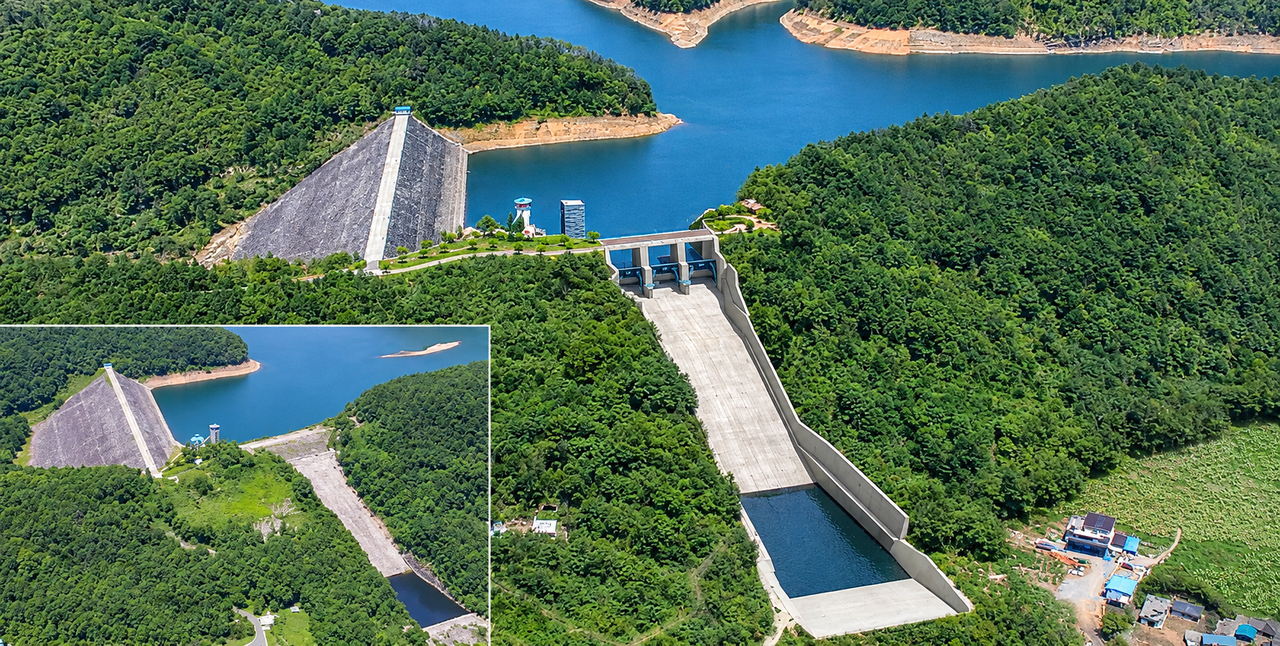
Spillway to be lowered 13 meters, three gates to be installed
Dam water level to be kept below 53 meters to protect rock art
Unmun Dam to supply drinking water lost to level adjustments
The Bangudae Petroglyphs — a UNESCO World Heritage site in Daegok-ri, Ulju-gun, Ulsan, preserving 6,000 years of prehistoric art — will be freed from flood-driven weathering for the first time in 65 years.
It took 15 years and six months from January 2010, when the petroglyphs were added to UNESCO's World Heritage tentative list, until their full inscription in July last year — largely because Sayeon Dam, located nearby, repeatedly submerged the site whenever its water level exceeded 53 meters, and no adequate plan to preserve the rock art's original state had been put in place.
In response, the Ministry of Climate, Environment and Energy and the Korea Water Resources Corporation, in consultation with Ulsan city, will carry out the Sayeon Dam Safety Enhancement Project, which calls for installing sluice gates at the dam to regulate water levels and permanently resolve the flooding problem.
According to the Korea Water Resources Corporation and Ulsan city, the project has secured a total budget of 80.9 billion won ($60.3 million) and has been contracted to BS Hanyang. Construction breaks ground Monday, with completion scheduled for the first half of 2030. The core work involves lowering the dam's spillway — the channel that regulates water levels — from 60 meters to 47 meters above sea level and installing three sluice gates, each 15 meters wide and 7 meters tall. A new water intake tower will also be built.
Once the gates are in place by the first half of 2030, the Bangudae Petroglyphs will no longer be submerged by rising dam levels during heavy rains and typhoons.
The petroglyphs sit between 53 and 57 meters above sea level. The problem began when Sayeon Dam was completed in 1965, 4.6 kilometers downstream along the Daegok Stream, to secure industrial water after the Ulsan Industrial District was designated. Whenever the dam's water level exceeded 53 meters, the site was submerged, accelerating weathering.
From 2014 through last year, the petroglyphs were underwater an average of 39 days per year over 12 years. The submersion lasted 62 days during Typhoon Nakri in 2014, 74 days in 2019 when Typhoons Danas, Tapah and Mitag passed through, 96 days in 2020 during Typhoons Maysak and Haishen, and 86 days in 2023 when Typhoon Khanun struck.
The repeated flooding has caused serious deterioration through weathering. An analysis of rock-face photographs taken in 1972 and 2008 by the Bangudae Petroglyph Heritage Conservation Research Institute at the University of Ulsan found that rock surfaces had broken off at 56 locations.
Various temporary measures — including provisional embankments and water barriers — were considered over the years before permanent sluice gate installation was settled on as the final solution, keeping the dam level at or below 52 meters to prevent submersion. The plan was confirmed at a government policy coordination meeting chaired by the prime minister in October 2021, followed by a feasibility study commissioned by Ulsan city in February 2022, a review and approval by the Ministry of Economy and Finance in May 2023, and the completion of basic and detailed design work in June 2026, leading to the current groundbreaking.
The shortfall of 49,000 tons of drinking water that Ulsan residents would face as a result of the lower dam level has also been resolved. The Ministry of Climate, Environment and Energy approved a revised Nakdong River integrated water management plan in December 2024, under which Ulsan city will draw the needed water from Unmun Dam in Cheongdo-gun, North Gyeongsang Province.
The twin challenges — protecting the petroglyphs from flood damage and securing Ulsan's drinking water supply — have now been addressed simultaneously, meeting the conditions the UNESCO World Heritage Committee set for inscription: that a management and protection framework be established to preserve the site's original state without flood-related deterioration.
"Once the sluice gate installation at Sayeon Dam is complete in 2030, we will be able to keep the dam level below 53 meters even during heavy rainfall, allowing us to renew our commitment to preserving the Bangudae Petroglyphs — a source of local pride and a World Heritage site," an Ulsan city official said.
The "Petroglyphs of Bangucheon" — encompassing the Bangudae Petroglyphs and the Cheonjeon-ri Carvings in Daegok-ri, Ulju-gun — were inscribed on the UNESCO World Heritage List in July last year. Spanning 6,000 years of human record from the Neolithic period through the Bronze Age to the Silla dynasty in the 9th century AD, they are regarded as a masterpiece of prehistoric culture.
cityblue@heraldcorp.com