Move aims to curb volatility from forced selling
Officials to monitor global semiconductor, policy trends
Additional stabilization steps ready if market stress deepens
The government will exempt securities firms from the obligation to maintain collateral ratios on margin financing for three months in response to sharp declines in domestic and overseas stock markets. The measure is designed to prevent excessive forced selling triggered by falling share prices from amplifying market volatility. Officials said they are also preparing additional stabilization steps in case market anxiety deepens further.
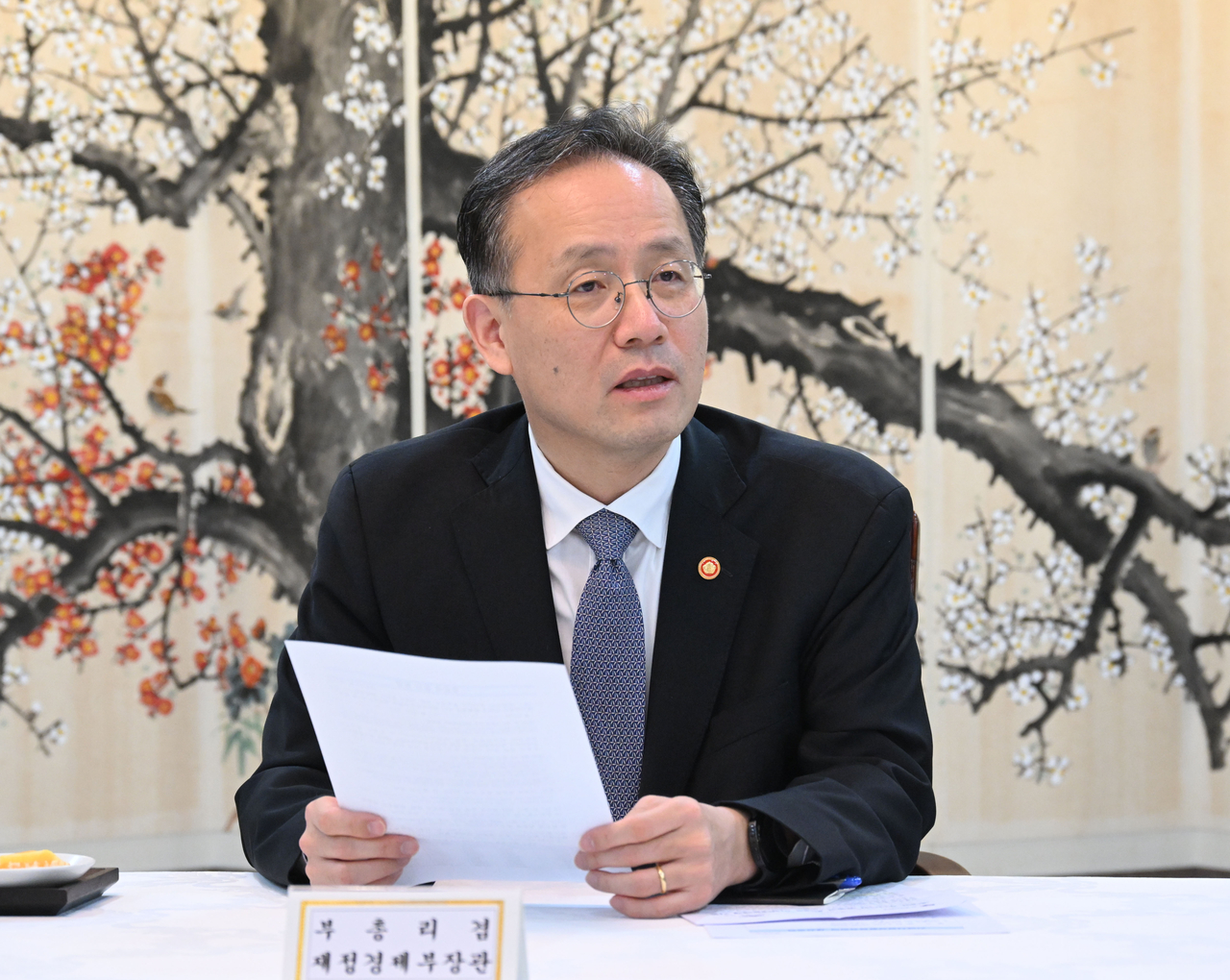
South Korea's Ministry of Economy and Finance said it held an emergency market situation review meeting — known as the F4 meeting — at Government Complex Seoul on Friday, chaired by Deputy Prime Minister and Finance Minister Lee Hyung-il, to discuss the response measures.
The meeting was attended by Financial Services Commission Chairman Lee Eok-won, Financial Supervisory Service Director General Lee Chan-jin and Bank of Korea Deputy Governor Kwon Min-su.
The government said it will exempt securities firms from the requirement to maintain a 140 percent collateral ratio on margin financing starting Monday for three months. Margin financing refers to transactions in which investors borrow funds from brokerages to purchase shares. When share prices fall sharply and collateral value drops, brokerages may be forced to liquidate investors' holdings through forced selling.
The government said its aim is to prevent a cycle in which selling pressure drives further price declines and amplifies market volatility.
In addition, authorities will monitor domestic and overseas markets and capital flows in real time and step up surveillance of global semiconductor industry trends and major countries' policy developments. Officials said they will also keep a close watch on excessive panic sentiment and supply-demand imbalances, and will prepare follow-up stabilization measures if volatility worsens further.
The steps come as a sell-off in domestic equities spread following a sharp drop in technology stocks on US markets.
According to Korea Exchange, the Kospi plunged more than 8 percent in early trading Friday, falling below the 5,000 mark. A Level 1 circuit breaker was triggered at around 9:03 a.m., halting trading for 20 minutes. A sell-side sidecar was also activated after trading resumed as the decline continued. The Kospi later pared some of its losses, trading down 5.76 percent from the previous session at 5,073.68 as of 11 a.m.
Meeting participants assessed that the recent share price decline reflected a combination of policy uncertainty surrounding the AI industry — including concerns over AI data center regulation — and a deterioration in global investor sentiment. They agreed that domestic markets had been reacting excessively to these external factors.
The government assessed South Korea's economic fundamentals as solid, citing forecasts for GDP growth in the mid-3 percent range this year, exports of $1 trillion and corporate operating profit surpassing 900 trillion won ($671 billion). Against that backdrop, officials said excessive pessimism driven by undue panic should be guarded against.
Separately from short-term market responses, the government said it will continue policy efforts to fundamentally improve the quality of domestic capital markets, including measures to enhance corporate value and strengthen confidence in financial markets.
y2k@heraldcorp.com