'Opportunities and strategies for Korean finance' policy seminar
Samsung Global Research shares strategy across electronics, financial affiliates
Card payment system development, insurance premium coin payments under review
Samsung financial affiliates exploring card payments, insurance premium use cases
Kakao Bank: 'Tether already used for wages, cutting labor costs for businesses'

Samsung has begun preparing at the group level for the anticipated introduction of a won-pegged stablecoin, with plans to integrate it into Samsung Wallet and explore its use for card payments and insurance premium settlements.
At a policy seminar titled "Opportunities and Strategies for Korean Finance," hosted Thursday by the office of Democratic Party of Korea lawmaker Ahn Do-geol at the National Assembly Members' Office Building in Yeouido, Seoul, Park Hyun-su, senior director at Samsung Global Research, said the company had expected both STOs and stablecoins to be introduced at Samsung next year. "Legislation has been delayed, but we had anticipated that stablecoins would arrive alongside STOs next year," Park said.
Park said Samsung Wallet already supports dollar-pegged stablecoins in the United States and has recently expanded remittance services to 60 countries. "When a won-pegged stablecoin is issued, it will naturally be integrated into Samsung Wallet as well," Park said.
Park added that Samsung's electronics division has been continuously exploring such applications, and that its financial affiliates are also making extensive preparations. "If STOs are issued, trading tokens and coins together on a blockchain would be far more efficient," Park said.
Samsung's financial affiliates are also preparing to accept stablecoins as a payment method. Park said the group's card affiliate is developing its payment systems to accommodate stablecoins, and that internal reviews are underway to allow insurance premiums to be paid in coin. "Various changes are being examined and prepared internally," Park added.
▶Visa: 'Stablecoin settlements reach 36 trillion won annually'=Visa, the global payments company, said stablecoin-based settlement volumes are growing rapidly and called for domestic discussions on activating real-world services in South Korea.
Jeong Jeong-ae, a senior director at Visa, said at the seminar that stablecoin settlements among Visa, overseas issuers and acquirers had already reached approximately 36 trillion won ($26.9 billion) annually. "In terms of annual growth rate, it is growing rapidly at more than tenfold," Jeong said.
Visa is also expanding its stablecoin-based payment infrastructure. The company participates in the OpenUSD consortium, a dollar-backed stablecoin initiative with global financial institutions and fintech firms, which distributes revenue to ecosystem partners rather than concentrating it among a small group of issuers. Through its stablecoin platform, Visa also supports financial institutions and fintech companies by providing a single hub for stablecoin issuance, custody and transfer.
Jeong said expanding stablecoin use in South Korea would require giving users a compelling reason to hold them. "South Korea does not have significant problems with monetary stability or payment convenience," Jeong said. "We need to think carefully about what incentives would make customers want to hold stablecoins."
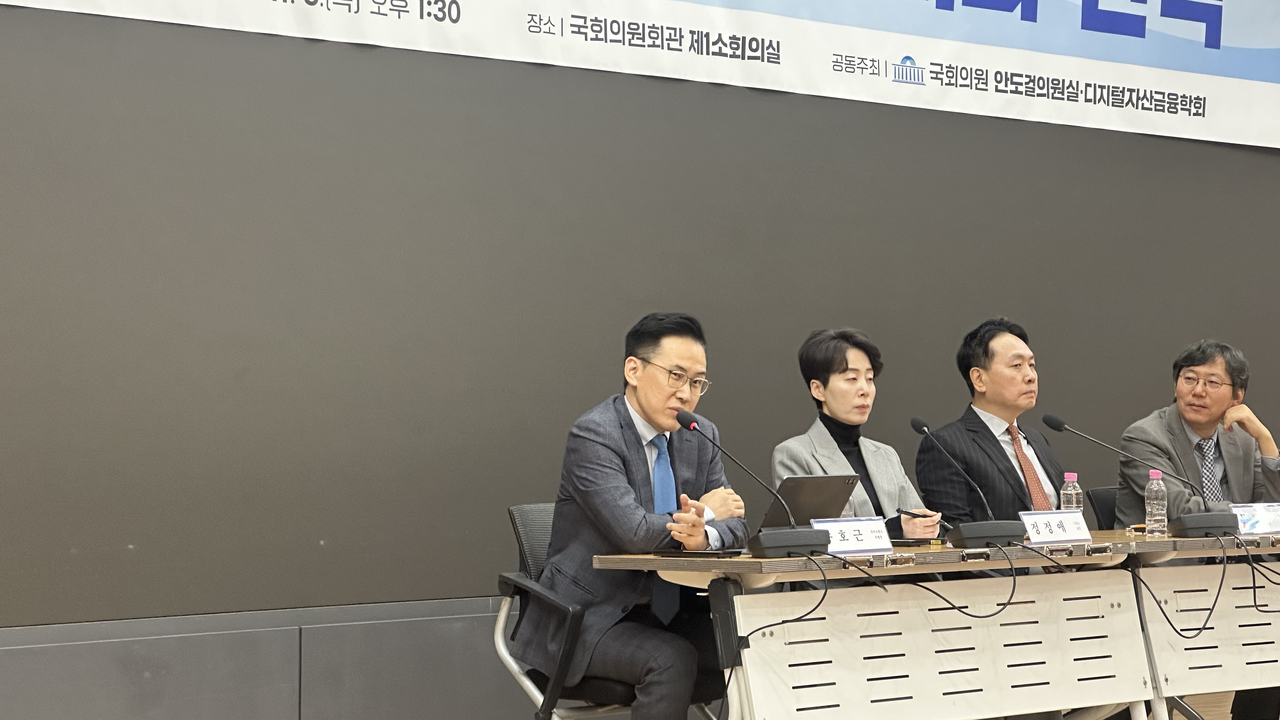
▶Kakao Bank: 'USDT already penetrating everyday life … urgent response needed'=Kakao Bank said dollar stablecoins are already being used for payments and remittances in everyday life both at home and abroad, and called for urgent action on won-pegged stablecoins and a financial sector response.
Song Ho-geun, executive vice president of Kakao Bank, said South Korean banks are at a critical inflection point. "Two game changers — AI agents and stablecoins — are arriving simultaneously and are converging," Song said.
Song cited examples of dollar stablecoins already in use at domestic plastic surgery clinics and overseas currency exchange booths. "When you go to exchange money in Da Nang, Vietnam, the exchange booth has a sign in hangul, and below it is a Tether (USDT) wallet address," Song said. "It means Koreans are already using Tether to make payments abroad. The changes we are discussing are already happening."
Song also said stablecoins could be used to pay wages to foreign workers in South Korea. "If a foreign worker living in Korea agrees to receive 970,000 won worth of USDT instead of 1 million won in salary, the company saves 3 percent on labor costs and its margin rises 30 percent," Song said. "There are already places paying wages in USDT. If banks fail to adapt to these changes, Korean banks will not exist in the form we know today."
Song identified foreign tourists and AI agents as the primary use cases for a won-pegged stablecoin. "We should first target foreigners visiting Korea, focusing on industries where Korea has a competitive edge — such as Korean culture and the popular cosmetics industry," Song said. "As AI agents automatically execute payments, they will generate an enormous volume of transactions, and overseas agents will also trade with one another."

kyoung@heraldcorp.com