Legislation needed to codify major shareholder qualifications, accountability
Assembly forum on insurance sales company regime set for Nov. 20
GA misselling rate lower than exclusive channels, chief says
Smaller GA firms in talks over cost of joining financial security body
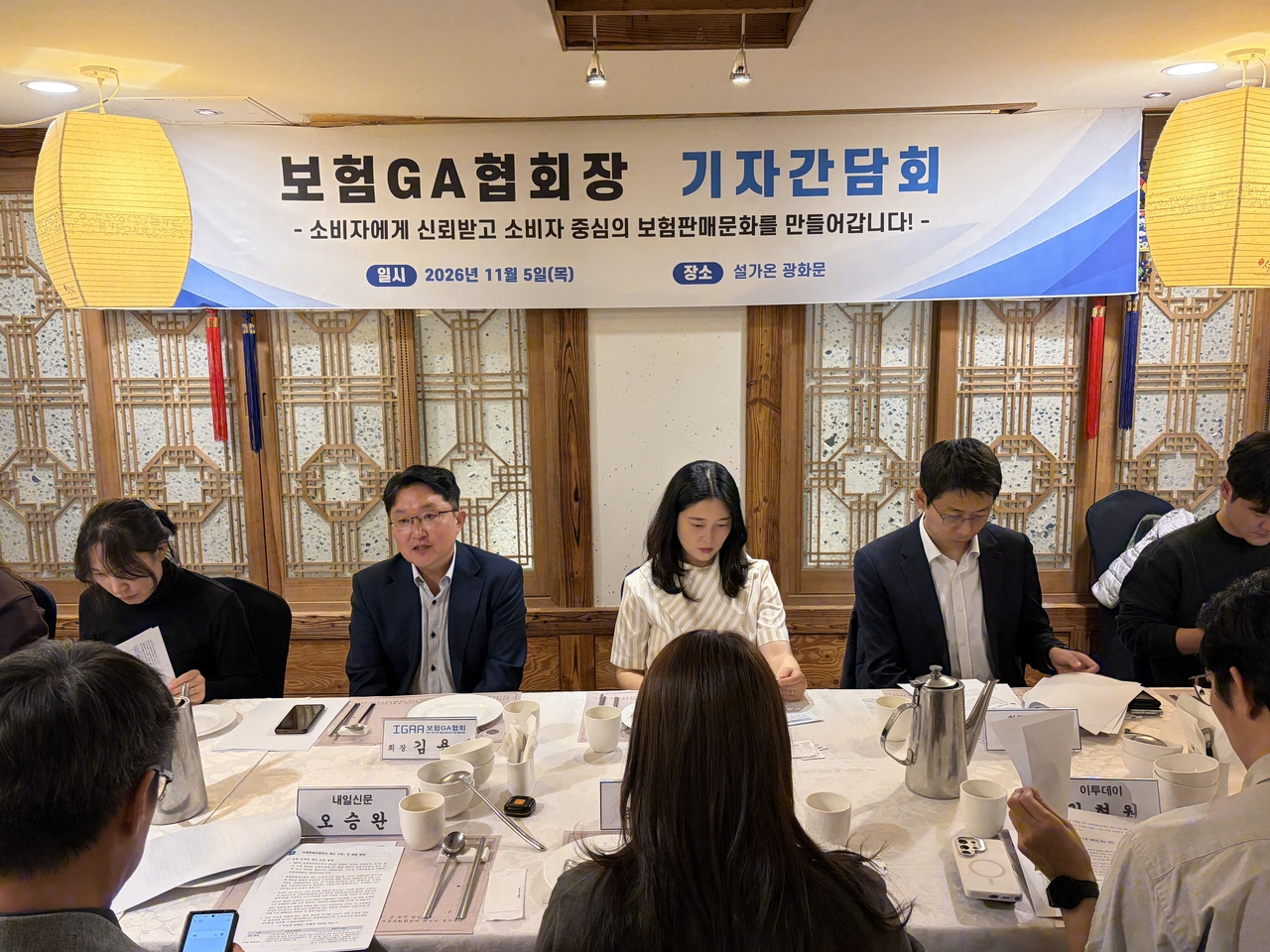
Kim Yong-tae, chairman of the Korea Insurance GA Association, said the industry would actively engage with National Assembly discussions on establishing a dedicated legal regime for professional insurance sales companies, and called for legislation to be passed.
Speaking at a press briefing in Gwanghwamun, Seoul, on Thursday, Kim said the association would "actively respond to any requests for revision, supplementation or strengthening that emerge during the legislative process," reaffirming its commitment to the bill. The association said it is prepared to accept stricter obligations than those in the bills currently before the Assembly.
The push for a professional insurance sales company regime gained momentum this year after bills were introduced by lawmaker Joo Ho-young in August and lawmaker Min Byeong-deok in September. The Min bill includes a provision making sales companies liable for damages arising from the solicitation activities of their affiliated agents. A legislative forum on the issue is scheduled at the National Assembly on Nov. 20.
Kim said there are limits to managing large general agencies — which account for a significant share of the sales channel — by classifying them under miscellaneous services and relying solely on administrative sanctions. "Codifying qualification requirements such as major shareholder eligibility and accounting transparency in law, and holding violators legally accountable, would be more effective for consumer protection," Kim said. Japan has regulated large GA firms by law since 2016 and revised the relevant legislation again in June this year. Japan targets GA firms with annual commission income of 2 billion yen ($12.6 million) or more; applying that threshold to South Korea, 70 of the country's 73 large GA firms would fall within scope. Kim said Korea needs similar legislation to govern large GA firms.
On the benefits legislation would bring to the GA industry, Kim said that even companies with sales reaching 1 trillion won ($746 million) are still classified under miscellaneous services — effectively as self-employed operators. "What the industry wants most is to be recognized with a legal status befitting our scale," he said. Kim also cited advantages on the commission side, noting that operating costs are currently set and handed down by insurers, and that a formal legal status would improve the predictability of cost structures, enabling firms to plan investments. "We also have to be prepared to shoulder regulatory burdens comparable to those of financial companies, including major shareholder eligibility reviews," he added.
Kim rebuffed criticism that GA firms have failed to achieve qualitative growth commensurate with their size. According to Financial Supervisory Service data presented by the association, the GA channel's misselling rate last year stood at 0.021 percent, down 0.004 percentage points from the previous year and lower than the exclusive channel rate of 0.024 percent. On the issue of improper policy switching, Kim said that the introduction of a computerized comparison and disclosure procedure in 2024, combined with the automatic printing of maturity refund amounts from this year, has made it structurally difficult for improper switching to occur. Kim said regulators are criticizing GA firms based on cases that predate these measures, and called for periodic public disclosure of improper switching statistics broken down by channel.
Smaller GA firms to join financial security body — cost talks ongoing
On a string of recent hacking incidents in the financial sector, Kim said no security breaches have been identified within the GA industry, but expressed concern about security gaps at smaller firms. Of roughly 4,500 GA firms nationwide, only 25 are currently members of the Korea Financial Security Institute. The association has asked that smaller GA firms be allowed to join and is pushing for membership fees to be tiered by company size.
The Korea Financial Security Institute said there are structural differences in how membership works. As a nonprofit incorporated association, the institute allows financial companies and electronic financial service providers under the Electronic Financial Transactions Act to join simply by applying. GA firms, which fall outside the act's scope, must go through a vote by existing member institutions. Membership fees are split according to total assets and headcount, with larger financial institutions paying more to subsidize smaller ones. The institute said it has already reduced GA membership fees once and is internally reviewing a further reduction in light of cybersecurity concerns among small and midsize GA firms. It also plans to establish a dedicated GA unit next year.
won@heraldcorp.com