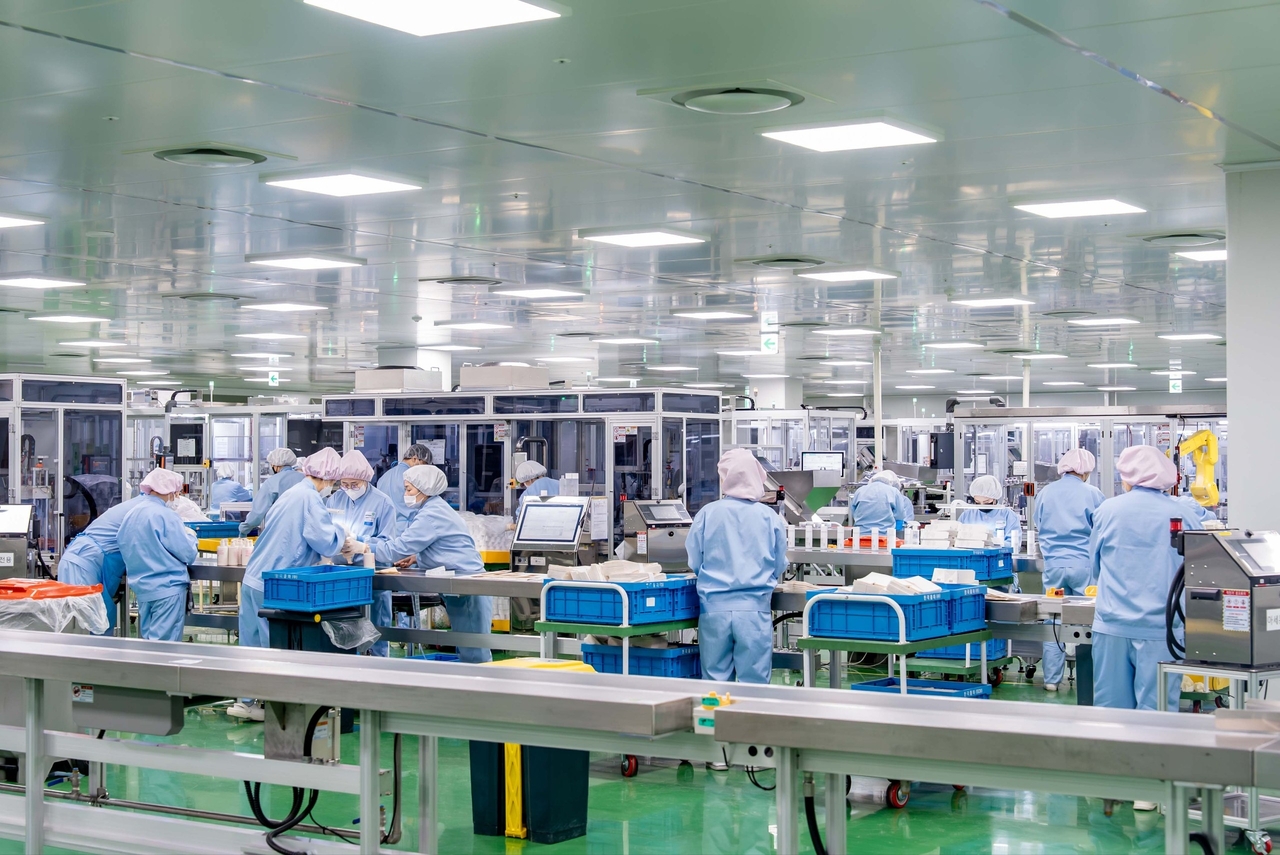
Kolmar Group's second-half recruitment draws record 13,000 applicants
Wonik Group also sees record turnout with over 10,000 candidates
Cosmax to hire 100; APR opens entry-level recruitment
More than 13,000 people applied for Kolmar Group's second-half graduate recruitment drive this year, with competition for some positions reaching 1,119 to 1 — a record high. Semiconductor materials and equipment conglomerate Wonik Group also drew more than 12,000 applicants. The figures highlight intensifying competition at mid-sized and fast-growing companies even as youth unemployment remains a persistent challenge.
According to Kolmar Korea, roughly 13,000 candidates applied for the group's second-half new-graduate recruitment held in September. Competition for certain positions at Kolmar Korea reached 1,119 to 1. The company is currently conducting document screening and interviews.
Kolmar Group accepted applications from Sept. 9 to Sept. 29. The drive targeted entry-level hires in cosmetics research and development, quality control, production management and business support. Kolmar Korea is expected to hire more than 100 new employees in the second half of this year.
Kolmar Korea evaluates candidates on their understanding of the company and industry, job fit, problem-solving ability and motivation. This year, the company said it added AI proficiency as an assessment criterion, noting that the ability to learn new technologies and adapt to change is also a key evaluation factor.
Wonik Group, a mid-sized conglomerate focused on semiconductor materials and equipment, also attracted a surge of applicants. The group announced Tuesday that 12,348 people applied for its 2027 new-graduate recruitment — the largest turnout since the group-wide drive launched in 2014. The figure represents a roughly 69.4 percent increase from the 7,290 applicants recorded in 2024.
Wonik Group operates across semiconductors, displays and secondary batteries, with affiliates including Wonik IPS, Wonik QnC and Wonik Materials, as well as Wonik Robotics. Seven affiliates participated in this round, recruiting entry-level staff across 45 job categories. Final successful candidates will be announced in December and are set to join in January next year.
Wonik Group also introduced an "AI literacy assessment" for the first time in this recruitment cycle. On the day of their interview, applicants are asked to complete a practical task using generative AI, with evaluators assessing how effectively they can apply AI tools to real work scenarios.
Cosmax, a cosmetics original design manufacturer, is also running its second-half recruitment. After hiring 70 people in the first half of this year, the company plans to bring on more than 100 additional staff in the second half. Applications closed Sept. 30, and successful candidates are expected to join in December.
The drive involves Cosmax BTI, Cosmax, Cosmax NBT, Cosmax Bio and Cosmax Pharma. Open positions span research and development, marketing, overseas sales, strategic marketing, design and quality control.
Cosmax is also factoring AI proficiency into its hiring process. The company said it extended its policy of giving preference to candidates with strong AI skills — first introduced in the first half of this year — to the second-half recruitment as well. It added a dedicated section to the application asking candidates to describe how they have used AI tools to improve work efficiency or develop personal skills, and included an online AI competency test in the screening process.
Beauty company APR also moved to secure talent in the second half of the year. APR had previously announced plans to hire more than 100 new employees in the second half of this year. Its entry-level recruitment drive in September sought candidates across 32 job categories in eight divisions, including product planning, marketing, design, legal, development and production. Successful applicants will have the opportunity to convert to full-time employment after a three-month internship.
While semiconductor and cosmetics companies are expanding hiring, the broader employment picture for young people remains difficult. According to employment data released by the Ministry of Statistics, the employment rate for people aged 15 to 29 stood at 44.0 percent in September, down 1.1 percentage points from the same month last year. The youth unemployment rate rose 0.6 percentage points to 5.4 percent — a stark contrast to the overall job market, where total employment grew by 113,000 from a year earlier.
Analysts say the spread of AI is reshaping entry-level hiring. In a report on youth employment challenges and policy responses released Oct. 26, the Bank of Korea said structural shifts in industry, the proliferation of AI and barriers to labor market entry are collectively weighing on youth employment. It found that as demand for experienced workers grows in AI-exposed roles and sectors, demand for the entry-level and foundational work typically performed by younger employees is shrinking.
hong@heraldcorp.com