Incheon Mayor Park Chan-dae unveils budget plan, pledging 'responsible management'
Incheon e-eum cashback fully funded at 210 billion won, monthly spending cap raised from 300,000 to 500,000 won
Social welfare allocated 6.97 trillion won; 600 billion won earmarked for future industries; GTX-B and Cheongna extension among transport projects
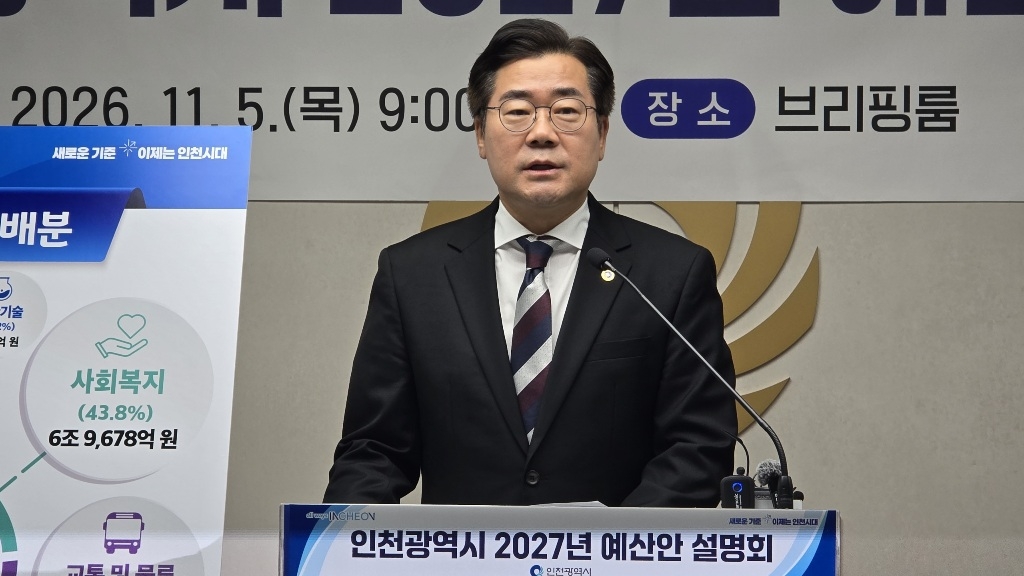
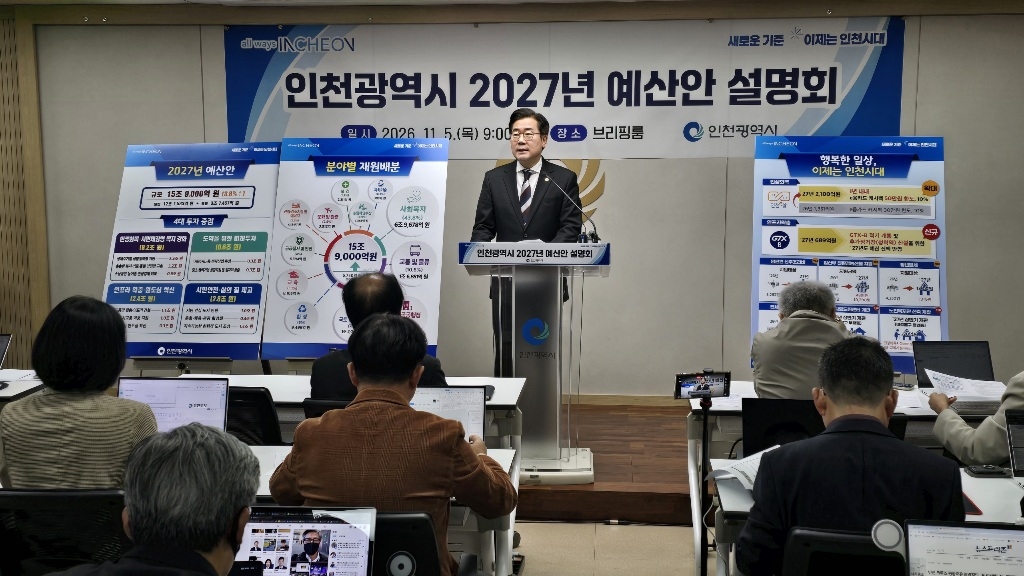
Incheon has drawn up a 15.9 trillion won ($11.9 billion) budget for 2027, directing fiscal resources toward reviving the local economy and securing new growth engines.
The plan — the first full-year budget prepared under Mayor Park Chan-dae's administration — centers on stabilizing residents' daily lives while stepping up investment in future industries such as AI, biotech, content and energy, and expanding transport infrastructure.
A particular emphasis is placed on boosting local consumption, with the full cashback budget for the Incheon e-eum local currency platform included and its monthly spending cap raised.
Park announced Thursday that the city would submit the 15.9 trillion won revenue-and-expenditure budget proposal for 2027 to the Incheon City Council.
The figure is 574 billion won, or 3.8 percent, higher than this year's original budget of 15.33 trillion won. The general account stands at 12.15 trillion won and the special account at 3.75 trillion won.
By funding source, central government transfers — including the ordinary local allocation tax and national subsidies — total 7.08 trillion won, up 780.1 billion won, or 12.4 percent, from this year.
Own-source revenue, combining local taxes and non-tax income, rose just 0.4 percent to 6.87 trillion won.
Mandatory and essential expenditures of about 11.4 trillion won also weigh on budget management.
Park said the city plans to concentrate resources freed up through project restructuring and reallocation on livelihoods and future growth.
Social welfare accounts for 6.97 trillion won of the total budget — 43.8 percent of the whole — up 10.1 percent from the previous year.
A combined 8.2 trillion won will go toward economic recovery and strengthening welfare programs that residents can feel directly.
The most prominent initiative is the expansion of the Incheon e-eum platform. Park said the city secured 210 billion won for the cashback program, an increase of 74.9 billion won from this year.
The 10 percent cashback rate for merchants with annual sales of 3 billion won or less will be maintained, while the monthly spending cap will rise from 300,000 won to 500,000 won.
Some 654.3 billion won has been set aside for small business and rural economic recovery. The budget includes 10 billion won in special guarantee contributions and 12.6 billion won in interest subsidy funds to ease the financial burden on small businesses, along with 6.2 billion won and 4.55 billion won respectively for fishing village revitalization and the Fishing Village New Deal 3.0 program.
Support for childbirth and child-rearing will also expand. The budget includes 46.9 billion won in angel support grants, 35.4 billion won in newborn welcome grants, 14.8 billion won in basic child allowances and 12.9 billion won in marriage support grants.
Eligibility for postnatal care subsidies will be broadened from households at or below 60 percent of the median income standard to those at or below 70 percent. A new savings program worth 2 billion won will also be launched to help young people build assets.
To ease housing costs for young people and newlyweds, the budget allocates 12.2 billion won for monthly rent support, 4.3 billion won for the Dream for Youth savings account for employed young residents, 8.4 billion won for the 1,000-won housing program and 3 billion won in mortgage interest subsidies for households with newborns.
For the elderly and vulnerable, the budget secures 1.59 trillion won for basic pensions, 818.3 billion won for livelihood benefits and 866.7 billion won for medical benefits.
Funding will also go toward an Incheon-specific emergency welfare program for households in crisis that fall outside national support criteria, as well as expanded activity support for people with severe and extreme disabilities.
Some 96.9 billion won has been set aside to subsidize K-Pass and Incheon Pass transit cards to reduce commuting costs.
The quasi-public city bus system will receive 231 billion won, while the metropolitan bus quasi-public system gets 67 billion won — an increase of 40 billion won from the previous year.
On public safety, the city will expand the fire department's special account to 477 billion won.
Plans include replacing aging fire trucks and ambulances, upgrading personal protective equipment and introducing unmanned firefighting robots for hazardous scenes. The budget for supporting crime victims will also be increased in response to a recent string of criminal incidents.
Investment in future industries underpins "Finding Incheon's True Value," a flagship policy of the current administration.
Park allocated 316.6 billion won to nurture what the city calls its ABC+E industries — AI, biotech, content and energy — and committed an additional 268.7 billion won to fostering the growth of small and medium-sized enterprises and venture companies and creating jobs.
In AI, the city will pursue the establishment of a physical AI demonstration center and develop a strategy for AI transformation in the logistics sector.
For biotech, 32.1 billion won has been earmarked for the K-Bio Lab Hub construction project, and a feasibility study for setting up the Incheon Bio Science and Technology Institute will also be conducted.
To strengthen the content industry, 2.5 billion won and 2 billion won have been allocated respectively for visual media industry support and the Pentaport Music Festival.
In the energy sector, 6.1 billion won will go toward building a hydrogen production base for carbon capture, and 2 billion won has been set aside to develop the Seohaegeomdан small research and development special zone.
Support for business growth and job creation will continue. The city will help small and medium-sized enterprises break into overseas markets, back youth entrepreneurship and provide incentives to companies that retain workers past the mandatory retirement age.
The city also plans to begin labor inspections of workplaces with fewer than 30 employees next year, following a delegation of supervisory authority from the central government.
A total of 2.4 trillion won will be invested in expanding the transport network and regenerating older urban areas — 1.14 trillion won for metropolitan transport links and key transport facilities, 997.4 billion won for urban transit support and 228.7 billion won for revitalizing older city centers.
Key projects include 237.9 billion won for extending Seoul Subway Line 7 to Cheongna, 21.9 billion won as Incheon's share of the GTX-B main line construction and 47 billion won for an additional station at Cheonghak.
Some 92.1 billion won has been allocated to the Incheon Boulevard normalization project to improve the urban traffic environment.
Old town revitalization projects include 9 billion won for redeveloping Incheon Inner Harbor Piers 1 and 8, 4 billion won to acquire the site for Bupyeong Sinchon Park and 4.4 billion won for the Young Square development in Michuhol-gu. Investment to promote balanced development across districts and strengthen local living infrastructure will also proceed in parallel.
The budget also draws attention for its support for residents of outlying islands. Some 5.7 billion won has been set aside to subsidize passenger ferry fares, and a new program will extend ferry fare support to military personnel. Veterans' honor allowances and other patriotic service-related expenditures total 23.2 billion won.
Several projects aim to raise Incheon's profile as an international city. A new allocation of 1.6 billion won has been made to support the city's bid to host the 2028 G20 Summit. The city will also push for national plan recognition of a trans-Korean east-west peace logistics expressway linking Incheon International Airport to Goseong in Gangwon Province, and will advance the creation of a Ganghwa Peace Economic Special Zone.
Park also focused on fiscal soundness. The city plans to issue municipal bonds as needed for major investment projects while targeting a debt management ratio of around 15.3 percent — below the 15.6 percent set in this year's original budget.
"The 2027 budget reflects our determination to protect the daily lives of residents and find Incheon's true value," Park said. "We will sustain livelihood support in a stable manner, invest in future growth, and responsibly manage the budget so that allocated funds are executed on the ground in a timely fashion."
gilbert@heraldcorp.com