Hoban, Cho gap stands at just 0.11 percentage points
Cho signs deal to buy additional 37 billion won stake, signaling reversal
Largest shareholder changes trigger repeated Fair Trade Commission filings
Share price surges 50% in 3 sessions, raising cost of further accumulation
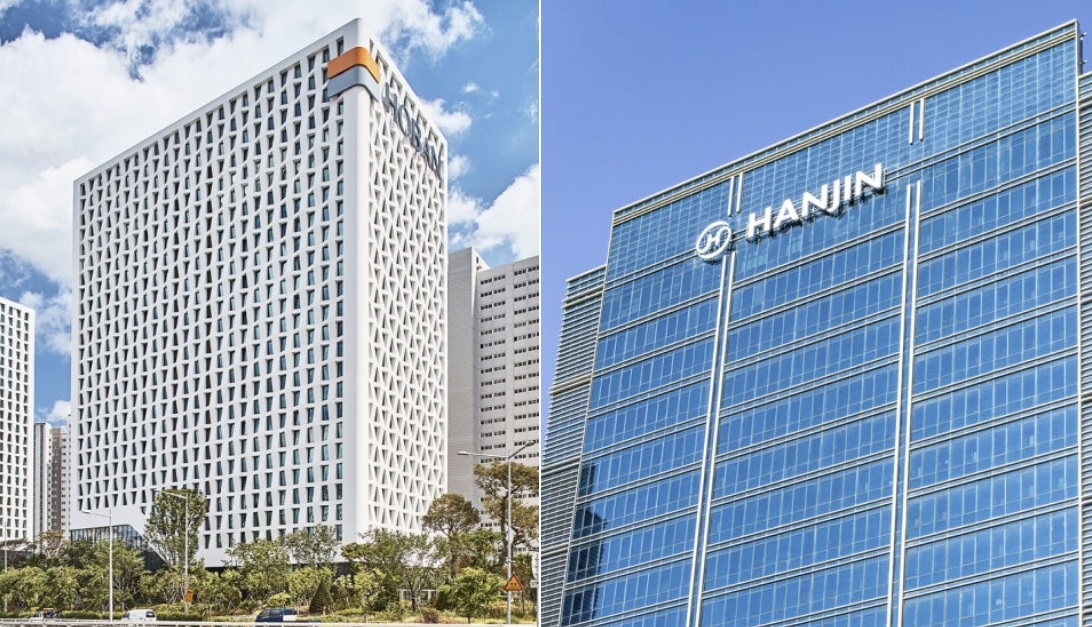
The top shareholder position at Hanjin KAL could change hands twice within a single month. Hoban Group edged past Hanjin Group Chairman Cho Won-tae and his affiliates to become the largest shareholder, but Cho has now signed a contract to purchase an additional 37.05 billion won ($27.6 million) worth of shares, signaling a potential reversal.
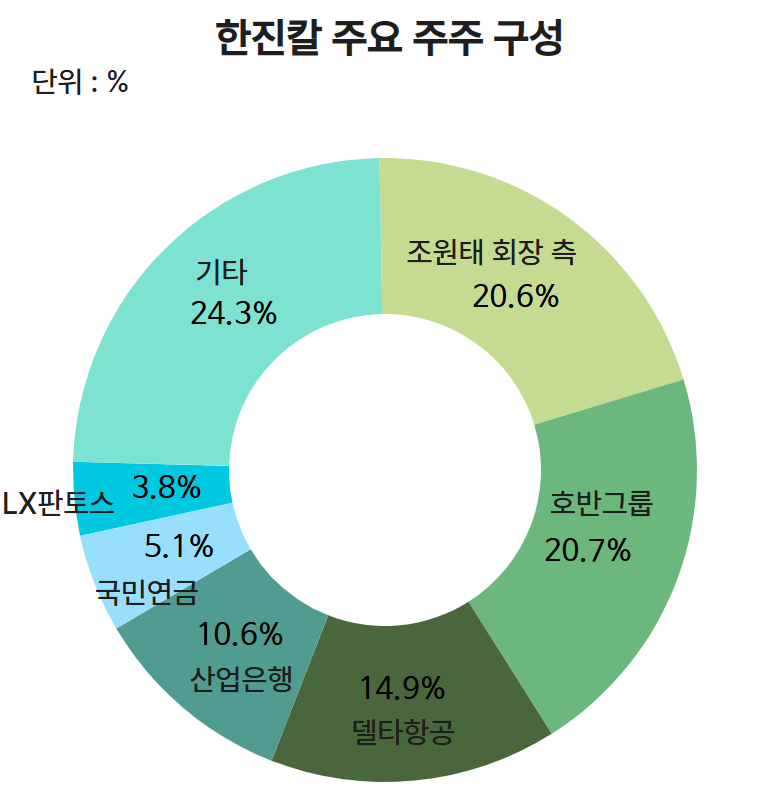
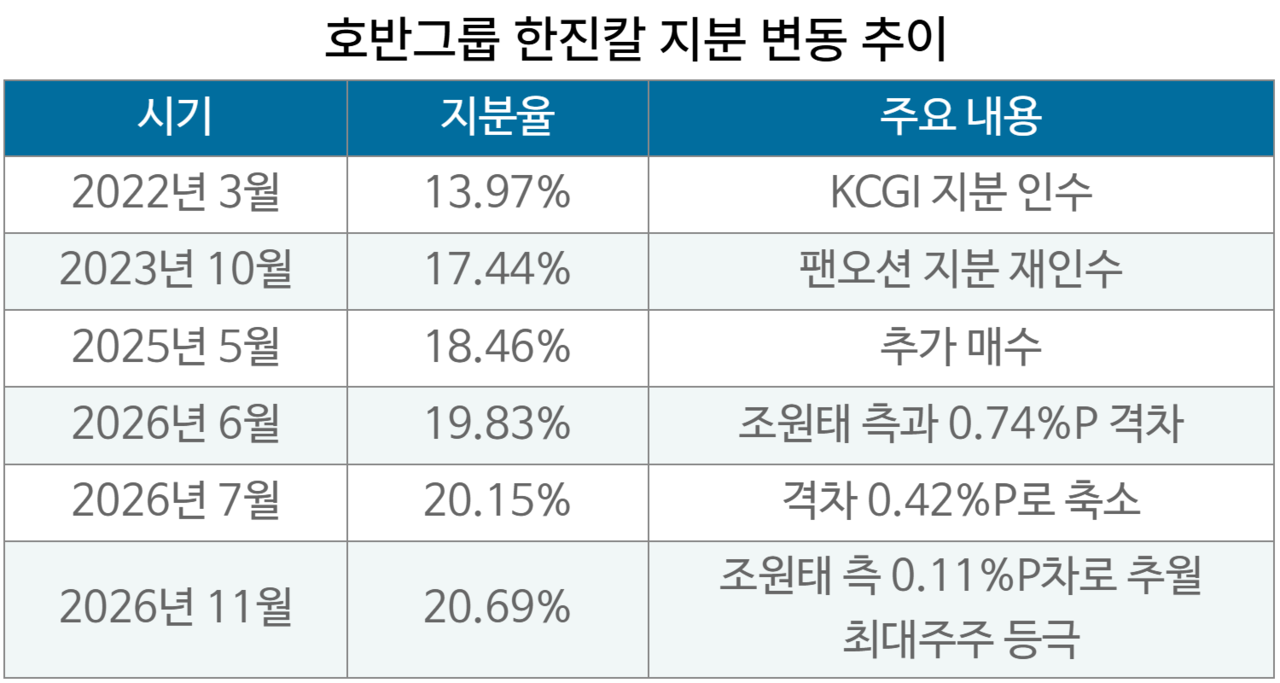
According to the Financial Supervisory Service, the gap between Hoban Group and Cho's camp stands at just 0.11 percentage points — a difference of 75,134 shares. A disclosure filed Wednesday showed Hoban Group holding a 20.69 percent stake, or 13,814,053 shares, narrowly ahead of the 20.58 percent, or 13,738,919 shares, held by Cho and his related parties.
The Herald Business exclusively reported Monday that Hoban Group had overtaken Cho through open-market purchases to become Hanjin KAL's largest shareholder. Wednesday's regulatory filing officially confirmed that report.
Hoban's hold on the top position may not last a month, however. Cho signed a contract Monday to acquire 325,000 shares — about 0.49 percent of Hanjin KAL — for 37.05 billion won, at a price of 114,000 won per share. The transaction is scheduled to take place between Dec. 3 and Jan. 1 next year.
If Cho completes the purchase as planned and no other shareholding changes occur, his combined stake would rise to roughly 21.07 percent, putting him about 0.37 percentage points ahead of Hoban Group and returning him to the top position.
Hanjin KAL said in a separate statement Wednesday that if Cho completes the planned share purchase, "the largest shareholder may change to Chairman Cho and his related parties."
If Cho's camp reclaims the top shareholder position next month, it will be required to file a new merger notification with the Fair Trade Commission. Under the Fair Trade Act, a shareholder that acquires additional shares and becomes the largest stakeholder must file for a merger review — even if that party previously held the position and is simply reclaiming it after losing it. Should Hoban Group subsequently regain the top spot through further purchases, the same process would repeat.
Hoban Group has already filed a merger notification with the Fair Trade Commission following its additional acquisition of Hanjin KAL shares last month and is currently under review. That existing review of Hoban would not automatically lapse if Cho's side reclaims the largest shareholder status.
Upon receiving a filing, the Fair Trade Commission examines whether the share acquisition meaningfully shifts control and how it affects market competition. Cases with limited competition concerns may be resolved through a simplified review, but if the commission finds a significant risk of restricting competition, it can approve the deal with remedies or block it outright. The standard review period is 30 days, extendable by up to 90 additional days if necessary.
Hoban Group continues to describe its purpose in holding Hanjin KAL shares as a "simple investment." Analysts note that competition concerns are likely limited given that the two groups operate in different core businesses — construction and aviation. The Fair Trade Commission may nonetheless take into account evolving shareholding structures as part of its overall review.
Hanjin KAL's disclosure of a largest-shareholder change is a separate process from the Fair Trade Commission's merger review. Under Korea Exchange rules, a change in the largest shareholder must be disclosed by the following business day after the company confirms the change. In practice, Hanjin KAL confirmed the change Tuesday after being notified by Hoban Construction, and filed the disclosure Wednesday. The same procedure would apply if the largest shareholder changes again.
The price at which Cho is buying the additional shares adds another layer of complexity. The 325,000 shares are understood to be held by Japan Airlines, and the contract price of 114,000 won per share is about 9.5 percent below Japan Airlines' average acquisition cost in August — a difference of roughly 3.9 billion won at current market prices. Given that Korean Air and Japan Airlines formed a strategic alliance in September, questions may arise over the appropriateness of the share price and the terms of cooperation between the two carriers if Hoban Group moves to assert management influence.
Views differ on whether the two sides will continue to accumulate shares. Yang Seung-yun, an analyst at Eugene Investment and Securities, said the competition for shares "will continue through year-end." Because Cho's additional purchase window runs from Dec. 3 to Jan. 1, the timing of the actual transaction could affect the voting dynamics at the annual shareholders meeting in March next year.
Others are skeptical that either side can significantly increase its stake through open-market purchases in the near term. Hanjin KAL's share price surged 48.5 percent in just three trading sessions, advancing from 122,900 won on Friday to 182,500 won on Wednesday. Based on Wednesday's closing price, the company's market capitalization reached 12.3 trillion won, meaning acquiring just one additional percentage point would cost roughly 120 billion won.
The limited supply of shares available on the market is another obstacle. After accounting for holdings by major shareholders and long-term investors, freely tradable shares are estimated to represent only about 10 percent of the total.
A change in the largest shareholder does not, however, automatically mean a transfer of management control over Hanjin Group. Cho's camp maintains cooperative ties with friendly shareholders including Delta Air Lines.
Voting rights restrictions under the revised Commercial Act add yet another variable. If Hoban Group holds the largest shareholder position, its combined voting rights in the election of audit committee members would be capped at 3 percent, while Cho's side would be subject to a 3 percent limit per individual shareholder — allowing it to exercise up to 15.03 percent in total. Hanjin KAL's board currently has nine members, with three independent directors whose terms expire in March next year. Unless existing directors are removed or the articles of incorporation are amended, Hoban would find it difficult to secure a board majority even if it wins all three seats at next year's shareholders meeting.
kwater@heraldcorp.com
y2k@heraldcorp.com