8,176 recipients collected 31.4 billion won last year; overseas assets hard to verify
New rule requires 5 or more years of domestic residence after age 19
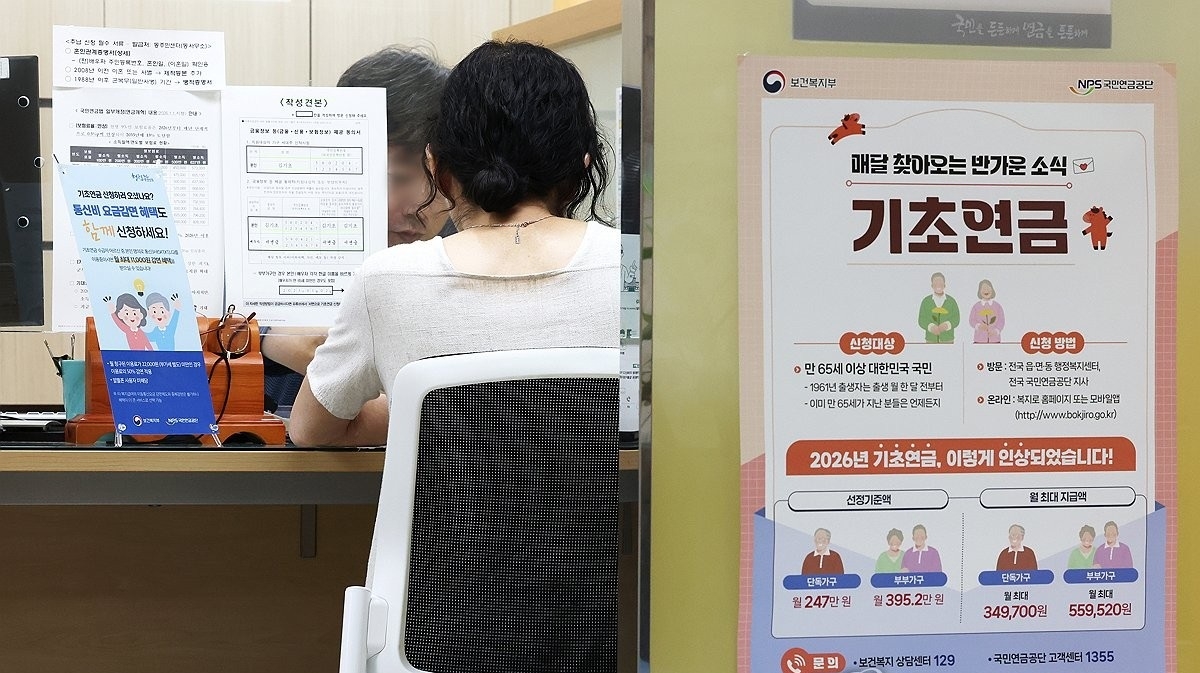
The number of basic pension recipients who hold dual nationality has grown 2.3-fold in four years, surpassing 8,000 last year. With concerns mounting over fairness toward domestic taxpayers, eligibility rules will be tightened starting in April next year, requiring at least five years of residence in South Korea.
According to the National Assembly Budget Office and the Ministry of Health and Welfare, the number of dual-national basic pension recipients rose 125.8 percent, from 3,621 in 2021 to 8,176 last year.
Over the same period, the average monthly pension payment per recipient climbed from 272,000 won ($203) to 320,000 won. Total annual payouts nearly tripled, rising from 11.82 billion won to 31.4 billion won — an increase of roughly 2.7 times.
Critics note that overseas public and private pensions, as well as financial assets held abroad by dual nationals, are difficult to verify through domestic administrative systems and may be overlooked during eligibility screening.
Under the current system, there is no separate requirement for dual nationals who have been living abroad to reside in South Korea for a set period before receiving the basic pension.
The National Assembly Budget Office's budget analysis division said the situation amounts to a regressive equity problem. "Domestic citizens who have faithfully paid taxes and social insurance premiums their entire lives have their benefits strictly reduced through a dense income-tracking system, while dual nationals who spent their lives abroad receive benefits in a blind spot of asset verification," it said.
Although the basic pension budget allocated to dual nationals accounts for only around 0.1 percent of the total, the fairness gap with domestic recipients has made reform necessary.
In response, eligibility requirements will be strengthened starting in April next year to bring parity with domestic citizens.
Previously, anyone meeting the age threshold of 65 or older and the income requirement could receive the basic pension. Under a recently amended law, the pension will no longer be paid to those who have not lived in South Korea for at least five years after the age of 19.
Earlier, the Ministry of Health and Welfare held the second meeting of its health and welfare normalization task force alongside the first meeting of a social security system fairness review and improvement committee last month, where it discussed imposing a mandatory domestic residency period as a condition for basic pension eligibility. The ministry plans to use the TF and the committee to re-examine whether there are any gaps in the social security system.
The National Assembly Budget Office urged the government to take action. "As the number of dual nationals receiving the basic pension continues to grow, measures must be put in place to prevent inequity with domestic citizens and to strengthen the infrastructure for verifying overseas assets," it said, adding that the government should also "explore ways to improve the effectiveness of the system, including building an overseas asset verification infrastructure that draws on tax and financial information exchange frameworks."
thlee@heraldcorp.com