Carrier cites large-scale service investment
Sustained customer service improvements earn high marks
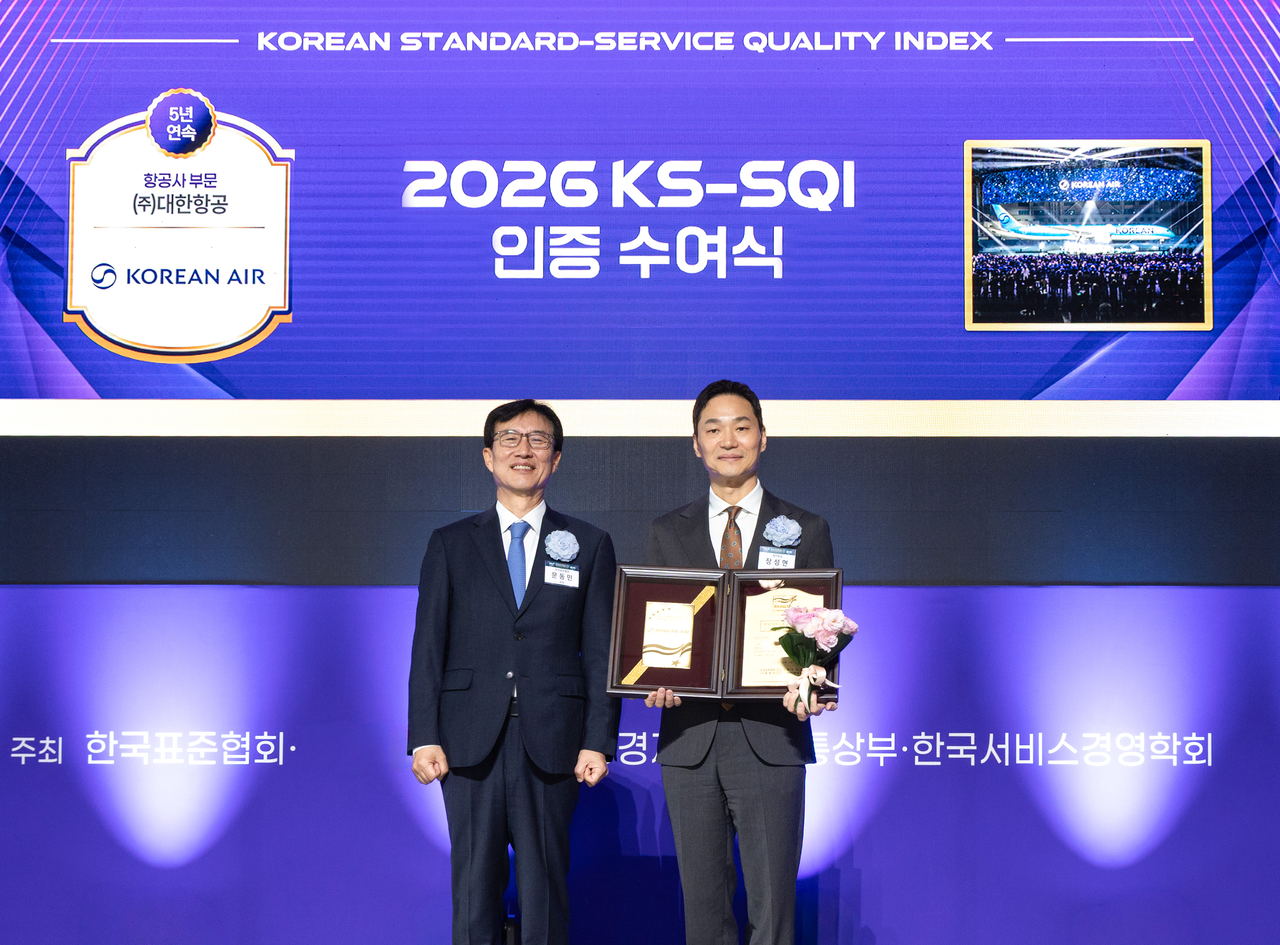
Korean Air announced Wednesday that it has topped the airline category of the Korean Standard-Service Quality Index (KS-SQI), administered by the Korean Standards Association, for the fifth consecutive year.
The KS-SQI is a service quality evaluation model jointly developed in 2000 by the Korean Standards Association and Seoul National University's Business Research Institute. It publishes an annual composite index measuring customer satisfaction with the products and services of domestic service companies. This year's certification ceremony was held Wednesday morning at Signiel Seoul in Songpa-gu, Seoul.
Korean Air was recognized for carrying out large-scale investment to deliver top-tier service and for its sustained efforts to improve customer service. The airline has worked to redesign the in-flight travel experience in ways that set it apart from past practice, while also focusing on systems integration and organizational culture alignment ahead of the launch of the merged carrier.
A prime example is the introduction of Starlink-based in-flight Wi-Fi in September — a first among full-service carriers in East Asia. The service allows customers to stay connected to their daily routines and work in the air just as they would on the ground. The easy connection process and a policy of offering the service free across all seat classes have also drawn a strong public response.
Korean Air has also unveiled next-generation airport lounges following extensive renovations. Following last year's opening, the airline opened a next-generation flagship lounge at Los Angeles International Airport in March and completed renovations of the first-class lounge and the Prestige West lounge at Incheon International Airport in April. The upgrades have been credited with redefining airport lounges from simple waiting areas into destinations in their own right.
In addition, the airline has worked to enhance travel convenience in ways passengers can tangibly feel. In June, Korean Air and Delta Air Lines expanded the routes covered by their Seamless Baggage Transfer (SBT) service, simplifying US customs inspections and baggage re-check procedures for connecting passengers. The service now operates on five transpacific routes linking Incheon with Atlanta, Seattle, Los Angeles, Minneapolis and Detroit.
For the winter season, Korean Air has also worked to strengthen its route and schedule competitiveness by closely reviewing customer preferences and the recovery in overseas travel demand — adding services to Melbourne, Australia, and Hiroshima, Japan, among others. The airline says it is taking every precaution to reinforce its safety operations and systems so that customers can travel without disruption.
"We see this top ranking in the service quality index as official recognition of the efforts Korean Air has made over the years, and we take it as encouragement and support," a Korean Air official said. "We will do our utmost to move our customers through absolute flight safety and continuous service improvement."
Meanwhile, Korean Air recently co-hosted the fourth "Safety Day" event with Asiana Airlines at Korean Air's headquarters in Gangseo-gu, Seoul.
The event brought together about 200 executives and employees from both carriers, along with staff from ground handling companies Korea Airport Service and Asiana Airport. The slogan for this year's event — "One Team, One Safety" — was carried over from last year.
The event aimed to sustain momentum toward genuinely merging the two airlines' safety cultures and embedding them at the operational level.
likehyo85@heraldcorp.com