Policy conference on industrial transformation held for southeastern region
Co-hosted with Ministry of Trade, Industry and Energy; about 190 regional business leaders attend
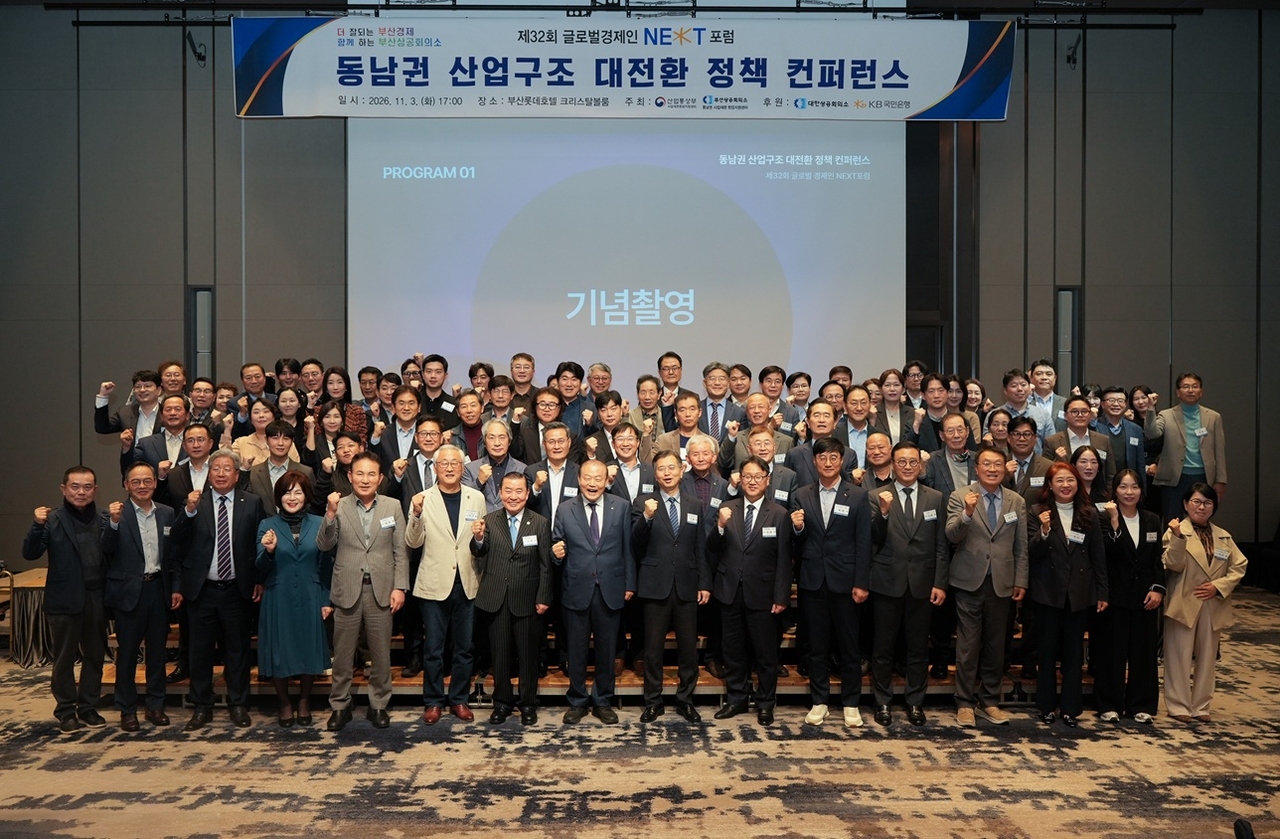
The Southeastern Region Business Restructuring Field Support Center of the Busan Chamber of Commerce and Industry co-hosted the Policy Conference on Industrial Structural Transformation in the Southeastern Region with the Ministry of Trade, Industry and Energy's Business Restructuring Comprehensive Support Center on Tuesday afternoon at the Crystal Ballroom of Lotte Hotel Busan. About 190 executives and employees from regional companies attended.
The event was organized to assess survival strategies for local businesses amid challenging domestic and international economic conditions — including high inflation and high interest rates — and to explore ways to shift the region's traditional manufacturing-centered industrial base toward high-value-added future industries.
In the first session, Moon Jeong-hee, a senior specialist at KB Kookmin Bank, delivered a lecture titled "2027 Global Economic Outlook and Responses to Industrial Structural Change." Moon projected that the global economy would stage a gradual recovery next year, drawing on scenarios involving a prolonged stalemate in the Middle East war and varying oil price trajectories. "Regional companies must proactively respond to shifts in the Federal Reserve's interest rate policy and changes in the tariff and trade environment following the US midterm elections," Moon said.
The second session featured Ko Tae-bong, head of research at iM Securities, who outlined a vision for the future of manufacturing under the theme "Industrial AX Transforming the Factory Floor: Dark Factories and Physical AI." Ko explained the concepts of physical AI — systems capable of autonomous judgment and control — and dark factories, fully unmanned and continuously automated production facilities. Ko also examined the global race for robotics dominance, touching on China's cost competitiveness and the deployment of humanoid robots by Tesla and Hyundai Motor Group. For a successful industrial AI transformation, Ko stressed the importance of securing real-world data for robot training.
A panel discussion moderated by Kim Byeong-jin, director of the Busan Anchor Center, brought together Lee Tae-hun, a team leader at the Korea Productivity Center's DX Consulting Center, along with the earlier speakers, to debate strategies for the structural transformation of industry in the southeastern region.
One-on-one consultation booths set up at the venue also drew considerable attention from business leaders. The center briefed attendees on business restructuring support programs and incentives under the Corporate Vitality Act and provided customized on-site consulting for individual companies.
Yang Jae-saeng, chairman of the Busan Chamber of Commerce and Industry, said the way manufacturers compete is changing, and the time has come for regional companies to consider restructuring their businesses to connect the technology they have built up with new technologies and emerging demand. "We will spare no effort in supporting companies to successfully transform themselves through the Business Restructuring Field Support Center," Yang said.
kaf2002@heraldcorp.com