7,112 units planned across Sanggye-boram, Jugong complexes 9 and 14
Sanggye Jugong 6 owners of 32-square-meter units face estimated levy of 760 million won for 84-square-meter upgrade
Actual costs subject to change; financing burden seen as key variable
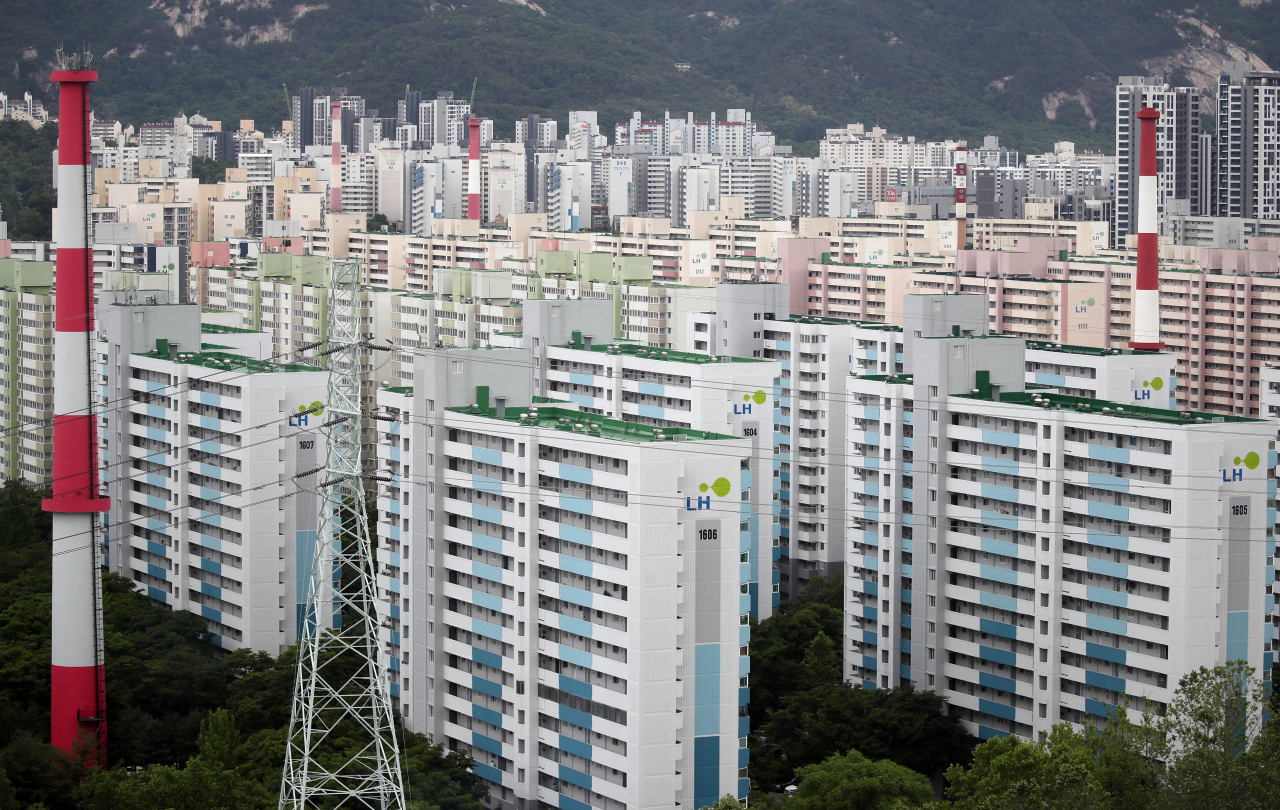
Reconstruction projects for aging apartment complexes in the Sanggye-dong and Junggye-dong areas of Seoul's Nowon-gu are advancing through key permitting stages in quick succession. Sanggye-boram Apartments was recently designated a maintenance zone, and Sanggye Jugong complexes 9 and 14 have since drawn up a plan to rebuild more than 7,000 units. However, estimated additional levies at some complexes — projected to exceed the current market value of existing homes — are emerging as a potential obstacle to the projects.
Six Nowon complexes launch reconstruction bids, eyeing large-scale redevelopment
According to the Seoul Metropolitan Government and Nowon-gu, Seoul designated Sanggye-boram Apartments as a maintenance zone and finalized its maintenance plan on Oct. 15. The project calls for rebuilding the existing 3,315 units into up to 4,483 units across buildings of up to 45 stories. A project viability correction factor of 1.8 was applied, keeping the floor-area ratio at or below 300 percent.
Sanggye Hansin 3rd Complex was also designated a maintenance zone last September, while Sanggye Hansin 1st and 2nd complexes cleared a Seoul Metropolitan Government urban planning committee review on Oct. 21 and are on the verge of designation. Among the major reconstruction complexes in the Sanggye-dong and Junggye-dong area, those that have completed maintenance zone designation include Sanggye Jugong 5, Sanggye-boram and Sanggye Hansin 3rd; most of the remaining complexes are still in early stages such as drafting maintenance plans.
Sanggye Jugong complexes 9 and 14 recently drew up a large-scale reconstruction plan. Complex 14 applied for fast-track integrated planning consultation on Oct. 12, and Complex 9 followed on Oct. 23. The two complexes are pursuing a plan to rebuild the existing 5,095 units into a total of 7,112 units across buildings of up to 49 stories — an increase of 2,017 units. Nowon-gu plans to hold a fast-track integrated planning team meeting this month to support the development of a maintenance plan.
Even as the reconstruction projects gain momentum, the additional levies that union members will have to bear are estimated to be substantial. Owners who choose to upgrade from a small unit to a mid-sized unit face particularly steep financing requirements, with estimates running into the hundreds of millions of won.
Upgrading to a larger unit after reconstruction may cost as much as the home itself
At Sanggye-boram, which was designated a maintenance zone last month, levies of several hundred million won are anticipated. Under the maintenance plan Seoul published on Oct. 15, the complex's estimated proportional ratio was set at 110.28 percent. Estimated union member pre-sale prices for new units were set at 834 million won ($622,000) for a 59-square-meter unit and 1.04 billion won for an 84-square-meter unit.
Applying the estimated prior asset values and proportional ratio by unit type as set out in the notice, an owner of an existing 44-square-meter unit who opts for a new 84-square-meter unit would face an estimated additional levy of about 612.21 million won — more than 220 million won above the estimated prior asset value of 390 million won for the existing home. The same owner choosing a new 59-square-meter unit would still face an estimated levy of about 403.91 million won.
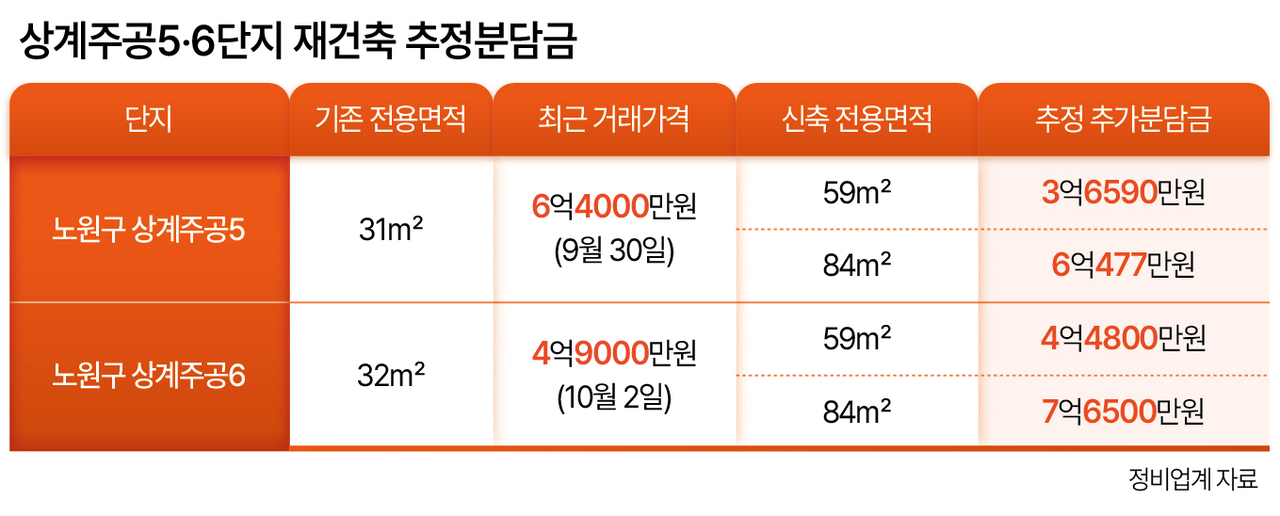
High levies have also been flagged at Sanggye Jugong 5, which is the furthest along in the process and is approaching management and disposal plan approval. During the union member pre-sale application period from May to July this year, owners of existing 31-square-meter units (exclusive use area; the same applies below) who chose a new 59-square-meter unit were estimated to face an additional levy of about 365.9 million won, while those opting for an 84-square-meter unit faced an estimated levy of about 604.77 million won.
Sanggye Jugong 6 disclosed during its maintenance plan drafting process in July that owners of existing 32-square-meter units who choose a new 84-square-meter unit would face an estimated additional levy of about 760 million won. Choosing a new 59-square-meter unit was estimated to require about 448 million won, and a 49-square-meter unit about 292 million won. Even owners of existing 49-square-meter units who opt to stay in the same 49-square-meter size after reconstruction were expected to face an additional levy of about 78.7 million won.
These levy estimates exceed the current transaction prices of the existing apartments. According to the Ministry of Land, Infrastructure and Transport's actual transaction price disclosure system, a 32-square-meter unit at Sanggye Jugong 6 sold for 490 million won on Oct. 2. Comparing that transaction price with the estimated levy for choosing a new 84-square-meter unit, the additional amount owed is 275 million won more than the value of the existing home.
However, the figures for Sanggye Jugong 5 were calculated at the union member pre-sale application stage, those for Sanggye Jugong 6 at the maintenance plan drafting stage, and those for Sanggye-boram at the maintenance zone designation stage. Actual levies may differ depending on future construction costs, pre-sale prices and appraisal results.
Rising construction costs make high levies unavoidable; measures to boost viability needed
The Sanggye-dong and Junggye-dong area has a high proportion of aging apartments with small units, meaning that expanding the share of mid-sized units through reconstruction could significantly increase the financial burden on union members. Seoul is pursuing measures to increase the number of units available for general pre-sale by applying project viability correction factors and floor-area ratio incentives, but analysts say there may be limits to how much these tools can offset the levy burden given rising construction costs and local pre-sale price levels.
Kim Je-gyeong, director of Toomi Real Estate Consulting, said areas like Nowon-gu — where union members hold small land shares and existing floor-area ratios are already high — require extraordinary measures from both the Seoul city government and the central government to improve reconstruction viability.
Kim added that owners who cannot afford the additional levies will have to sell their units and move out, but that various regulations currently make even selling difficult, which could delay the projects. With the exception of Sanggye Jugong 5, which is approaching management and disposal plan approval, most complexes are still at or before the maintenance zone designation stage, Kim said, raising the possibility that levies could reach 1 billion won by the time reconstruction gets fully under way.
quq@heraldcorp.com