Philadelphia Semiconductor Index rises 2.6% amid mixed Wall Street session
Nvidia, Micron advance; oil prices fall on peace-talks optimism
MSCI Korea ETF gains 2.3%; Kospi night futures also rise
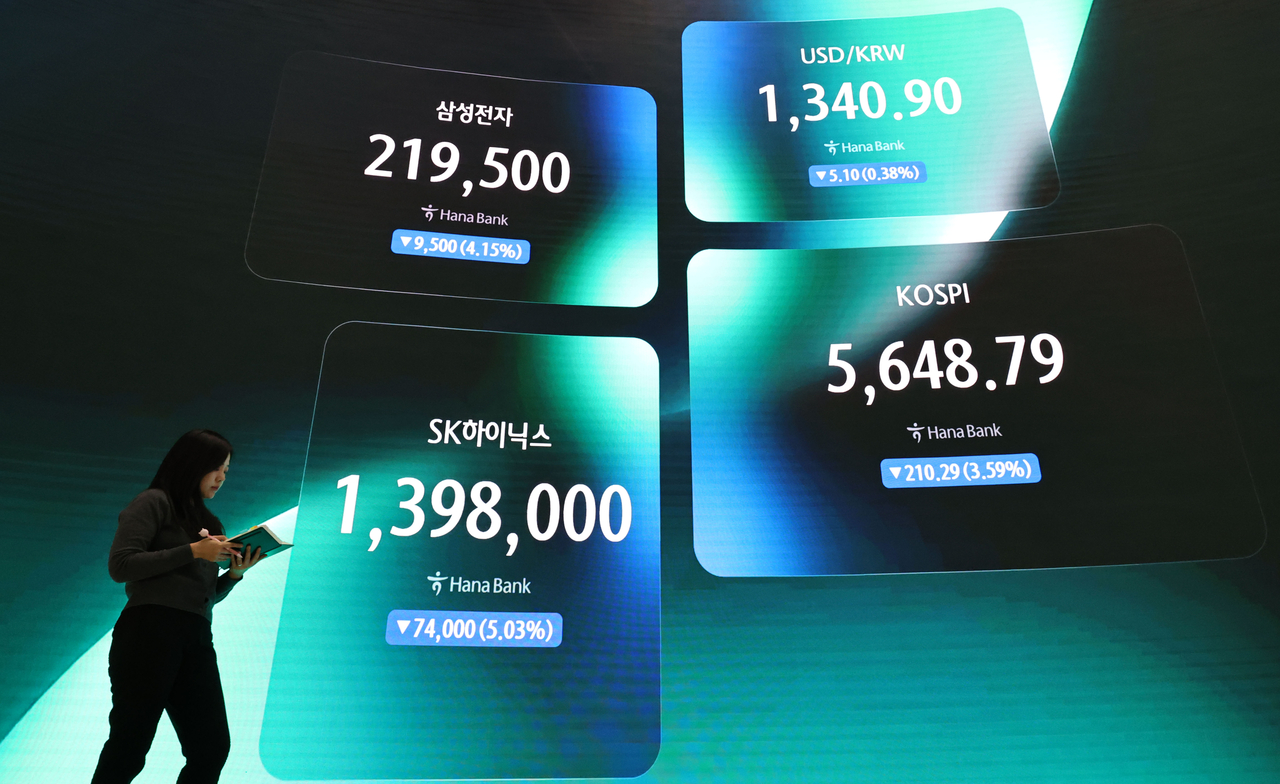
With US semiconductor stocks rallying overnight, the Kospi is expected to attempt a rebound Wednesday after tumbling sharply on Tuesday.
The Kospi closed down 210.29 points, or 3.59 percent, at 5,648.79 on Tuesday, dragged lower by a sell-off in US technology stocks. The index opened 143.89 points, or 2.46 percent, lower at 5,715.19 and at one point slid as far as 4.15 percent to 5,615.80 during the session.
Foreign investors drove the decline with trillion-won-scale net selling on the main board. They posted net sales of 1.53 trillion won ($1.14 billion) on the Kospi market by the close of the regular session, while institutional investors also sold on a net basis, offloading 514.7 billion won. Retail investors, by contrast, made net purchases of 1.66 trillion won.
Market watchers attributed the sell-off in part to renewed concerns over AI funding. Oracle announced plans to raise $20 billion through a stock and bond offering to finance AI infrastructure, while Anthropic said it expects to spend $895.4 billion on infrastructure purchases and related costs — moves that stoked investor anxiety over the scale of capital being deployed across the sector.
A wait-and-see mood ahead of the US midterm elections also weighed on technology shares, sending domestic heavyweight chipmakers Samsung Electronics and SK hynix down 4.15 percent and 5.03 percent, respectively.
Overnight on Wall Street, however, major technology stocks bounced back from their recent slide. The three main US indexes were mixed, as caution over the midterm elections kept a lid on gains.
The Dow Jones Industrial Average fell 197.26 points, or 0.38 percent, while the S&P 500 and the tech-heavy Nasdaq Composite rose 0.36 percent and 0.83 percent, respectively.
Among individual stocks, memory chip companies rebounded after a string of losses — Micron gained 2.58 percent, SK hynix's American depositary receipts rose 2.09 percent, and SanDisk advanced 4.78 percent. CoreWeave, a neocloud provider that recently drew scrutiny over credit concerns, also surged 7.16 percent.
The Philadelphia Semiconductor Index rose 2.63 percent.
Seo Sang-young, a managing director at Mirae Asset Securities, said Apple's warning during its earnings call on Tuesday that memory chip price increases could persist into next year served as a positive signal for suppliers, raising expectations for higher selling prices and improved profitability.
The warning appeared to weigh on Apple's own shares, however, which fell 1.90 percent. Among other big-tech names, Nvidia rose 2.29 percent, Microsoft gained 2.74 percent and Meta advanced 2.36 percent.
Oil prices fell on optimism over prospects for negotiations to end the conflicts between the United States and Iran and between Russia and Ukraine, lending some support to investor sentiment. Brent crude futures for January delivery on the London ICE Futures Exchange dropped 1.12 percent, while West Texas Intermediate futures for December delivery on the New York Mercantile Exchange fell 0.38 percent.
The MSCI Korea ETF, a gauge of foreign investor sentiment toward the domestic market, rose 2.27 percent. The KOSPI 200 night futures index also gained 1.7 percent.
The domestic market is expected to have somewhat more room to rise Wednesday, supported by bargain hunting after Tuesday's sharp decline and the overnight rebound in US semiconductor stocks.
Han Ji-young, a researcher at Kiwoom Securities, said the local market would push for a rebound Wednesday, driven by strength in major AI stocks and growing incentives for bargain buying, even as investors remain cautious ahead of the US midterm elections. Han added that the Kospi's forward price-to-earnings ratio had fallen to 3.96 times, dropping below 4 times for the first time since June 2000.

yuni@heraldcorp.com