Both delivery theft cases result in 1 million won fines
Judge cites 'unspoken rule of our society' in sentencing
Lawyers say ruling reflects court's view of brazen conduct
"It is an unspoken rule of our society that you do not touch a delivery package that is not yours."
"The defendant has punched a hole in the social trust."
— Excerpt from the ruling against delivery thief A
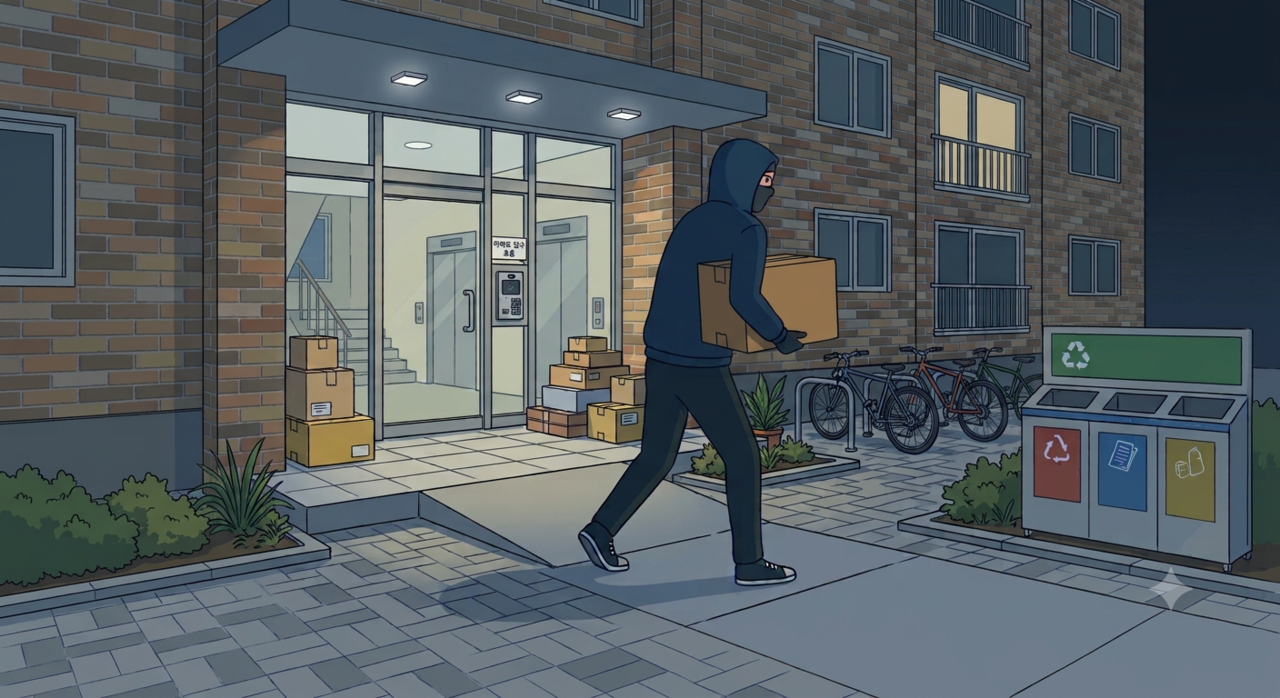
A court took the unusual step of increasing the fine for a person who stole a neighbor's delivery package, imposing a penalty of 1 million won ($749) — higher than the 700,000 won set under an initial summary order. The court rebuked the defendant, saying the theft had "punched a hole in the social trust."
According to legal sources, Judge Cha Ki-hyeon of the Gwangju District Court's Criminal Division 6 sentenced the defendant, identified only as A, to a fine of 1 million won on Sept. 15 in the first-instance ruling. The verdict was finalized without appeal.
A was accused of stealing another person's delivery package from a spot near the security office of an apartment building in Gwangju last November. The stolen items — a shirt, a padded jacket and a regular jacket — were valued at around 100,000 won. A was caught after attempting to sell the items through a secondhand trading platform. Police recovered all the goods and returned them to the victim.
A had originally been summarily indicted with a proposed fine of 700,000 won. A summary indictment is a procedure used by the public prosecution office (formerly the prosecution service) when it determines that a fine, rather than imprisonment, is appropriate for a relatively minor offense; the court issues a summary order based solely on submitted documents without holding a separate hearing. A full trial may be convened if the court finds the summary procedure inappropriate or if either party contests the order.
Judge Cha said the fine set under the summary order alone was "difficult to regard as punishment befitting the offense."
Explaining the reasoning, Cha said it is "an unspoken rule of our society that you do not touch a delivery package left at a front door, a common entrance, or near a security office if it is not yours." That norm, Cha added, allows "many people to use delivery services without hesitation, in a relatively reassured atmosphere, despite the inconvenience of in-person receipt and the shortage of parcel locker facilities."
Cha then said A had "punched a hole in the social trust by walking off with another person's delivery package sent to the apartment's common entrance," and noted that A had "not yet received forgiveness from the victim."
However, Cha also noted that A had acknowledged wrongdoing, that "the damage from the theft was relatively minor," that the stolen items had been returned to the victim, and that A had no prior criminal record involving a penalty more serious than a fine.
Kim Ji-hyeok, an attorney at law firm Taerin, said the ruling clearly showed the court viewed A's conduct as particularly egregious. "The fact that the judge went so far as to cite 'the unspoken rule of our society' in the sentencing rationale — that is unusual, and it seems clear the court took a very dim view of what A did," Kim said.
Kim said courts typically do not raise fines in full trials for minor subsistence-related offenses such as petty theft or small wage arrears — they may lower them, but not increase them as in this case. Kim added that "had A reached a settlement with the victim, there is a good chance the case would have ended in a deferred prosecution or a fine of less than 300,000 won."
Park Ji-young, an attorney at law firm Hwinmoe, said it was hard to call the 1 million won fine excessive given that the statutory range for theft runs from 50,000 won to 10 million won. At the same time, Park said, "given that the value of the stolen goods was 100,000 won, a fine of 1 million won appears to be close to the maximum end of the sentencing range."
notstrong@heraldcorp.com