
National Institute of Toxicological Research reports results of 28-day combined-exposure experiment

Drinking alcohol while exposed to environmental pollutants can significantly worsen kidney health, according to new research.
The National Institute of Toxicological Research (KIT) announced Wednesday that a research team led by principal researchers Yu Min-hee and Kim Yong-beom of its Next-Generation Non-Clinical Research Division had identified the effects on the kidneys of combined exposure to perfluorooctanoic acid (PFOA) — a representative per- and polyfluoroalkyl substance (PFAS) — and ethanol.
PFAS are synthetic chemicals widely used in everyday products such as nonstick pan coatings, waterproof clothing and food packaging because of their resistance to water and oil. Some compounds do not break down easily in the natural environment and can persist in the human body for extended periods, fueling ongoing debate over their health risks.
PFOA in particular can affect kidney tissue as it is excreted through the kidneys. Conventional toxicity assessments have focused on evaluating individual chemicals in isolation, however, leaving relatively little research on the combined toxic effects of lifestyle factors such as alcohol consumption and environmental pollutants acting simultaneously.
The research team administered PFOA and ethanol together to laboratory animals for 28 days and analyzed changes in kidney function.
Animals exposed to both substances simultaneously showed more pronounced indicators of kidney dysfunction than those exposed to either substance alone.
Blood urea nitrogen — a key marker used to assess kidney function — rose, while blood sodium levels fell. The findings suggest the kidneys' ability to excrete waste and regulate electrolytes may have been impaired.
Particularly notable was a confirmed decline in the function of the renal tubules, the structures in the kidney responsible for reabsorbing water and electrolytes.
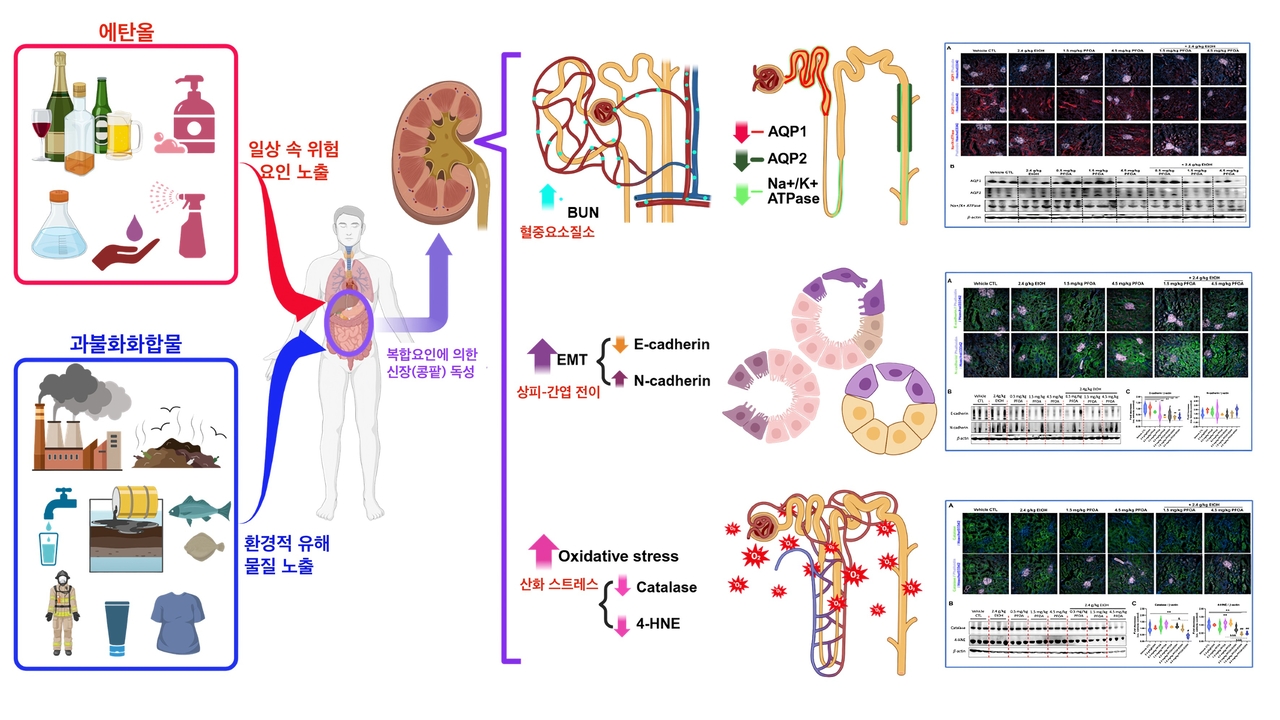
The research team found that the expression of key proteins responsible for maintaining the function and structural integrity of the renal tubules had decreased. This indicates that toxic responses at the cellular level can begin before visible damage to kidney tissue appears.
To corroborate the animal study results, the team also conducted follow-up research using three-dimensional kidney organoids — miniature organ models derived from human cells.
That research found increased oxidative stress, which causes cellular damage, along with changes to cell structure. The findings further support the conclusion that combined exposure to environmental pollutants and alcohol can place additional strain on kidney cells.
The study is significant in that it provides a scientific basis for factoring in lifestyle elements such as alcohol consumption when assessing the health risks of environmental pollutants.
However, the results were obtained through animal experiments and human-derived organoid research, and additional studies are needed to determine whether the same degree of kidney function decline occurs in humans.
The research team expects the methodology developed in this study can be applied to assess the risks of combined exposure to a range of environmental pollutants and lifestyle factors beyond PFAS, including heavy metals and smoking.
"The human body is in fact simultaneously exposed to a wide variety of environmental pollutants and lifestyle factors," Yu said. "We hope this research serves as a catalyst for moving beyond single-substance assessments toward a risk evaluation framework that accounts for combined exposures."
The findings were published in the international journal Environmental Pollution, and the follow-up results appeared in Journal of Hazardous Materials Advances.
nbgkoo@heraldcorp.com




