World Hydrogen Expo 2026 runs Wednesday through Friday at Kintex in Goyang
Vice Chairman Jang Jae-hoon visits exhibition floor
First public showing of 5MW electrolyzer stack module configuration
Group eyes scale-up to large-scale hydrogen production facilities
Hydrogen trucks, automatic charging robots among exhibits
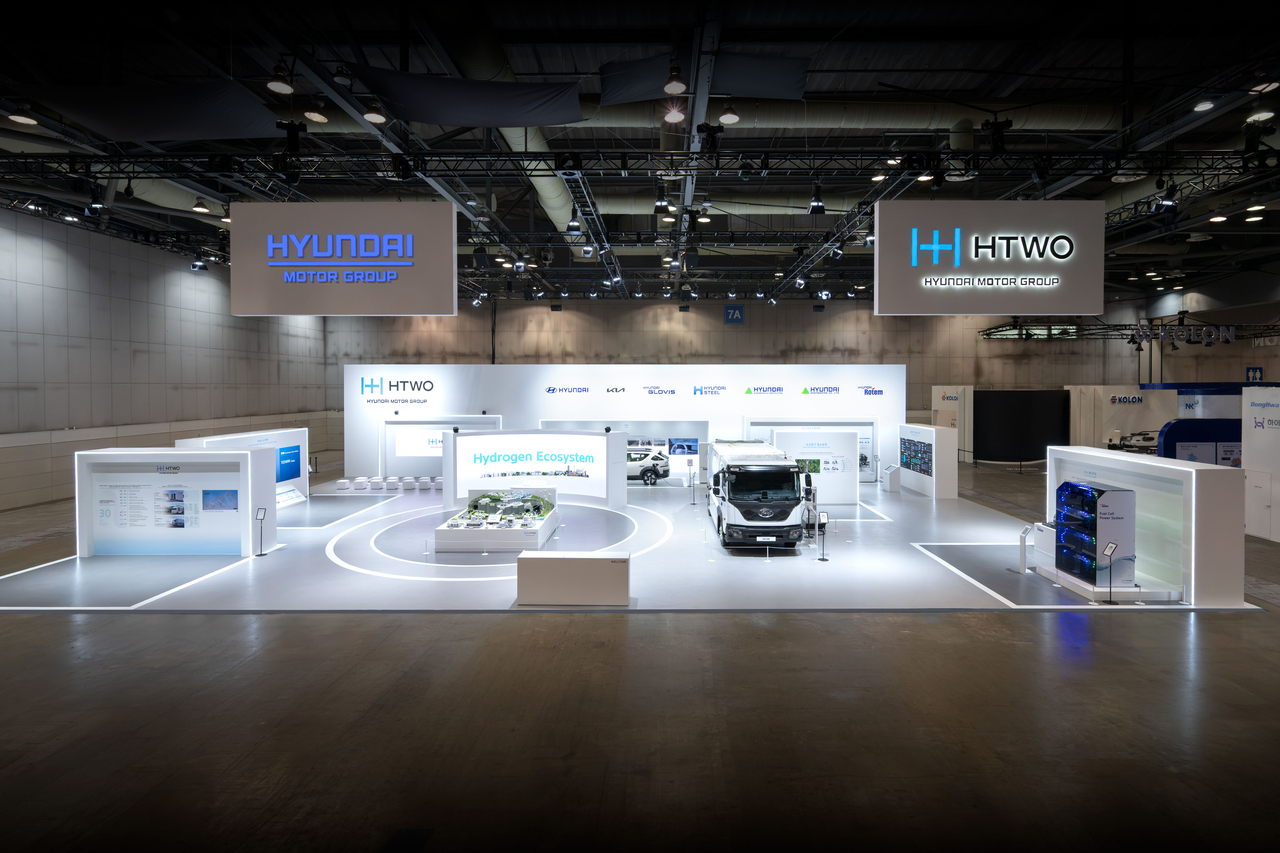
Hyundai Motor Group has publicly unveiled for the first time a 5-megawatt electrolyzer stack module configuration capable of producing about 700 tons of hydrogen a year. The group is also presenting a commercial-vehicle fuel cell system and an automatic hydrogen charging robot as it moves to accelerate its expansion across the broader hydrogen ecosystem.
Hyundai Motor Group said Wednesday it is participating in the World Hydrogen Expo 2026 (WHE 2026), a three-day event running through Friday at Kintex Exhibition Center Hall 2 in Goyang, Gyeonggi Province, where it is presenting an integrated hydrogen solution linking production, mobility, and industrial and urban infrastructure.
Vice Chairman Jang Jae-hoon visited the venue Wednesday, touring the group's exhibition pavilion and the booths of major participating companies to review hydrogen-related technologies and the progress of ongoing projects.
Hyundai Motor Group has set up a 720-square-meter exhibition space at the event, covering everything from hydrogen production technology to hydrogen-powered vehicles and railways, and a city model that combines hydrogen production and utilization facilities.
The centerpiece is the group's technology for scaling up hydrogen production facilities. Hyundai Motor Group made its first public showing of a 5MW electrolyzer stack module (ESM) configuration based on proton exchange membrane (PEM) electrolysis technology.
Electrolysis uses electricity to split water into hydrogen and oxygen. The PEM method uses a polymer membrane as the electrolyte during the water-splitting process. Using power generated from renewable energy can reduce carbon emissions in the hydrogen production process.
The ESM bundles 12 electrolysis stacks into a single module. One 5MW module can produce about 700 tons of hydrogen per year. Connecting multiple modules in series allows the system to scale up into a large-scale electrolysis plant in the hundreds-of-megawatts range.
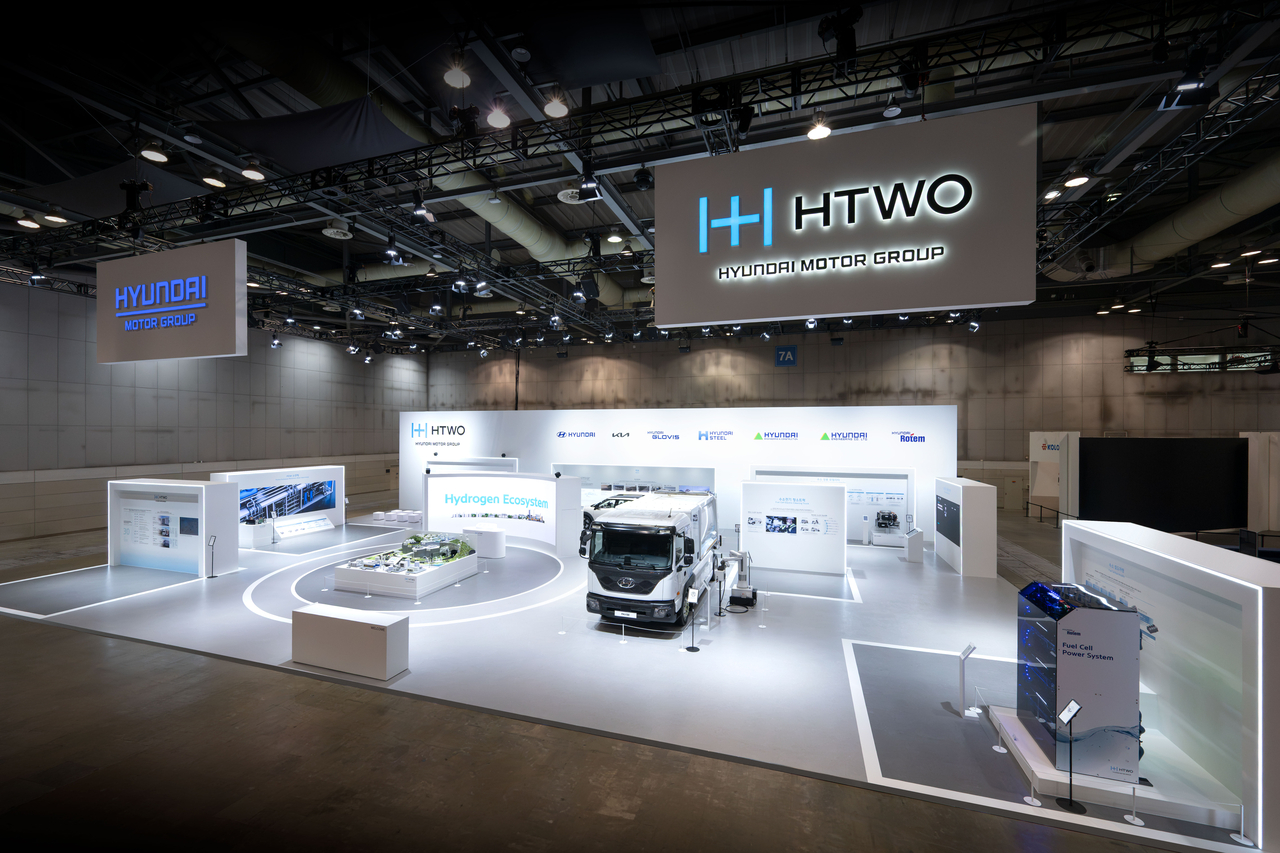
In hydrogen mobility, the group is presenting a range of products spanning passenger cars, commercial vehicles and railways.
Alongside the 2027 Nexo, the group made its first public showing of a commercial-vehicle fuel cell system with improved durability for long-distance operation. On the railway side, a hydrogen-electric locomotive model and a flat-type fuel cell module were on display, illustrating the potential for hydrogen use in rail transport.
A test-drive program is also available for visitors to experience hydrogen commercial vehicles firsthand. Wednesday and Thursday, attendees can ride the Universe hydrogen electric bus — an upgraded model with improved product quality — and the new Xcient hydrogen electric truck.
The group is also unveiling the Elec City hydrogen electric low-floor wide-area bus, a model under development with accessibility in mind. Designed to meet the mandatory introduction of low-floor wide-area buses in 2027, the vehicle is open for visitors to board and inspect the interior.
The group is also showcasing technologies aimed at improving the efficiency of vehicle operation and refueling.
BlueLink Uptime Care, an integrated fleet management system for hydrogen commercial vehicles, analyzes real-world driving data to reduce downtime caused by breakdowns or maintenance.
An automatic charging robot for hydrogen fuel cell vehicles (ACR-H) is also being demonstrated. The robot uses vision AI technology to locate a vehicle's hydrogen inlet, open the protective cap and connect the charging connector. At the venue, the automated charging process is demonstrated on a hydrogen electric street-sweeper truck.
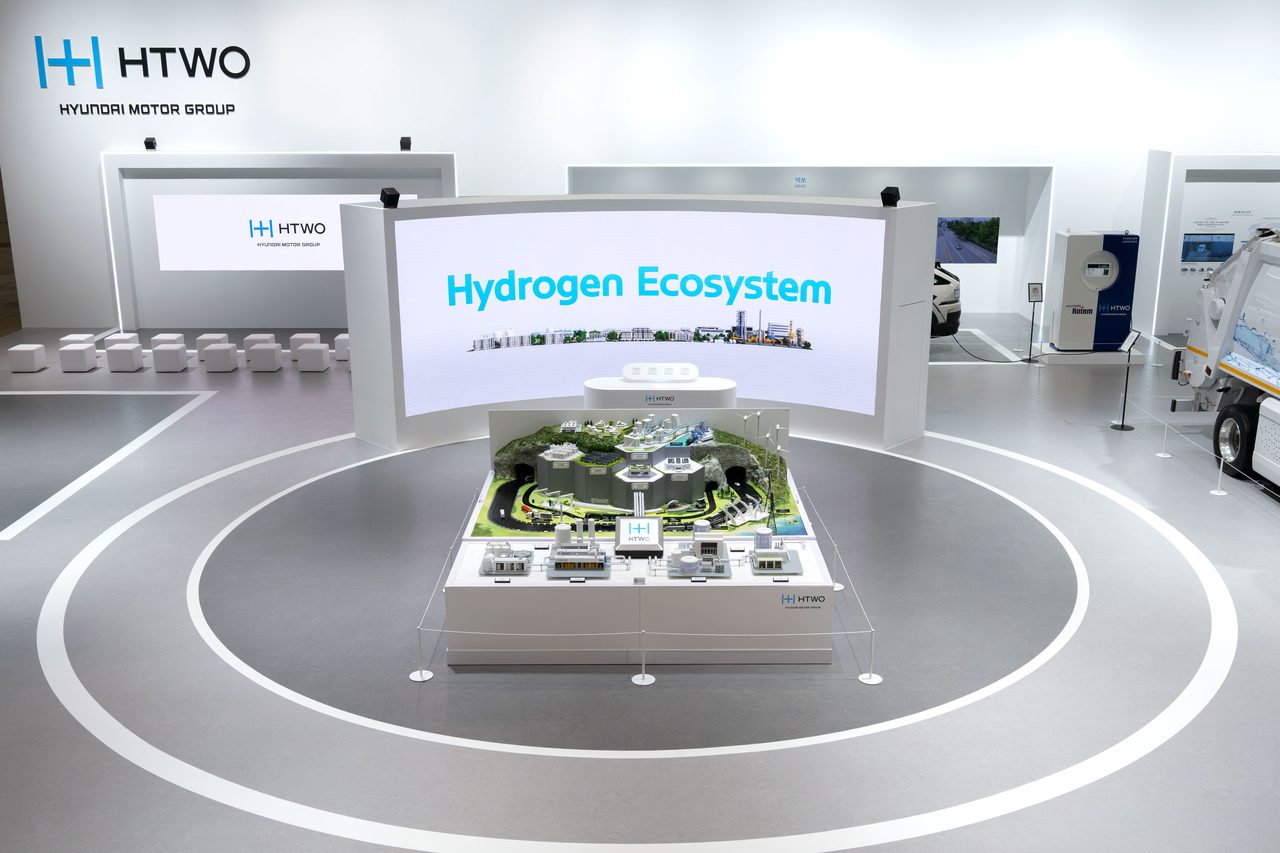
The group also presented a vision for a future city that integrates hydrogen production and utilization within a single industrial complex.
A prime example is the AI Valley project in Saemangeum, North Jeolla Province. Hyundai Motor Group rendered its vision of a future industrial city — linking renewable energy generation facilities, an electrolysis plant, AI data centers and robot manufacturing factories — in a scale model.
The concept ties directly into the group's 9 trillion won ($6.71 billion) investment plan for Saemangeum. On Thursday, Vice Chairman Jang held a site briefing at Saemangeum where he outlined plans to develop an industrial hub combining AI data centers, robot manufacturing facilities and hydrogen production facilities.
The following day, the group announced a concrete timeline: two special purpose companies (SPCs) to handle the AI data center project will be established in November, with groundbreaking set for March 2027. Hyundai Motor Group plans to invest 1 trillion won in building an electrolysis plant at Saemangeum.
At the exhibition, the group also unveiled hydrogen utilization scenarios tailored to different sectors — urban residential, port logistics and manufacturing industry. The vision goes beyond hydrogen production to building supply and utilization facilities matched to regional demand.
Alongside the exhibition, an HTWO Academy is being held at the venue. Hyundai Steel, Hyundai Rotem and Hyundai Motor Group's HMG Construction Technology Research Institute will present updates on hydrogen technology development and project progress and share examples of collaboration.
The group is also taking part in the Global Hydrogen Industry Conference on the opening day of the event. Ivana Jemelkova, CEO of the Hydrogen Council, will present on the progress of global hydrogen projects and the investment outlook, while Hyundai Motor Group and other major domestic companies are set to discuss expanding investment in the hydrogen industry and avenues for international cooperation.
"At this exhibition, we will introduce the group's integrated hydrogen solutions — from production to mobility and applications in urban and industrial sectors — and broaden opportunities for cooperation with customers and partners," a Hyundai Motor Group official said. "Building on our hydrogen production capabilities, we will identify diverse applications, provide solutions optimized across the entire value chain, and translate them into tangible business outcomes."
kwater@heraldcorp.com