Current system linking grants to domestic taxes would be kept under proposal
Two-thirds of increases above 5% would go to national future investment
One-third of decreases above 5% would be covered by the state
Superintendents seek guarantee of 11.7 trillion won in this year's settlement funds
South Korea's regional school superintendents have proposed keeping the current system that ties local education finance grants to domestic tax revenue, while offering to channel surplus funds into national future investment when grants grow sharply — a compromise floated ahead of next year's budget deliberations.
The Korea Superintendents Association held a press conference at the National Assembly communications room Wednesday and unveiled what it called an "education finance coexistence plan." The core of the proposal is to retain the existing formula allocating 20.79 percent of domestic tax revenue to education grants while reducing the volatility those grants experience as tax receipts fluctuate.
Under the plan, if grants rise more than 5 percent from the previous year, two-thirds of the amount exceeding that threshold would be set aside as a national future-response fund. Conversely, if grants fall more than 5 percent from the previous year, the state would cover one-third of the portion exceeding that decline.
The association said applying this formula would put 2027 education grants at roughly 89.6 trillion won ($66.8 billion), enough to meet the 88.4 trillion won minimum that regional education offices have identified as necessary. It also estimated the arrangement would generate about 44.5 trillion won in national future-response funds over the four years from 2027 to 2030.
The association put forward the plan as an alternative after the government signaled it wanted to scrap the domestic-tax linkage entirely. The superintendents said they recognize the need for national future investment but oppose raising those funds by dismantling the foundation of education finance.
According to the association, the 16 regional education offices nationwide expect a combined shortfall of 7.37 trillion won when drawing up their base budgets for 2027. "Even as student numbers fall, the basic costs of running schools remain," the association said. "Essential education needs — guaranteeing foundational academic skills, special education, and student mental health support — are not shrinking either."
The association also raised a fairness concern relative to local allocation tax. "The government intends to keep the domestic-tax linkage for local allocation tax while abolishing it only for education grants," it said. "The stability of education finance must be guaranteed just as local government finance is."
The association further demanded that the government guarantee 11.7 trillion won in grant settlement funds estimated to arise from this year's increase in tax revenue. It said any legislation restructuring the system must explicitly require that amounts owed to education under current law be settled even if funds are moved to a national account in the process.
The association urged the National Assembly to conduct a thorough review. "The essence of our coexistence plan is to share the gains when grants grow substantially and to share the burden when they fall sharply," it said. "Teaching and caring for children in schools is itself an investment in the nation's future, and we ask the government and the National Assembly to actively consider alternatives that can achieve both stable education finance and national future investment."
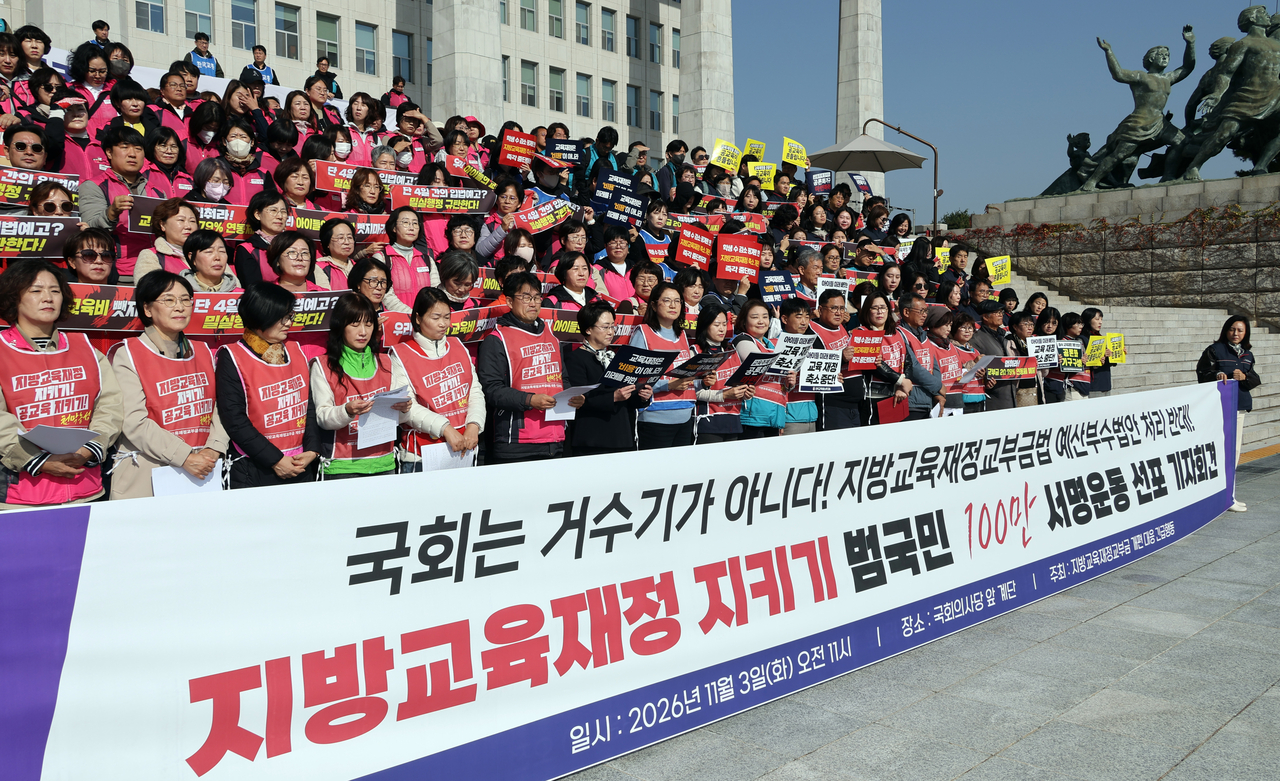
Meanwhile, an emergency coalition of 408 organizations opposing changes to the local education finance grant system held a press conference outside the National Assembly on Tuesday, calling for the withdrawal of a bill to amend the education grants law and for a halt to its processing as a budget-linked measure. "The government contradicts itself by telling educators that funding will increase while simultaneously touting grant reductions as a spending-efficiency achievement," the group said, demanding that the bill's budget-linked processing be stopped.
brunch@heraldcorp.com