EY-Parthenon CEO Outlook survey: 56% plan M&A, 58% weigh divestitures within 12 months
Korean firms sharpen focus on core businesses by shedding non-essential assets
South Korean CEOs are simultaneously pursuing mergers and acquisitions and divestitures to reshape their business portfolios amid mounting uncertainty, according to new survey data. The trend reflects a broader push to shed non-core assets and concentrate resources on high-growth businesses, while AI is being rapidly adopted to accelerate deal-making and due diligence.
EY Han Young, the Korean arm of the global accounting and consulting firm EY, released the results of its EY-Parthenon CEO Outlook survey Tuesday, which polled 1,200 CEOs across 21 countries including South Korea.
The survey found that 56% of Korean CEOs plan to pursue M&A within the next 12 months, while 58% said they are considering divestiture-related transactions. Analysts see the figures as evidence that companies are not merely seeking to expand in scale but are actively restructuring their business mix to secure new growth engines. Compared with the same survey conducted in May, the share planning M&A rose 12 percentage points and those considering divestitures climbed 16 percentage points.
Particularly striking was the appetite for carve-outs and partial divestitures: 16% of Korean CEOs said they plan to spin off or partially sell a business unit, more than double the global average of 7% and a roughly eightfold jump from the 2% recorded in the May survey. The data underscores a clear shift toward shedding non-core operations and channeling capital into strategic areas that will drive future growth.
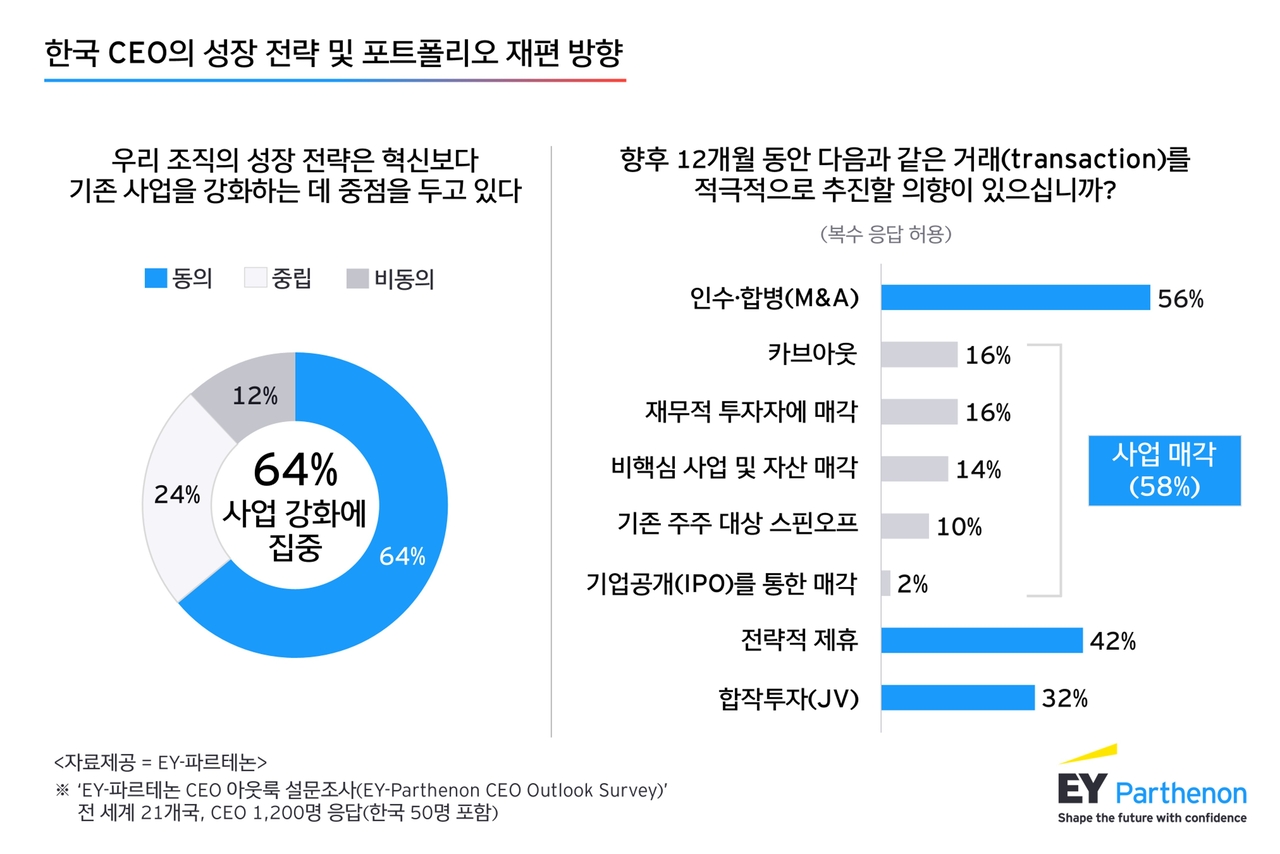
The same cautious orientation showed up in growth strategy priorities. Some 64% of Korean CEOs said their organization's growth strategy places greater emphasis on strengthening existing businesses than on bold innovation — a figure broadly in line with the global CEO average of 69%.
When asked about the biggest challenges in executing divestitures, 40% of Korean CEOs cited inadequate preparation for buyer due diligence, while 32% pointed to balancing deal speed and cost management with maximizing sale value. The findings suggest that as portfolio restructuring through divestitures becomes more widespread, thorough pre-deal preparation and precise execution management are growing in importance.
AI adoption in deal evaluation is also expanding rapidly. Some 96% of Korean CEOs said they have piloted or are actively using AI during the deal assessment phase. Of those, 32% said AI is now embedded in most of their deal evaluation work — 20 percentage points above the global average of 12%.
Financial analysis and valuation was the most common application, cited by 58% of Korean CEOs. This was followed by risk assessment and compliance review (48%), synergy identification and value creation planning (42%), and market and competitive landscape analysis (42%). Some 35% of Korean CEOs also said they use AI for commercial due diligence — assessing a target's business viability and market potential — outpacing the global figure of 25%.
Expectations for AI also diverged between Korean and global respondents. Some 46% of Korean CEOs said the biggest benefit they expect from AI is shortening deal execution and due diligence timelines, compared with 35% globally, reflecting a stronger emphasis on deal speed. Global CEOs, by contrast, were more focused on value creation and strategic decision-making, with 45% prioritizing early value identification in divestitures and 41% citing faster and more accurate decision-making.
"The greater the management uncertainty, the more companies must keep both acquisitions and divestitures on the table, continuously reviewing their portfolios to concentrate capital and capabilities on core businesses and future growth," said Gil Tae-min, EY-Parthenon partner and head of the M&A Solutions Group. "AI adoption must also evolve beyond simply speeding up transactions — it should be directed toward identifying value creation opportunities earlier and improving the quality of investment decisions."
Meanwhile, EY Han Young — which combines the Han Young accounting firm and EY Consulting — posted combined sales of 798.4 billion won ($595 million) for its most recent fiscal year running from July 2025 to June 2026, up 4.4% from the prior year. Operating profit surged 30.1% to 18.1 billion won, marking a notable improvement in profitability.
an@heraldcorp.com