Hyundai Motor, which climbed as high as third in Kospi market capitalization earlier this year, has slid to eighth amid a string of headwinds including a slowdown in the auto sector, rising raw materials prices and exchange rate pressures. A sharp rebound in the rankings is far from certain, but the combination of government and National Assembly policy support and the stock's undervaluation appeal is drawing attention to whether the automaker can lay the groundwork for a comeback. Some market watchers say Hyundai Motor could rejoin the race for a top-three market cap position if it defends profitability in its core auto business and revives momentum in future ventures.
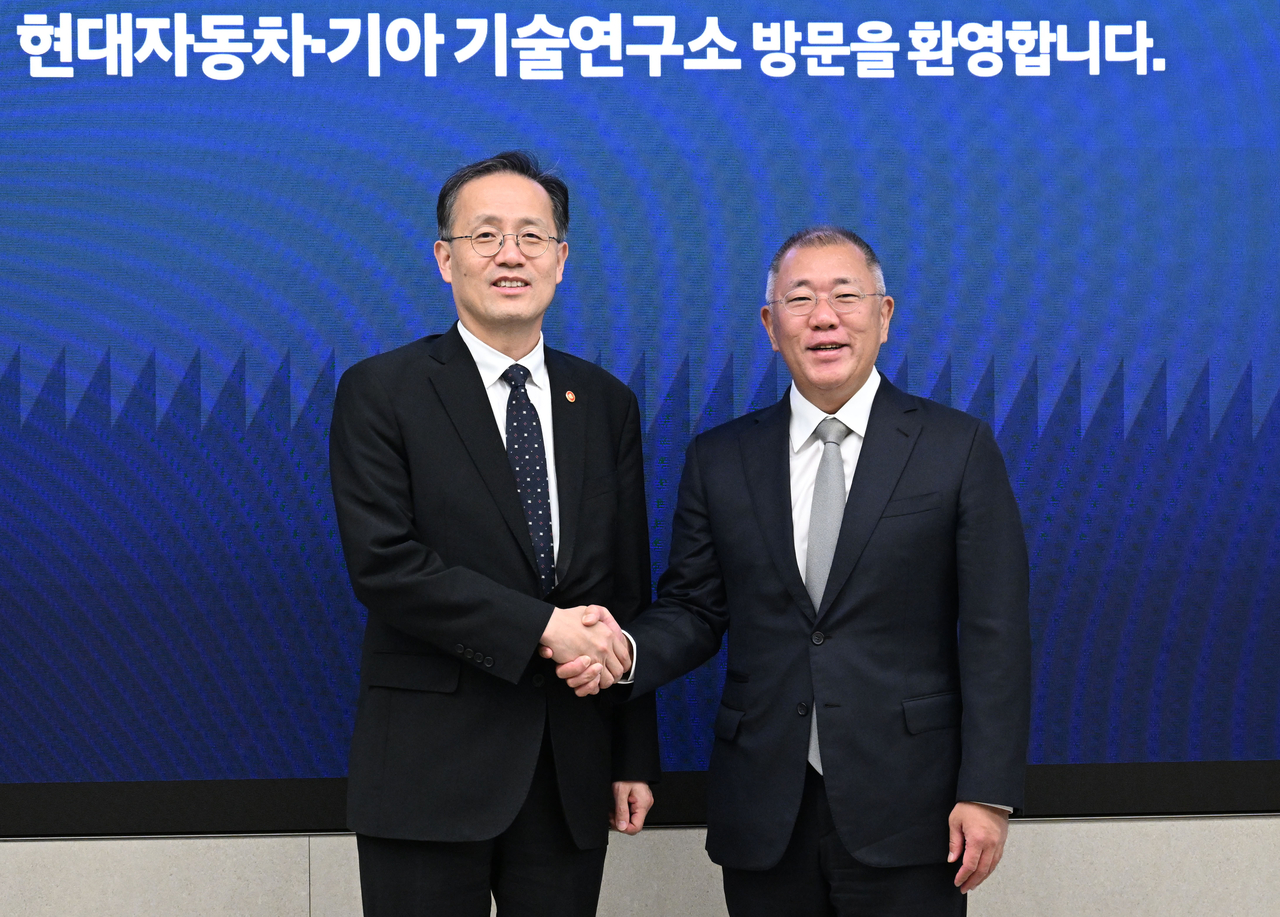
Deputy Prime Minister and Minister of Economy and Finance Lee Hyung-il visited Hyundai Motor and Kia's technology research center in Hwaseong, Gyeonggi Province, on Monday to hold an industry roundtable on strengthening the competitiveness of the electric vehicle sector, according to industry sources Tuesday. At the meeting, Lee said the government would announce an "EV industry competitiveness enhancement plan" this month, centered on improving autonomous driving technology and expanding research and development of key components and technologies.
In its tax reform package announced in August, the government created a new domestic production tax credit that reduces taxes based on output at home, but excluded the EV industry from its scope. Industry players have been vocal in calling for EVs to be added to the eligible categories, and attention is focused on whether the forthcoming plan will address that demand.
Nineteen lawmakers from both the ruling and opposition parties — including Democratic Party lawmaker Yun Hu-deok and People Power Party lawmaker Yun Han-hong — jointly submitted an amendment to the Special Tax Treatment Control Act. The bill would expand the eligible categories for tax deductions from six to seven by adding electric vehicles, and broaden the basis for calculating deduction limits. With competition intensifying in global markets amid an aggressive overseas push and price offensive by Chinese EV makers, investor sentiment toward Hyundai Motor is expected to hinge on the government's forthcoming plan and whether the legislation passes.
Hyundai Motor's share price has had a turbulent ride this year. Starting the year ranked sixth in Kospi market cap, the automaker surged to third — behind only Samsung Electronics and SK hynix — on Jan. 19, buoyed by its future vision around robotics and physical AI.
The stock then lost ground after LG Energy Solution overtook it in late March. It fell to fifth by late April, seventh by late August, and slipped to eighth this month. Hyundai Motor's share of total Kospi market capitalization dropped to 1.11 percent as of Monday. The share price is down 63.3 percent from its intraday high of 783,000 won ($584) recorded on June 1. Foreign investors have net sold 11.365 trillion won worth of shares so far this year, pulling the foreign ownership rate down to 24.05 percent from 35.97 percent at the start of the year.
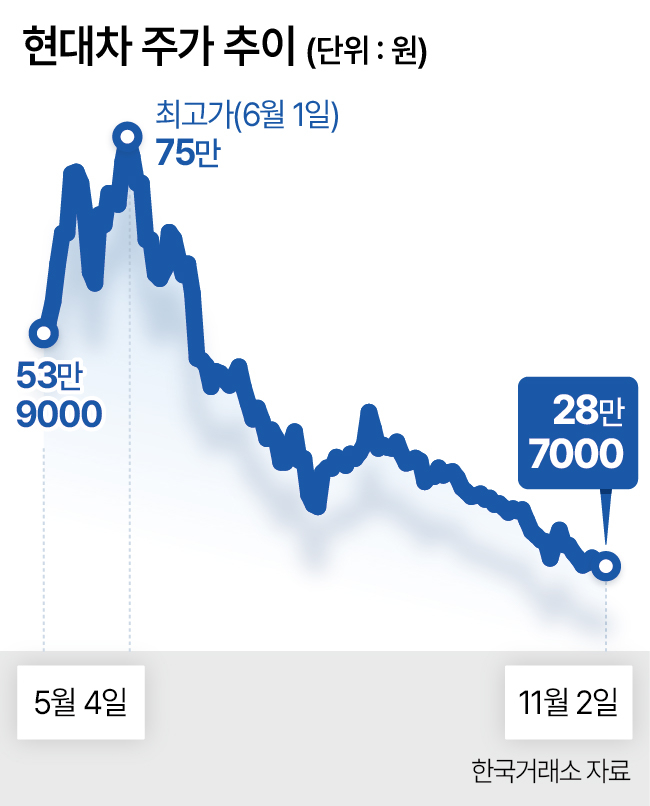
The pressures stem from a combination of factors: a stronger won and rising materials costs weighing on margins, and production disruptions caused by a parts supplier fire and a partial union strike. Aggressive overseas expansion and price competition from Chinese EV makers are also squeezing the profitability of traditional original equipment manufacturers in global markets. While near-term headwinds dominate, some analysts see room for the stock to return to market leadership, citing its valuation appeal and medium-to-long-term fundamentals.
Hana Securities, in a recently published research note titled "2027 Stock Market Outlook and Strategy," named autos and pharmaceuticals and biotech as the leading sectors for the second half of next year. "A battle for third place in market cap is expected between Samsung Biologics, a long-underperforming stock, and Hyundai Motor, which is expected to see its return on equity rise but has a relatively low price-to-book ratio," said Lee Jae-man, a researcher at Hana Securities.
Based on Hana Securities estimates, Hyundai Motor's projected ROE is expected to rise from 7.8 percent in 2026 to 8.02 percent in 2027, but its estimated PBR is projected to remain at 0.63 times in 2026 and 0.59 times in 2027 — levels that analysts say place the stock in deeply undervalued territory. The net profit growth rate for the auto sector is also forecast to improve from 1.1 percent in the first half of next year to 13.4 percent in the second half.
"The trend of improving product mix is expected to continue through the launch of major new models and the expansion of the electrification lineup in the second half," said Lee Hyeon-uk, a researcher at IBK Investment Securities. "Over the medium to long term, physical AI businesses including the expansion of robotaxi supply and the commercialization of Atlas are also proceeding as planned, so the ability to defend profitability in the core auto business and new business momentum remain intact despite a near-term slowdown in sales growth," Lee added.

jiyun@heraldcorp.com