135,441 deals recorded in Gyeonggi Province over the past year
Policy loans and semiconductor belt expectations fuel demand
Prices in Byeongjeom, Gwonseon breach 900 million won threshold
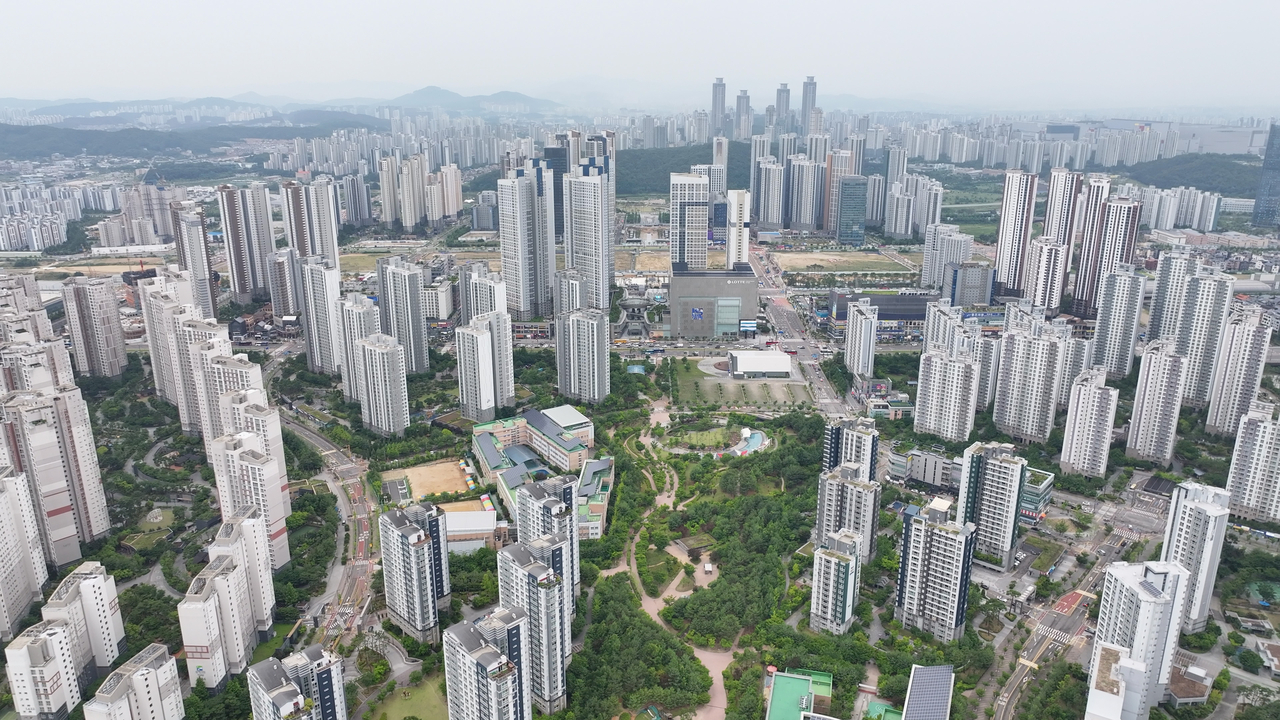
A working professional who recently had a child plans to use the newborn special preferential loan to purchase a home. The target area is the old downtown of Seongnam, Gyeonggi Province. With the policy loan available for homes priced at 900 million won or less, the buyer is eyeing a small apartment of about 56 square meters still available for 770 million won, factoring in both the reduced financial burden and future reconstruction potential.
Transactions involving apartments priced at 900 million won or less in Gyeonggi Province surged more than 20 percent over the past year compared with the previous year. Analysts attribute the increase to a combination of rising expectations for home price gains along the semiconductor industry belt in southern Gyeonggi Province and strong demand from end-users seeking to take advantage of policy financing products such as the newborn special preferential loan. That demand has helped sustain upward price momentum, while some complexes have begun crossing the 900 million won mark.
According to the Ministry of Land, Infrastructure and Transport's actual transaction price disclosure system, a total of 135,441 apartments in Gyeonggi Province changed hands at 900 million won or below in the 12 months through Monday — a 21.4 percent increase from the 111,563 transactions recorded in the same period a year earlier.
By contrast, transactions involving apartments priced at 900 million won or less in Seoul edged down 0.3 percent over the same period, from 30,984 to 30,877. While the mid-to-low-price apartment market in Seoul was essentially flat, buying activity in Gyeonggi Province expanded markedly in that price range.
Market observers see the trend as the result of rising home price expectations in southern Gyeonggi Province converging with end-user demand driven by policy loans. The development of semiconductor industrial complexes and anticipated investment expansion by related companies have spread housing demand from key areas in southern Gyeonggi Province to surrounding regions. Buyers looking to secure relatively affordable apartments before prices climb further have added to the momentum, analysts say, fueling activity in the mid-to-low-price segment.
Among the options drawing the most interest are homes priced at 900 million won or less that qualify for the newborn special preferential loan. The product is a policy financing instrument that supports home purchases by households without a home who have a child born on or after Jan. 1, 2023, including adopted children. It covers homes with an appraised value of 900 million won or less and an exclusive use area of up to 85 square meters — or 100 square meters in towns and villages — with a maximum loan limit of 400 million won.
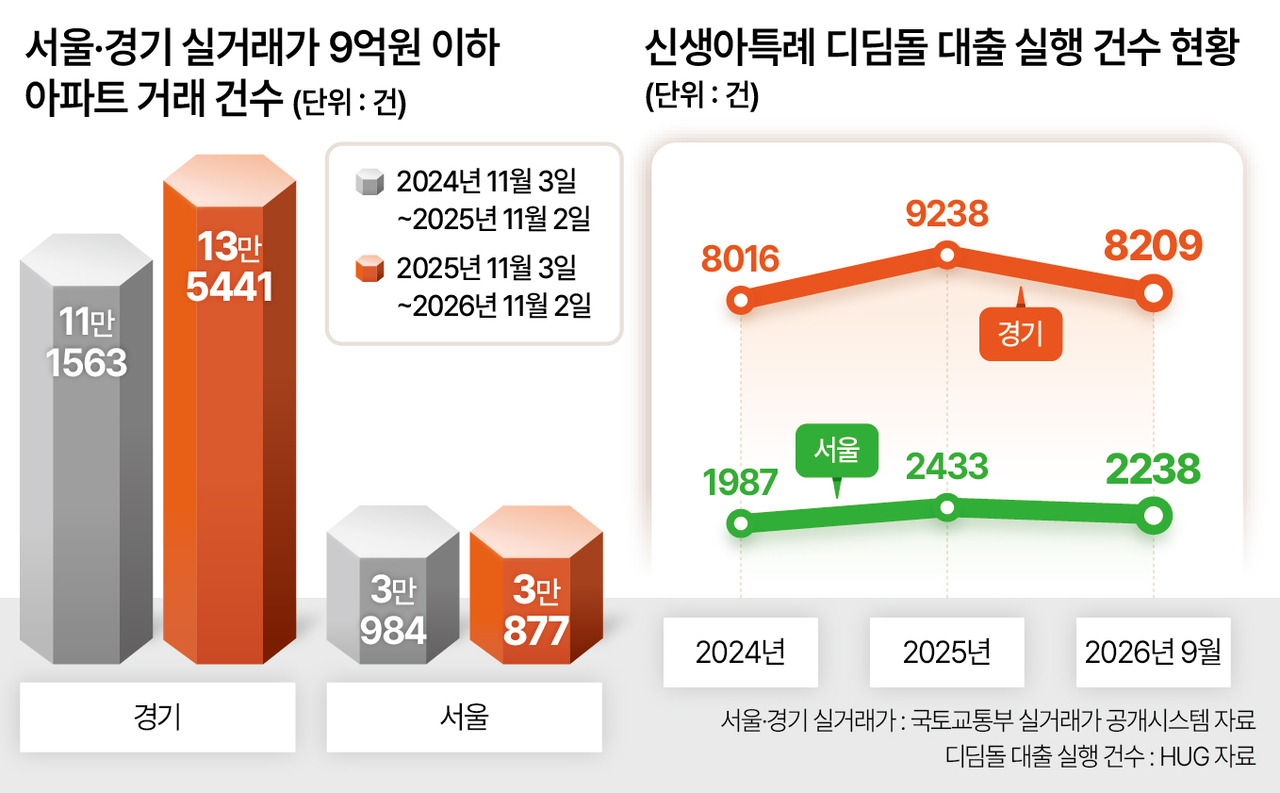
According to the Korea Housing and Urban Guarantee Corporation, a total of 8,209 newborn special Didimdol loans were disbursed in Gyeonggi Province through the end of September this year, reaching 88.9 percent of the 9,238 loans issued throughout all of last year. With roughly three-quarters of the year elapsed, disbursements had already approached 90 percent of the prior year's full-year total.
The outstanding loan balance also stood at 2.61 trillion won as of end-September, equivalent to 85.9 percent of last year's full-year balance of 3.04 trillion won. The figures suggest that policy financing products, including the newborn special preferential loan, have become a primary funding tool for prospective homebuyers purchasing apartments in Gyeonggi Province.
The surge in policy loan disbursements has coincided with rising prices for apartments below 900 million won in southern Gyeonggi Province. The 84-square-meter unit at Byeongjeom Station iPark Castle in Hwaseong's Byeongjeom-gu traded in the 700 million won range as recently as June, when a ninth-floor unit sold for 770 million won, before climbing into the 800 million won range from September onward. The upward trend continued, and on Oct. 1 a 22nd-floor unit set a record high at 1.03 billion won.
The 84-square-meter unit at Hoban Verdi Um The Central in Suwon's Gwonseon-gu similarly traded between 778 million won and 880 million won through June, before crossing the 900 million won threshold in October with a 13th-floor unit changing hands at 945 million won.
Analysts also say the price rally in southern Gyeonggi Province could spread further into surrounding mid-to-low-price markets. The government's Aug. 13 measures eased income requirements for newlywed couples seeking Didimdol and Biteomok loans from the National Housing and Urban Fund, a move analysts say could draw demand into the sub-600 million won segment as well.
To address what had been called the "newlywed penalty," the government on Oct. 19 relaxed the income threshold so that couples in which one spouse earns less than 60 million won annually can now access Didimdol and Biteomok loans. With the pool of policy loan beneficiaries expanding, analysts expect buying demand to increase in relatively lower-priced areas and complexes, potentially narrowing price gaps between neighboring districts in what the market calls "price alignment."
"Demand for homeownership through policy loans appears to be spreading beyond Seoul to the broader metropolitan area and regional cities, particularly among newlyweds and one- or two-person households," said Nam Hyeok-woo, a real estate researcher at Woori Bank. "Since policy loans offer more favorable interest rates and higher loan limits than conventional mortgage products, there is a strong likelihood that end-user buying will continue to flow steadily into areas and apartments priced within the range accessible through these products."
hss@heraldcorp.com