Democratic Party calls future reserve fund 'efficient tool'
PPP warns it bypasses fiscal controls
Experts divided on the measure
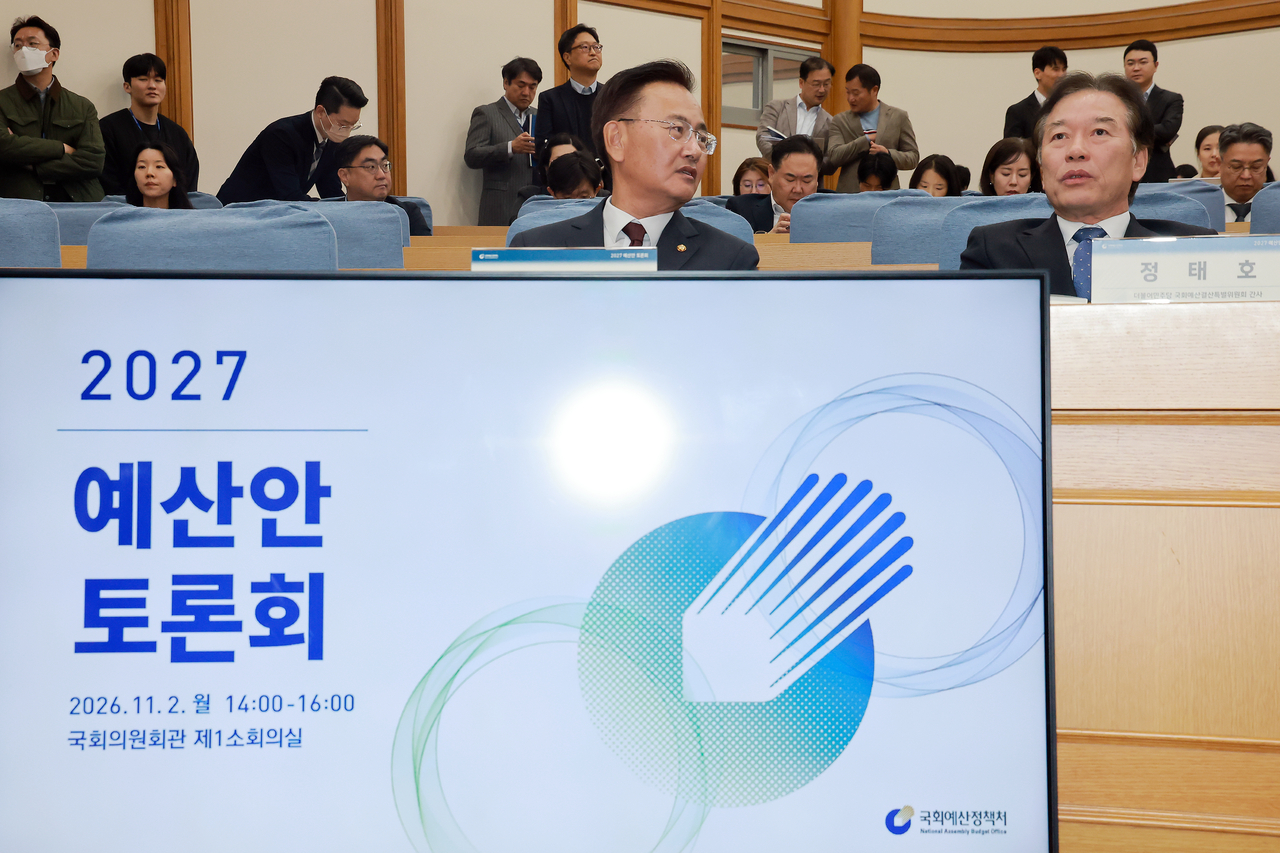
The ruling and opposition parties traded sharp words at a forum organized by the National Assembly Budget Office ahead of the legislature's review of next year's budget proposal.
The Democratic Party of Korea defended the government's roughly 820.9 trillion won ($614 billion) budget plan as "a safety net for the future," while the People Power Party criticized it as "populist, bloated spending."
Jung Tae-ho, a Democratic Party lawmaker who leads his party's side on the Budget and Accounts Committee, said the budget was guided by a commitment to "expanding future growth engines and easing inequality and polarization," adding that the plan placed significant emphasis on securing fiscal soundness.
"This year and next year, tax revenues are coming in strong — we could spend a lot, or we could pay down debt," Jung said. "But shouldn't we be building a safety net for when the economy slows and revenues shrink?"
People Power Party lawmaker Yoo Sang-beom, who leads his party's side on the committee, pushed back, warning that "reckless spending expansion riding a temporary tax windfall threatens fiscal sustainability." He also argued that the budget, including so-called blank-check spending and fund projects, was "seriously hollowing out the National Assembly's constitutionally guaranteed right to review the budget."
Yoo also took aim at increases in funding for state policy priorities, saying programs flagged for cuts or improvements in performance reviews were seeing their budgets multiplied simply because they carried administration-priority status. "There is an urgent need to rein in the notion that state policy priorities are a cure-all, and to overhaul inefficient spending," he said.
The sharpest exchange centered on the proposed future response fund, valued at roughly 162 trillion won.
Jung argued the fund had been recognized as necessary "from the perspective of how to manage temporarily increased revenues," and said the IMF, the OECD and international rating agencies had assessed it as "a very good and efficient tool."
Yoo rebuffed that characterization, calling the future response fund "not a reservoir for future generations, but a means of bypassing fiscal controls." He vowed to push through institutional safeguards that would sharply reduce the share of fund assets the government can manage at its own discretion without a National Assembly vote — currently set at 30 percent.
Experts at the forum were also divided over the fund.
Lee Jeong-hyeok, a professor at Hongik University's Department of Economics, argued that beyond the philosophical question of expanding the central government's role and discretion, the fund "conflates two fundamentally different mechanisms — an investment platform and a fiscal stabilizer — within a single framework." He said the right approach was to treat the issue as a matter of institutional reform to respond to rapidly changing fiscal conditions.
Kim Dae-jong, a professor at Sejong University's School of Business Administration, took a more critical view. "The surest way to help future generations is to leave them with less national debt," Kim said. "A massive increase in fiscal spending and the creation of the future response fund are not the right direction. Rather than setting aside 106 trillion won in reserves, the government should be paying down national debt."
Meanwhile, National Assembly Speaker Jo Jeong-sik said in a congratulatory address that "there is no ruling party or opposition party when it comes to preparing for South Korea's future, improving people's lives and restoring livelihoods." He pledged to do his utmost to support a smooth budget review and ensure the budget is passed within the legally mandated deadline.
notstrong@heraldcorp.com