Greenbelt rules loosened for greater Seoul while provinces remain restricted; governor calls for action on Bujeon-Masan rail link and Gadeok airport
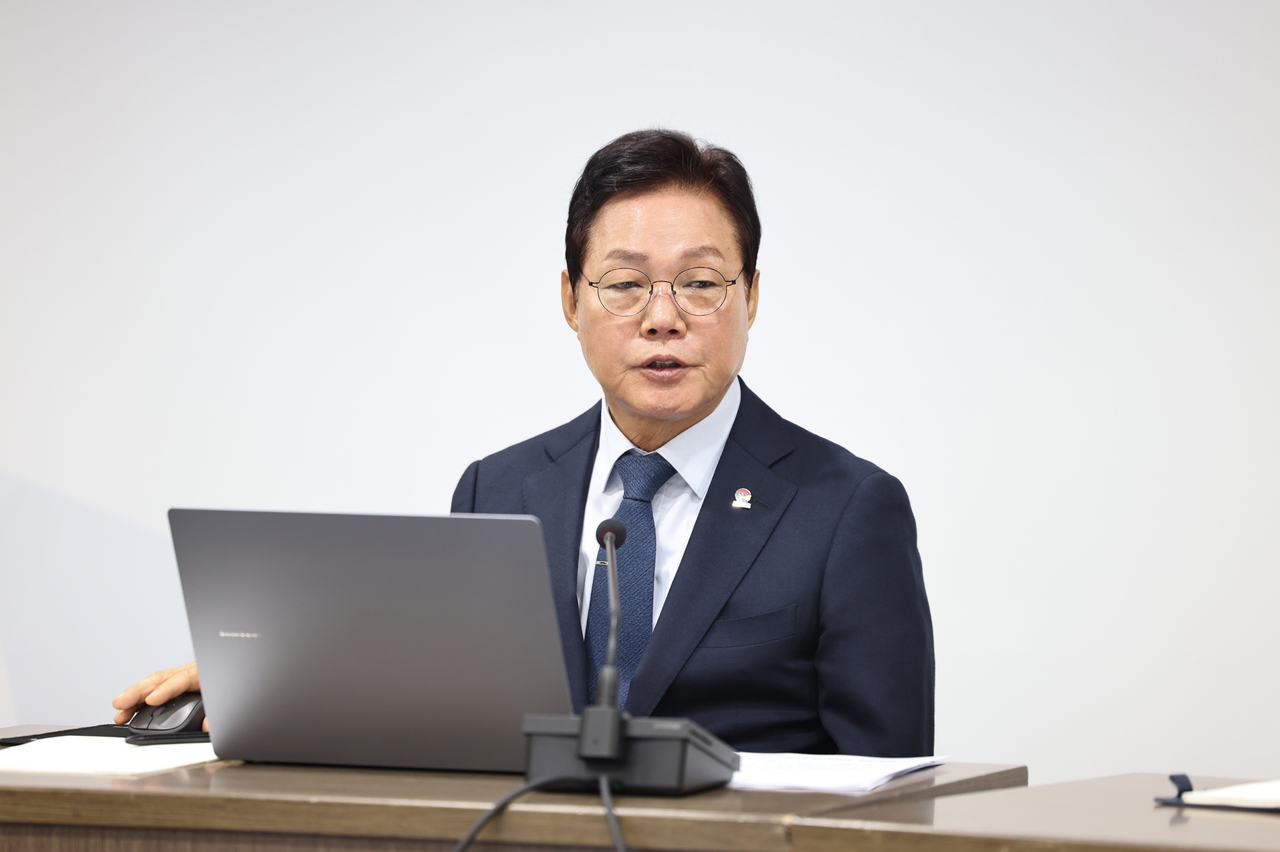
South Gyeongsang Province Governor Park Wan-su on Monday sharply criticized the central government's Seoul-centric policies and its passive support for regional development, urging the full-scale introduction of effective preferential measures for non-metropolitan areas.
Speaking at an expanded executive meeting at the provincial government office that morning, Park said the government talks up region-led growth but that actual policies either increase the fiscal burden on local governments or ease regulations only in the greater Seoul area.
Park took particular aim at what he called the irrationality of development regulations and real estate policy. "The greater Seoul area is expanding housing supply by lifting greenbelt restrictions, while regions facing population decline cannot even contemplate having their greenbelts released," he said. He added that market conditions differ starkly between the two: while rising housing prices are the problem in the capital region, provincial areas are suffering from a prolonged buildup of unsold units. "The central government's real estate and development policies are turning a blind eye to the realities of the regions," he said.
Park also pressed hard for reforms to the way local finances are managed. Available local revenue is shrinking, he said, while centrally driven projects such as a basic rural income program are piling up matching-fund obligations on local governments. He criticized the resulting structural contradiction and instructed provincial officials to actively petition the Ministry of Interior and Safety to ensure that its proposed "regional preference index" translates into a meaningful increase in the national government's share of state-subsidized project costs.
Park also called on the government to make responsible decisions on major pending issues in the Yeongnam region. He noted that the Bujeon–Masan double-track railway has yet to open despite massive budget outlays, and that construction of Gadeok New Airport has been delayed even though the need for it was raised more than 20 years ago. He further argued that Gimhae Airport, which serves 8 million Yeongnam residents, is already at capacity, yet facility improvements are being blocked on the grounds that Gadeok New Airport is under development. He called for swift infrastructure expansion and measures to ease passenger inconvenience.
South Gyeongsang Province plans to formalize the reform proposals raised at the meeting and submit them officially to central government ministries, while also pressing ahead with efforts to secure its own sources of growth.
Building on two consecutive years of attracting more than 10 trillion won ($7.48 billion) in investment, the province said it will focus on drawing companies in future industries — including aerospace, small modular reactors and physical AI — while accelerating AI-driven transformation across public services such as transportation, culture, healthcare and disaster management through the launch of an AI-based integrated welfare platform, with the aim of making improvements tangible to residents.
ook967@heraldcorp.com