Starting Monday, a "low-PBR (price-to-book ratio)" tag will appear next to the stock tickers of companies including Hanwha Life Insurance, Hyundai Steel and Lotte Shopping. Korea Exchange published, for the first time, a list of 151 listed companies that have languished in undervalued territory for an extended period while doing little to support their share prices.
Expectations are growing that companies will accelerate shareholder returns — through higher dividends and share buyback and cancellation — if only to avoid the public embarrassment. Investors, meanwhile, are busy sorting through the names to identify firms that will take genuine steps to improve corporate value, rather than simply buying cheap stocks. Some of the newly flagged companies saw their share prices surge in early trading Monday.
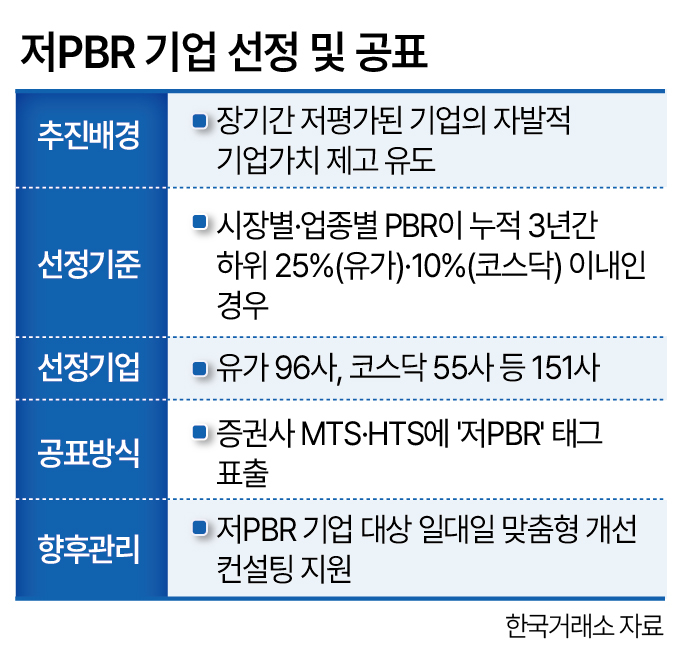
Korea Exchange released the list Sunday, naming 151 companies — 96 on the Kospi and 55 on the Kosdaq — whose price-to-book ratios have remained stuck near the bottom of their respective market and sector ranges for the past three years. The companies will be posted on KIND, Korea Exchange's listed-company disclosure system, from Monday until the next publication date of May 4 next year, and a "low-PBR" tag will also appear next to their tickers on brokerage mobile and desktop trading platforms. The exchange said the "naming and shaming" approach is intended to encourage companies to voluntarily improve their valuations.
PBR is calculated by dividing a company's market capitalization by its net assets, showing how a share price compares with book value. A ratio above 1 means the share price exceeds book value; a ratio below 1 means the stock is trading below even the company's liquidation value.
The list includes large companies with market capitalizations in the 2 trillion to 3 trillion won ($2.24 billion) range. While the average PBR of companies listed on domestic exchanges stands at around 1.8 times, Hanwha Life Insurance (0.27 times), Hyundai Steel (0.19 times), Lotte Shopping (0.17 times), E-mart (0.15 times) and Kolon (0.15 times) were all in a state of extreme undervaluation. As of 9:15 a.m. Monday, all of these companies' share prices were advancing. Hyundai Steel surged more than 8%, while Lotte Shopping and E-mart were each up more than 3%.
The exchange said its action is not aimed at penalizing companies simply for having a low PBR. The goal is to publicly identify companies that, despite prolonged undervaluation, have made no meaningful effort to improve shareholder value — through higher dividends, share buyback and cancellation, or better profitability — and thereby pressure them to change.
Industry watchers expect companies to step up their value-enhancement disclosures in a bid to shed the low-PBR label, accelerating shareholder returns and capital efficiency efforts. Na Seung-du, a researcher at SK Securities, said that because predicting share price movements is difficult, companies are likely to focus on improving the quality of the denominator — net assets. "There is a high probability this will lead to measures such as increased share buyback and cancellation or expanded dividends," Na said.
For investors, the publication of the list could be an opportunity to identify undervalued companies likely to follow through with stronger shareholder returns. Low-PBR stocks are generally seen as having significant upside potential because their share prices are cheap relative to their assets, but the risk of perpetual undervaluation due to deteriorating profitability also exists — making it essential to identify companies that actually have the capacity to act.
Lee Jae-mo, a researcher at independent research firm Aris, said investors should pay attention to companies that have not yet announced a value-enhancement plan but have maintained a low PBR for an extended period while holding ample tools — such as cash, treasury shares and idle assets — to act. "The core of an investment strategy using this policy is to assess in advance whether actions such as dividend expansion, share buyback and cancellation, non-core asset sales, return-on-equity improvement targets and governance restructuring are likely to materialize," Lee said.
Analysts advise that investors should ultimately focus less on whether a company made the list and more on the regulatory changes tied to subsequent value-enhancement disclosures. Kim Jun-seop, a researcher at KB Securities, said the development "will serve as an opportunity for investors to expand the basis on which they evaluate investment targets, centered on value-enhancement disclosures rather than on list inclusion itself."
Ryu Je-hyeon, a researcher at Mirae Asset Securities, said that while actual follow-through on value-enhancement disclosures is anticipated, investors should also watch the longer-term effects of related policy measures being pursued in parallel — including bear-hug acquisition proposals and a mandatory tender offer regime.
jiyun@heraldcorp.com