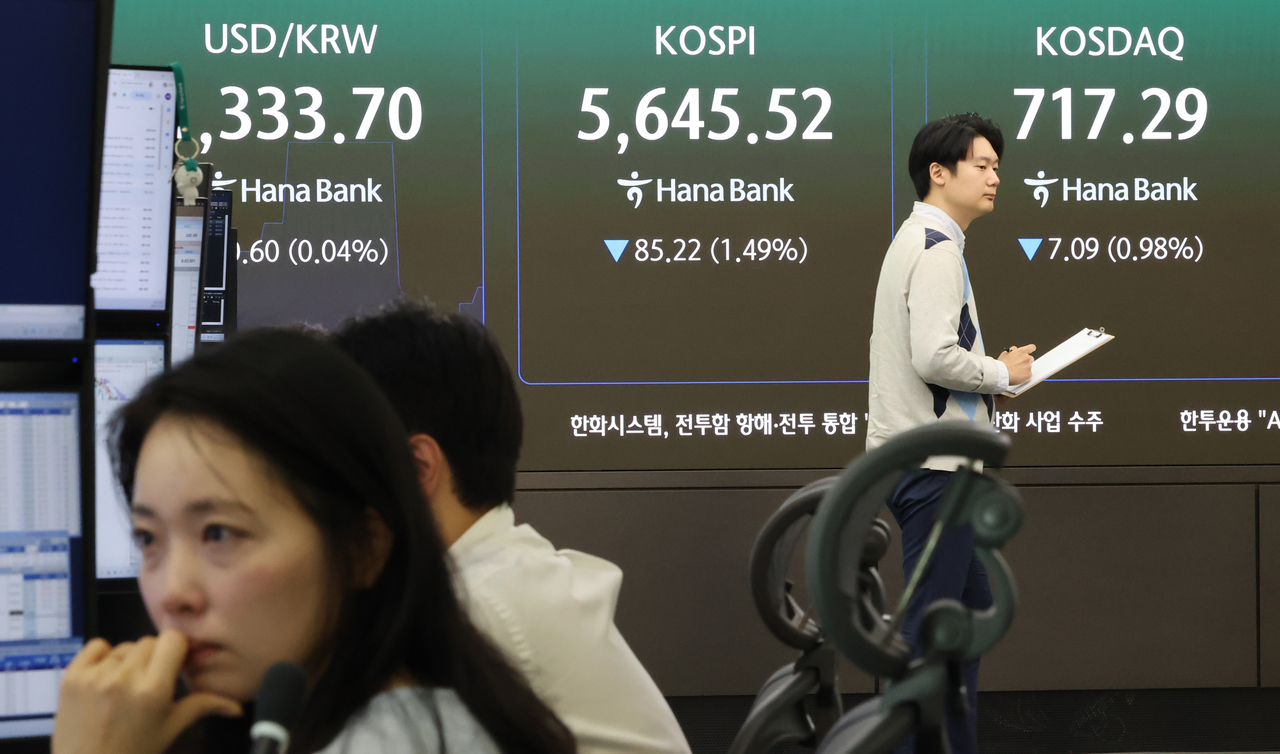
Expectations are growing that share buybacks by Samsung Electronics and SK hynix could support the market's downside, as both companies post record earnings and roll out large-scale shareholder return programs. However, analysts caution that the actual effect will vary depending on the scale and execution of the buybacks, and that headwinds from domestic equity fund redemptions and limits on further global IT sector weighting leave the prospect of a sustained rebound uncertain.
Financial investment industry watchers say shareholder return measures alone from Samsung Electronics and SK hynix — both of which have wrapped up record third-quarter earnings announcements — will have limited power to lift the broader market. SK hynix began an additional share buyback Thursday, but the total purchase volume has been cut in half compared with the previous round, and the amount to be canceled has been reduced to a quarter. Samsung Electronics, meanwhile, has more than two months before it is expected to announce further shareholder return measures.
SK hynix's second-round buyback is set at 20 trillion won ($15 billion), half the size of the first. The company plans to purchase 20 trillion won worth of its own shares by Jan. 28, but only 10 trillion won of that — the portion designated for shareholder returns — will be canceled, while the remaining 10 trillion won will be used for employee compensation. That contrasts with the previous 40 trillion won buyback, completed Thursday, which was canceled in full. The amount purchased on the first day of the new buyback was also only about a third of the roughly 1 trillion won per day seen during the earlier round.
"To gauge the market-boosting effect of a share buyback, you also need to look at the buyback period and the share of average daily purchases relative to total market trading volume," an analyst surnamed Kang said. "If the market secures enough liquidity to absorb buy and sell shocks, it will have a significant impact on share price volatility."
One positive factor is that lower trading volume could amplify the relative influence of the buyback. On Thursday, the first day of SK hynix's new buyback, Kospi trading volume fell to 12 trillion won — the lowest level of the year. That creates conditions in which purchases of even a few hundred billion won could meaningfully affect supply and demand dynamics.
The capacity for sustained shareholder returns is another positive. SK hynix's third-quarter profit surged 632 percent from a year earlier, and the company expanded long-term supply agreements with 14 clients. It has maintained a policy of returning more than 50 percent of free cash flow to shareholders. "If earnings continue to improve and free cash flow increases, the capacity for shareholder returns will be sustained," Kang said.
For Samsung Electronics, a key variable is how much of its total shareholder return budget will actually go toward buying common shares. The company decided Thursday to pay a third-quarter cash dividend of 4,601 won per share, totaling about 30 trillion won. Its remaining shareholder return budget is estimated at between 55 trillion won and 75 trillion won, but how much of that will be allocated to cash dividends versus share buyback and cancellation has not been disclosed.
"Even if Samsung Electronics carries out a large-scale shareholder return program, the effect on supporting the Kospi will differ depending on how much of the budget is directed toward buying common shares," Kang said. "It would not be appropriate to treat the entire remaining shareholder return budget of 55 trillion won to 75 trillion won as potential stock purchase demand."
Beyond individual company buyback programs, the broader market's capacity to absorb new supply is also a concern. A recent global trend toward reducing IT sector exposure is working against supply-demand conditions. The IT sector's share of global equity market capitalization has approached 30 percent, and there are concerns that Anthropic's listing in November could absorb a significant portion of any additional allocation.
"After the IT sector's share of global market capitalization approached 30 percent in June–July and again in September–October this year, large-scale selling followed both times, making it difficult to further increase IT exposure in the current environment," said Kim Seong-no, an analyst at BNK Investment Securities. "The valuation appeal of the Kospi and expectations for shareholder return policies are positive, but it is too early to expect a clear upward momentum."
With earnings and buybacks alone unlikely to drive a rebound, the investment community is watching closely for signs of improvement in foreign investor flows. "During the period when buybacks by Samsung and SK hynix exceeded foreign selling — from Aug. 24 to Oct. 6 — the Kospi rose 0.4 percent, but as buyback volumes declined and foreign selling intensified, downward pressure on the index quickly returned," said Han Ji-young, an analyst at Kiwoom Securities. "Share buybacks help ease downward pressure, but for a rebound to be sustained, semiconductor earnings forecasts need to be revised upward and foreign investor flows need to improve."
kacew@heraldcorp.com