From VR to AI: BIFAN structures creative filmmaking education beyond tool training
22 participants, including Korean Japanese children, complete two-day workshop and finish their own one-minute AI films
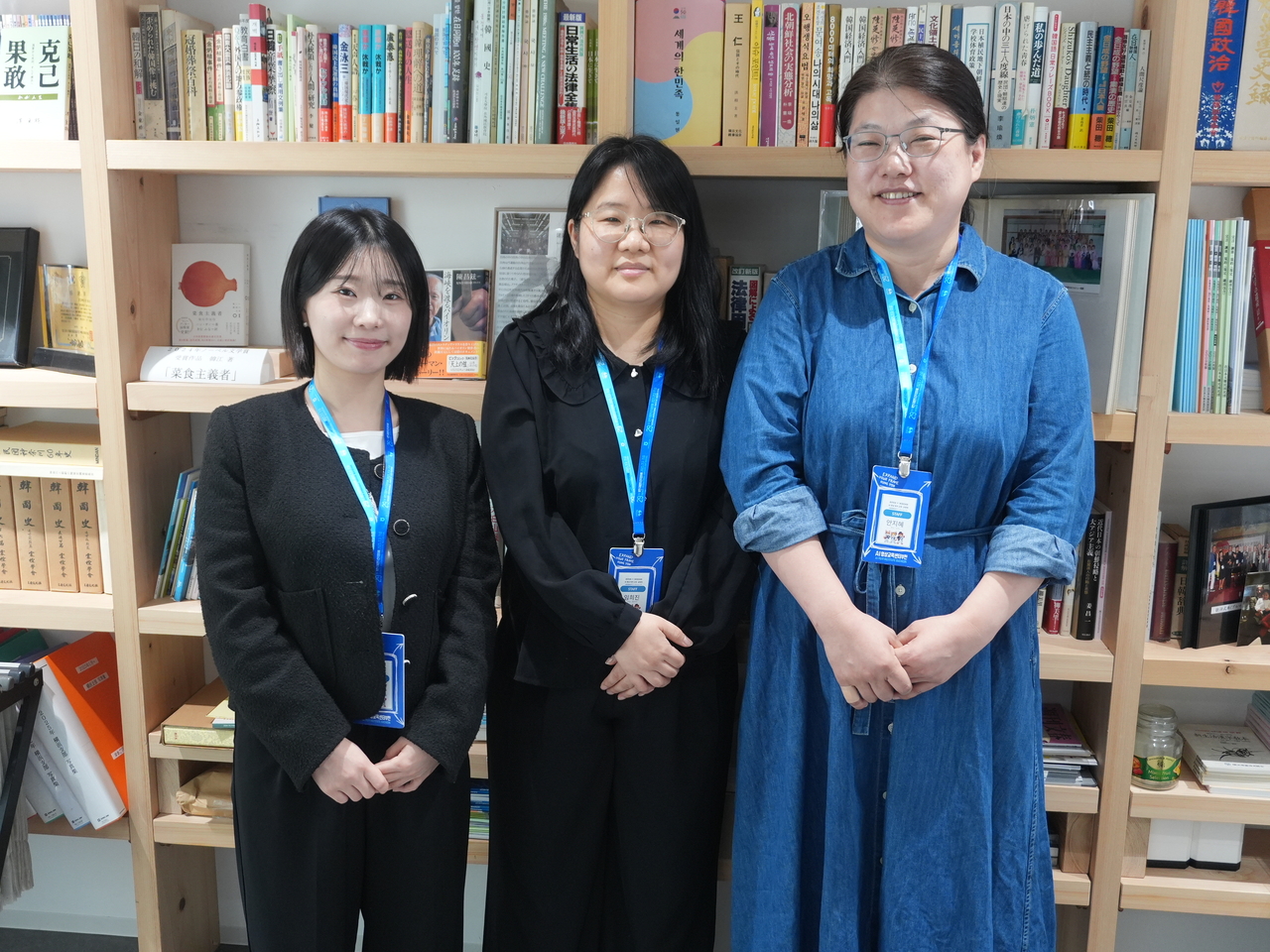
"I think the experience we had accumulated in embracing new technologies allowed us to take in AI as well — naturally, and a little faster."
The AI education team at the Bucheon International Fantastic Film Festival is shifting the focus of its film education from technology experience to actual production. Drawing on years of work with emerging video technologies such as virtual reality, the team has built a structured AI curriculum and now helps creators turn their own stories into finished films. Through a partnership with the Korean Residents Union in Japan, the program has also extended to Japan, broadening opportunities for the diaspora community to participate in creative work.
The Herald Business sat down with Im Hee-jin, director of the BIFAN AI Video Education Center; Ahn Ji-hye, head of the AI education team; and Kim Young-eun, an education team member, in Yokohama, Japan, on Sunday. The three explained how the AI education program began, how it has evolved, and what the team has achieved through its work in Japan.
Im said BIFAN's AI education is an extension of the festival's long-running exploration of emerging technologies. The foundation for the curriculum, Im said, was built through years of examining how new tools reshape the creative environment — work that went beyond screening films and discovering new works.
According to Im, BIFAN began paying attention to video content using new technologies such as VR in 2016. While preparing a VR program in 2022, discussions arose about organizing a workshop focused on AI. The festival then launched an AI filmmaking workshop and a technology conference in 2024, marking the formal start of its education program.
"In 2024, we started from a place of simply accepting new attempts," Im said. "By 2025, an atmosphere had formed where AI needed to be embraced and used more naturally."
The direction of the education has also changed. Early on, the focus was on introducing participants to unfamiliar technology and confirming its possibilities. Over time, the priority shifted to helping creators apply those tools in actual production — moving beyond learning how to use software toward connecting what was learned to finished work.
The team has put considerable effort into providing hands-on opportunities so creators can experience those possibilities directly. The goal is to help filmmakers who are interested in AI but hesitant about unfamiliar tools — guiding them to master production software and apply it to their own projects.
To that end, the team has built a sustained educational foundation. According to Im, the workshop launched in 2024 expanded its target audience the following year. With the establishment of a dedicated education center, the conditions were also put in place to support filmmakers and creators through a structured curriculum.
"It became an opportunity to move away from one-off event-style education and establish a proper curriculum — one that allows us to train filmmakers and creators in a more systematic way," Im said.
This year, the team is focused on refining the curriculum. The emphasis is on how AI tools can be integrated into video content production, and the scope of creative work has expanded to include extended reality and VR alongside AI. The team is bringing that direction to life through actual classes and hands-on sessions with creators.
The AI Video Education Center Bucheon offers tailored programs for three groups: filmmakers and other creators; "future talent," centered on elementary, middle and high school students as well as university and graduate students; and "citizens," including content industry workers and people with disabilities. The center frames its mission as opening an era in which anyone can become a director.
Results in the "future talent" category have been particularly notable. For elementary, middle and high school students, the center launched an outreach program in 2025 that brings AI video education directly to schools. In 2026, it significantly expanded hands-on AI video experiences tailored to public school settings by linking up with existing education infrastructure, including ART ON School, a public school arts education initiative. Through these programs, students experienced the full production process — from concept development and prompt writing to sound design and video creation.
University and graduate students who completed the "Univ Course" have also gone on to intern at AI video production companies or join feature-length AI film productions as key crew members, demonstrating that the education translates into employment.
Programs for the general public have also yielded meaningful results. Education for people with disabilities, conducted in partnership with the Bucheon Welfare Center for the Disabled since 2025, has enabled participants to use AI tools to overcome physical limitations and complete their own short AI films.
For content industry professionals, the center has actively introduced courses on building AI agents, automating workflows and hands-on AI video production, helping workers in the field strengthen their practical AI skills.
Taken together, the programs spanning future talent and the general public have produced tangible outcomes — competition awards, employment connections, the development of specialist AI instructors and the building of professional portfolios.
One standout example is director Bae Jun-won, who won at BIFAN's inaugural AI international competition section in 2024 and completed the AI Video Education Center Bucheon's AI+XR workshop in 2025, going on to establish himself as an AI filmmaker. Bae now serves as a lead instructor at the center and joined this year's program for the Korean diaspora in Japan as its main teacher.
Building on these achievements, Bucheon is positioning itself as a hub for an AI video creation ecosystem — a role that goes beyond simply hosting a film festival.
The Yokohama program represents a case where BIFAN's accumulated educational experience met genuine demand from a local diaspora community. Early last year, while planning a Japan event, the team connected with representatives from smaller regional chapters of the Korean Residents Union and found shared recognition of the need for education. Those conversations led the Yokohama chapter of the union to move forward with the program as a formal project.
The Yokohama chapter sought support from the Kanagawa prefectural headquarters of the Korean Residents Union and worked to secure a budget. Additional funding from the Overseas Koreans Agency, channeled through the Kanagawa headquarters, helped underwrite the local program. The initiative came together through the combination of a local chapter's proposal and drive, BIFAN's educational expertise and the diaspora community's support structure.
In the first year, the budget and operational conditions were not sufficient. "The funding wasn't in place from the outset, so we had a difficult start," Im said. "Based on the challenges of last year, we prepared more and worked harder this year."
This year, additional support from the Yang Won Sun Foundation — a nonprofit that supports the spread of Korean culture and the development of Korean diaspora communities — made it possible to expand the workshop from one day to two.
The extended format gave participants more time not only to learn new tools but also to develop their own stories into films. Drawing on last year's experience, the team also refined its on-site operations and strengthened the production practice component.
sjkim@heraldcorp.com