- Transparent electrode cuts electrical resistance by factor of 10,000
- Peak efficiency of 12.32%; suited for buildings and farmland

South Korean researchers have developed a solar cell technology that converts into electricity not only sunlight striking the front surface but also light reflected off the ground — allowing the rear side of a panel, which conventional cells largely waste, to contribute to power generation.
The Daegu Gyeongbuk Institute of Science and Technology (DGIST) announced Monday that a research team led by Senior Researchers Hwang Dae-gyu and Kim Dae-hwan of its Energy and Environment Research Division had developed a bifacial antimony-based thin-film solar cell capable of absorbing light from both sides, using a transparent polymer electrode.
Conventional solar cells convert primarily the sunlight that strikes their front surface. In real-world installations, however, a significant amount of light is also reflected off the ground and building facades. Harnessing that reflected light allows more electricity to be generated from the same panel area.
The key challenge lies in the electrode mounted on the rear of the cell. Bifacial power generation requires an electrode that is transparent enough to let light pass through while still collecting the generated electricity with minimal loss — a combination that existing electrodes have struggled to achieve simultaneously.
The research team fabricated a transparent rear electrode by stacking multiple layers of a specially formulated conductive polymer. They fine-tuned its electrical properties by adding dimethyl sulfoxide (DMSO) as an additive to the conductive polymer.
As a result, the team maintained optical transparency while reducing electrical resistance — which impedes current flow — by a factor of approximately 10,000 compared with conventional electrodes.
The antimony-based solar cell incorporating this electrode recorded a photoelectric conversion efficiency of 8.2 percent when illuminated from the front and 3.3 percent when illuminated from the rear.
The team went a step further by combining two solar cells that absorb different wavelengths of light. The resulting structure — a four-terminal tandem configuration — places the antimony-based cell on top and a copper indium selenide (CuInSe₂) cell below.
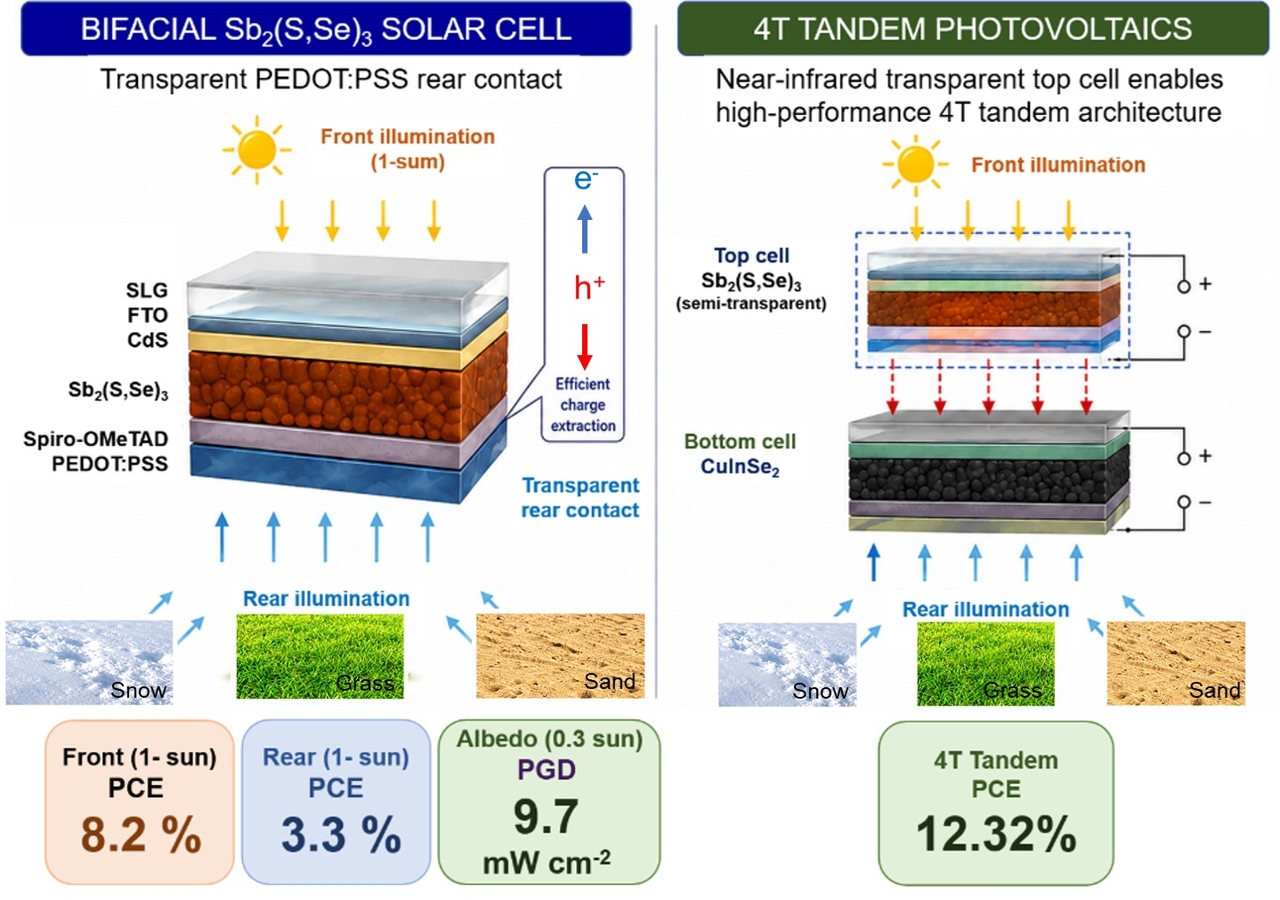
The tandem solar cell achieved a peak photoelectric conversion efficiency of 12.32 percent. When both the front and rear surfaces were simultaneously illuminated at standard solar intensity, the power output per unit area reached 18.81 milliwatts per square centimeter.
The technology is expected to find applications in building-integrated photovoltaics (BIPV) — panels mounted on exterior walls or rooftops — as well as agrivoltaic systems that combine crop cultivation with power generation. It is particularly well suited to environments where ground-reflected light is abundant.
However, challenges remain before the technology can be commercialized. The performance demonstrated in small-area experiments must be replicated in large-area cells, and the long-term durability of the transparent polymer electrode and its stability under real outdoor conditions still need to be verified. The research team confirmed storage stability over one month, but further research is needed to improve long-term operating performance and reduce manufacturing costs.
"Through the transparent polymer rear electrode, we confirmed both the bifacial generation potential of antimony-based solar cells and their applicability to tandem configurations," Hwang and Kim said. "We plan to further improve power generation performance by optimizing the interface between the electrode and the light-absorbing layer, as well as the optical structure."
The findings were published in the international journal Advanced Materials.
nbgkoo@heraldcorp.com