'2026 Global ICT Standards Conference' brings together experts to discuss strategy for establishing technology leadership through standards and intellectual property
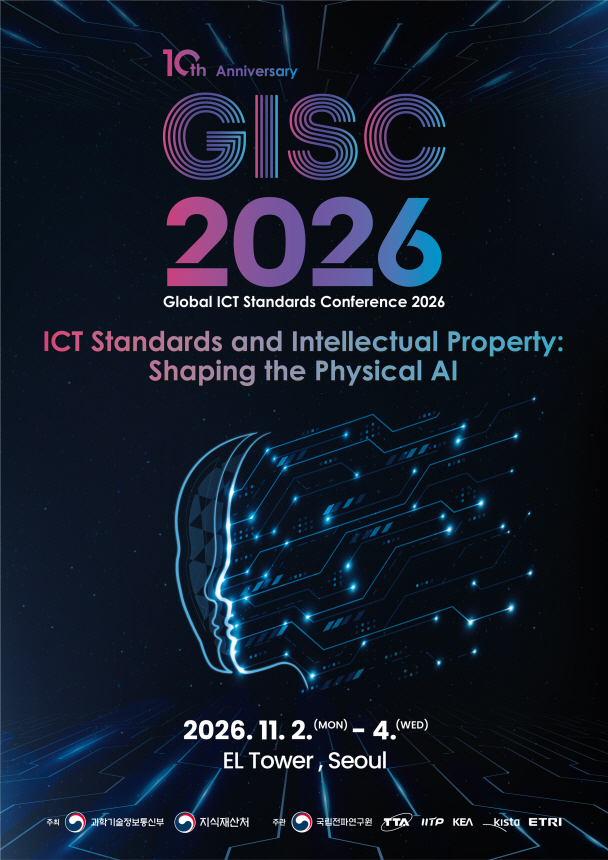
An international forum will convene to discuss strategies for advancing Korea's position as a technology-leading nation through AI and AX standards and patent linkages.
The Korea Intellectual Property Office and the Ministry of Science and ICT are jointly hosting the 2026 Global ICT Standards Conference (GISC) from Monday through Wednesday at L Tower in Seocho-gu, Seoul.
Marking its 10th anniversary this year, GISC will explore ways to lead and expand diverse technology standards — including physical AI and agentic AI, which have emerged as core technologies driving the AI transformation (AX) — across all economic and social sectors.
Given that AI technology and markets are evolving at an exceptionally rapid pace, this year's GISC recognizes the critical role of de facto standards — developed quickly by private companies and organizations — alongside formal standards set by bodies such as the ITU and ISO. Around 1,000 leading experts from a range of organizations will attend to discuss AI standardization strategy, including de facto standards bodies MLCommons and IEEE, regional standards body ETSI, and the Infocomm Media Development Authority of Singapore.
The event opens with a keynote address by KAIST Professor Jang Young-jae on autonomous manufacturing using physical AI in industrial settings and the role of standards in spreading physical AI adoption, followed by a talk concert featuring domestic and international experts on advancing AI and ICT standards and patents.
Next, organizers will present the progress and direction of the AI Partnership Project (AIPP), an initiative led by Korea's Telecommunications Technology Association and Europe's ETSI in collaboration with the US-based ATIS and Japan's TTC to advance de facto AI standards.
A total of 27 commendations and citations will then be presented to institutions and companies that have contributed to strengthening national competitiveness in AI and ICT standards and patents through sustained research and commercialization efforts.
The conference will also be divided into a global track — where domestic and international companies and organizations discuss ICT standardization strategies covering AI, quantum and satellite communications — and a domestic track focused on standards, patents and technology-driven competition in the physical AI era, with industry and academia sharing strategies for industrial growth.
The global track is subdivided into the Global Standards Strategy Seminars 1 and 2 covering AI, quantum and satellite communications, and an insights session on the AX standards ecosystem shaped by companies, experts and de facto standards bodies. The domestic track comprises the ICT Standards and Patent Outcomes Presentation, the ICT Standard Patent Seminar, the Physical AI ICT Convergence Standards Framework Public Hearing, and the ICT Future Innovation Standards Seminar.
Kim Il-gyu, director general of the IP Policy Bureau at the Korea Intellectual Property Office, said major countries including the United States and Japan now view standards as part of a broader hegemony strategy and are reinforcing their national standards and patent policies to secure future markets. "The Korea Intellectual Property Office will strengthen its standard patent acquisition policy to generate high-value standard patents from the R&D stage onward, in order to secure global leadership in next-generation communications, physical AI and other key future ICT sectors," Kim said.
kwonhl@heraldcorp.com