
Partnership with National Institute of Ecology and local civic groups
90 larvae of anchor-marked tiger beetle bred and released
Company pledges continued expansion of biodiversity conservation efforts
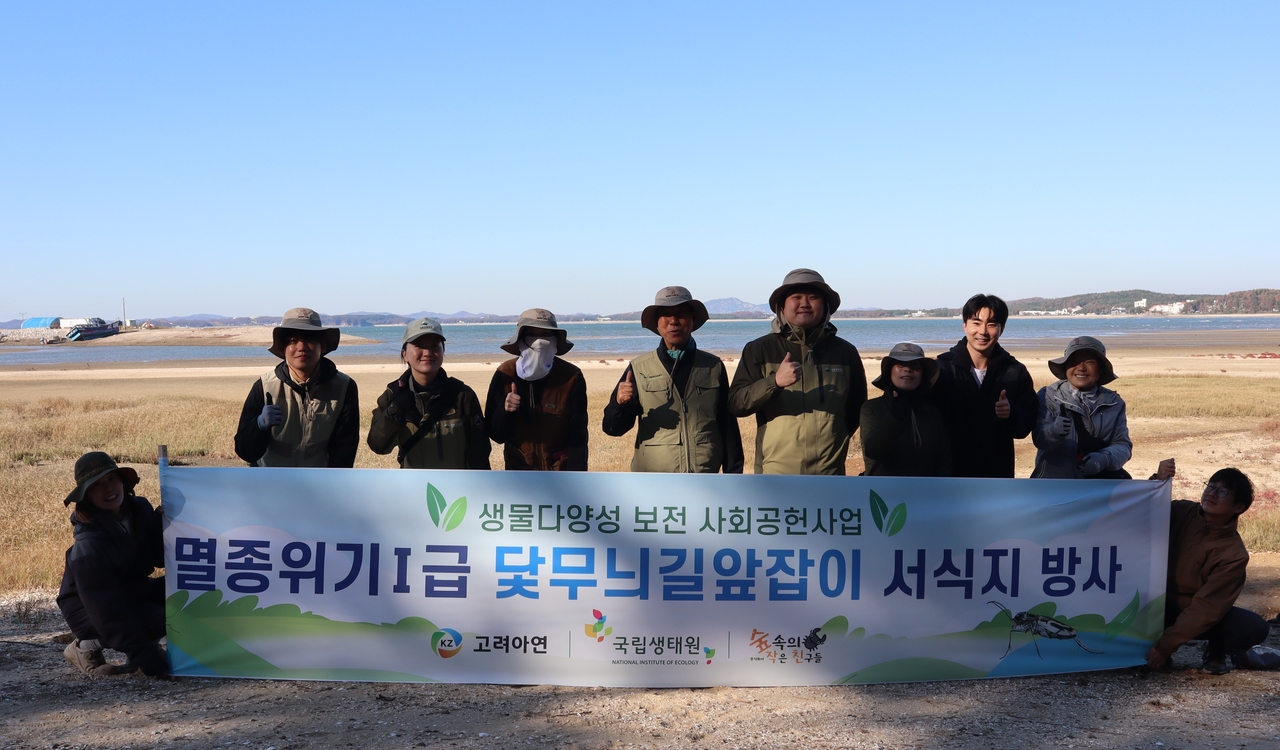
Korea Zinc announced Monday that it had released 90 artificially bred larvae of the critically endangered anchor-marked tiger beetle into their natural habitat within Taean Haean National Park on Thursday, in a biodiversity conservation effort carried out alongside the National Institute of Ecology, Korea National Park Service and local citizen scientists.
The anchor-marked tiger beetle lives primarily on coastal sandy beaches. Declining populations due to coastal development and habitat destruction have led to its designation as a Class I endangered wild species under South Korea's wildlife protection framework.
The release was part of an MOU on restoring endangered insects and promoting biodiversity that Korea Zinc signed with the National Institute of Ecology and Soop Sok-ui Jageun Chingudeul in May. Korea Zinc has been continuing similar efforts to restore endangered species for local ecosystem conservation — on Oct. 16, for instance, the company released giant water bugs, another endangered insect, into Galti Pond at Ulsan Grand Park.
The late-October timing was chosen to align with the anchor-marked tiger beetle's life cycle, as larvae burrow into sand in autumn to overwinter. Release sites were selected near coastal sand areas suitable for the species' habitat. Locations with minimal human foot traffic and outside interference were prioritized to help the larvae settle stably in their natural environment.
"This release of anchor-marked tiger beetle larvae is a meaningful activity in that it can help restore the population of an endangered insect and rehabilitate its natural habitat by releasing artificially bred larvae into the wild," a Korea Zinc official said. "We will continue to work closely with specialist institutions such as the National Institute of Ecology and local communities to contribute to the protection of endangered species and the promotion of biodiversity, and to carry out a wide range of activities for the conservation of local ecosystems."
Meanwhile, Korea Zinc's Onsan Smelter has been pursuing a range of corporate social responsibility initiatives, including donating 50 million won ($37,400) to the Ulsan Community Chest of Korea — funds raised by converting messages of support from citizens who participated in the Ulsan Industrial Festival into charitable contributions.
likehyo85@heraldcorp.com




