Rice output projected at 3.46 million tons, 1.9% above demand
Government to buy 400,000 tons for public reserves, extend 4 trillion won in purchase loans
Agriculture minister visits Seosan harvest and milling sites
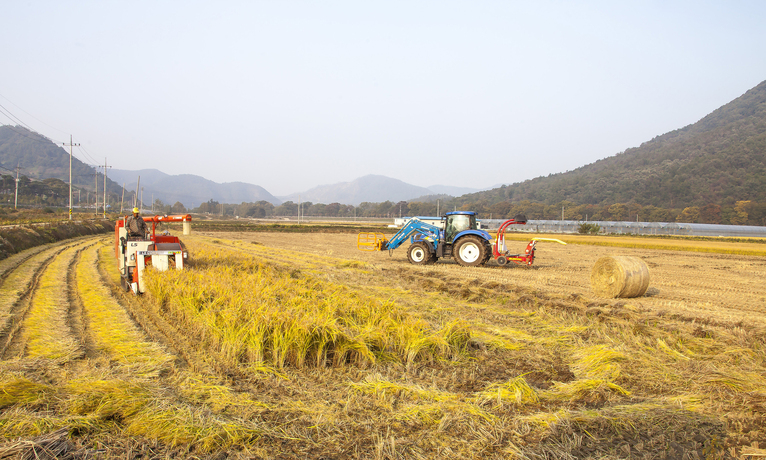
South Korea's rice output is projected to reach 3.46 million tons this year, exceeding demand by about 66,000 tons. To prevent a price drop from the surplus, the government plans to remove as much of the excess supply from the market as possible by requiring the return of grain previously lent from government stockpiles, while extending 4 trillion won ($2.99 billion) in rice purchase loans to stabilize prices during the harvest season.
The Ministry of Agriculture, Food and Rural Affairs said Minister Song Mi-ryeong visited a rice harvest site in Unsan-myeon, Seosan, South Chungcheong Province, and the Dongseo Seosan Agricultural Cooperative Federation's rice processing complex (RPC) on Monday to inspect harvest and purchase operations and hear from farmers.
According to the ministry, this year's projected rice output stands at 3.46 million tons, with the surplus estimated at about 66,000 tons — equivalent to 1.9 percent of total production. The projected yield is 525 kilograms per 10 ares.
The government finalized a rice supply stabilization plan on Oct. 12 following a review by the Grain Supply and Demand Management Committee. It will maintain the plan to require repayment of the remaining 120,000 tons of grain lent from government reserves, using those returns to isolate as much of this year's surplus as possible from the market.
The government will also pursue the purchase of 400,000 tons for public reserves and extend 4 trillion won in rice purchase loans. It plans to support stable sales by farming households during the harvest season and tighten oversight of rice distribution.
Song joined farmers in harvesting rice with a combine harvester before discussing this year's crop conditions and price trends with them.
Farmers said they were optimistic about this year's purchase prices, noting that farmgate rice prices had improved recently. Officials at the RPC called on the government to take preemptive supply management measures to keep prices stable through next year.
"We drew up a rice supply stabilization plan last month and are doing everything we can to stabilize harvest-season prices — including isolating as much of the 2026 crop surplus as possible through the return of lent grain," Song said. "We will work to ensure that farmers feel the rewards of a bountiful harvest this season."
The Dongseo Seosan Agricultural Cooperative Federation RPC that Song visited is jointly operated by four cooperatives — Unsan, Eumam, Haemi and Gobuk. It is currently pursuing a further merger with five additional cooperatives — Daesan, Seosan, Buseok, Jigok and Seongyeon — and plans to establish a joint cooperative business entity by the end of this year to complete the integration.
"I hope the RPC consolidation will lead not only to lower production costs and stronger bargaining power through greater scale, but ultimately to higher incomes for farmers," Song said. "The rice industry can only grow if RPCs — the heart and arteries of the rice supply chain — go beyond simple milling to connect the fields to the table and deliver quality rice without interruption."
Song added that the government was pursuing proactive output management this year through measures including the introduction of direct payments for supply-adjustment paddy farming. "We will manage rice prices in a stable manner through more systematic supply and demand management under the revised Grain Management Act, which took effect in August," Song said.
adastra@heraldcorp.com