
Lee delivers budget policy speech for 2027 fiscal year
President emphasizes 'growth for all' over 'growth for the few'
Defense budget raised 8.2% to 73.3 trillion won
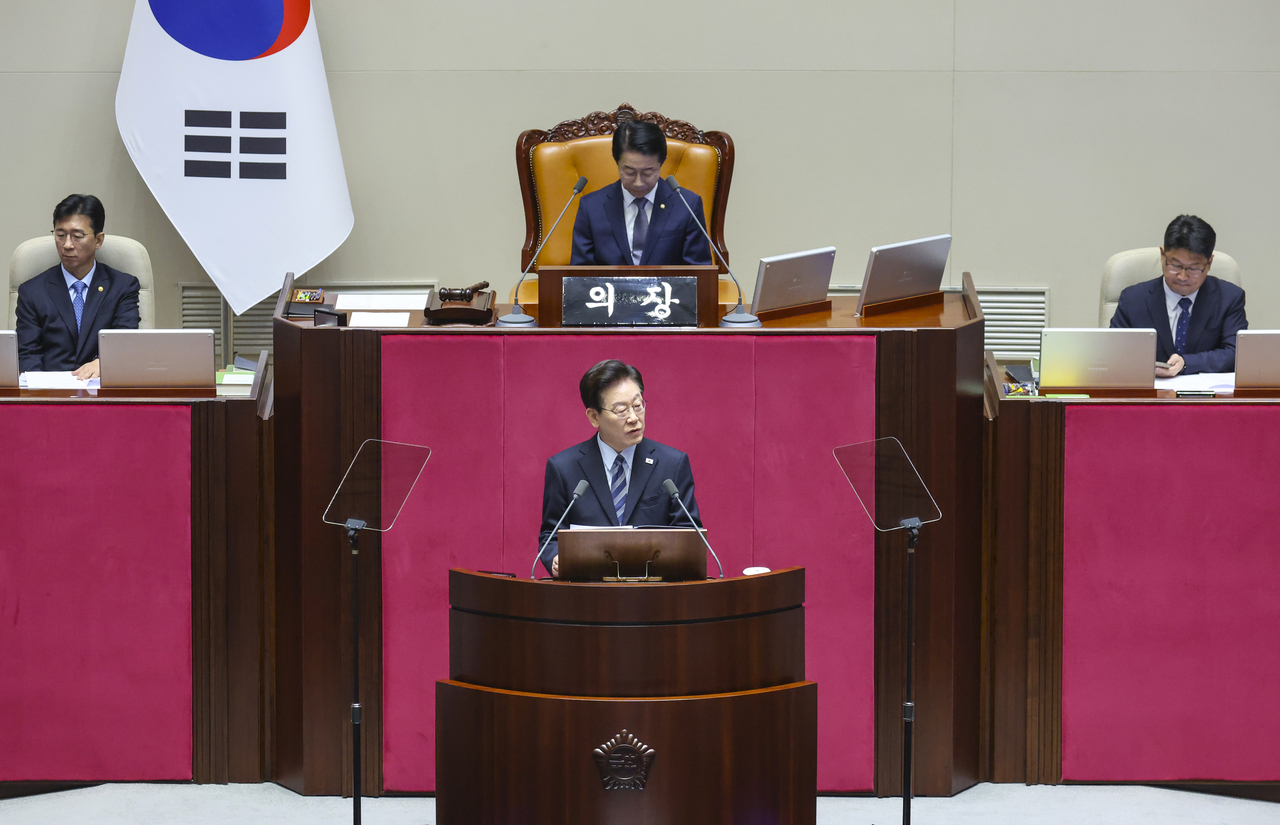
President Lee Jae Myung on Monday outlined plans to secure future growth engines through record-level fiscal spending while spreading the benefits of that growth to everyday livelihoods and redistribution, in a budget policy address to the National Assembly for the 2027 fiscal year.
Last year's focus was on economic recovery and laying the groundwork for growth, largely through expanded AI investment. Lee's address for the administration's third year signaled a stronger fiscal role in supporting vulnerable groups and stabilizing livelihoods, backed by a recovering economy and rising tax revenues.
Lee said the central theme of the budget proposal was "growth for all."
"We must make a great shift — away from 'growth for the few,' where opportunities and gains are concentrated in specific regions, classes and a handful of companies, and toward 'growth for all,' where every region and every citizen shares equally in the opportunities and fruits of growth," Lee said.
The administration aims to overcome the limits of so-called K-shaped growth — in which inequality and polarization deepen — through a record fiscal outlay of 820.9 trillion won ($614 billion), a 12.8 percent increase from this year.
"The shadow of inequality and polarization still falls heavily across our society," Lee said. "We must break free from the outdated binary debate of growth versus distribution and apply a new growth formula suited to the changed times and circumstances."
Lee said the newly established Future Response Fund would serve as "a strategic investment platform to support a rebound in potential growth, and an innovative fiscal stabilizer to manage expanding tax revenue volatility."
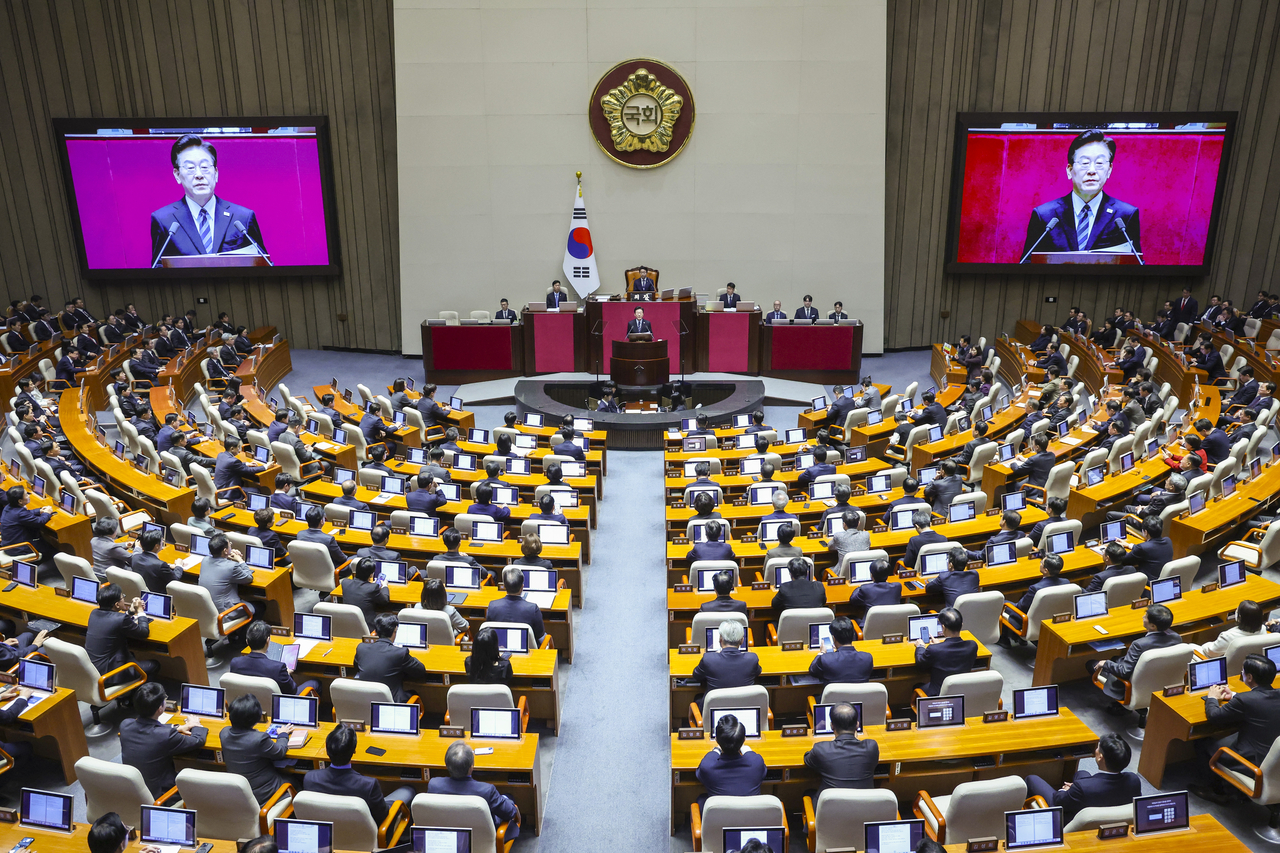
While discussing how the Future Response Fund would help reduce new government bond issuance and support market stability, Lee was interrupted by loud criticism from some opposition lawmakers. Turning toward the opposition benches, Lee said, "If you have something to say, please say it," before continuing the address. The opposition has argued that increased tax revenues should be used to strengthen fiscal soundness and pay down national debt.
Lee also laid out plans to sharply expand investment in AI and advanced industries to secure future growth engines.
The budget allocates 21.3 trillion won — nearly double this year's figure — to three mega-projects covering semiconductors, physical AI and AI data centers, and sets R&D spending at a record 39 trillion won.
The defense budget will rise 8.2 percent from this year to 73.3 trillion won, with the funds directed at securing core military capabilities and building AI-based manned-unmanned combined systems.
Fiscal support for livelihoods and balanced regional development will also expand. Lee said the administration would "dramatically strengthen support for vulnerable groups, regions and generations," announcing a record 6.7 percent increase in the median income standard and a 53.5 percent rise in the youth budget to 43.3 trillion won. The issuance of local gift certificates to support small businesses will expand to 25.6 trillion won, and the rural basic income program will be extended to 35 counties.
Investment in locally driven growth will more than double from this year to 33 trillion won.
Closing the address, Lee said execution and speed were paramount, and called on the National Assembly to pass the 2027 budget and its accompanying bills by the statutory deadline of Dec. 2.
Monday's address was Lee's fourth budget policy speech to the National Assembly since taking office, and the second this year following one in April.
Last year's budget address was a half-empty affair after the People Power Party boycotted, leaving only Democratic Party of Korea lawmakers in attendance. On Monday, PPP members remained in the chamber — though they made their objections heard vocally.
sang@heraldcorp.com




