
- KIGAM develops 'capture-free mineral carbonation' technology that skips CO₂ separation and concentration
- Technology directly uses power plant flue gas and industrial waste to produce calcium carbonate and fertilizer feedstock
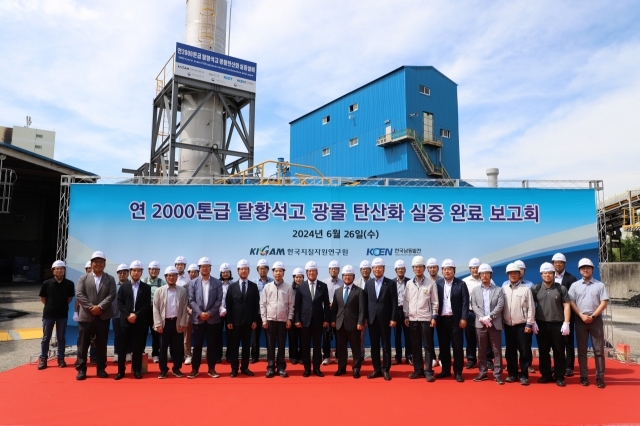
A technology that converts carbon dioxide (CO₂) from power plant smokestacks into construction materials and fertilizer feedstock — without separately capturing the gas — is under development in South Korea.
The Korea Institute of Geoscience and Mineral Resources (KIGAM) said it is developing "capture-free mineral carbonation" technology that directly uses flue gas from power plants and industrial facilities to convert CO₂ into carbonate minerals.
Mineral carbonation reacts CO₂ with calcium or magnesium to produce solid carbonates such as calcium carbonate. The resulting carbonates can be used as construction materials and industrial feedstock. Because CO₂ is fixed in solid mineral form, the technology is also expected to deliver long-term carbon storage benefits.
Conventional carbon capture and utilization (CCU) technology has required significant energy and cost to separate and concentrate CO₂ from flue gas — a major factor that has undermined the economic viability of CCU and hindered its commercialization.
The capture-free mineral carbonation approach KIGAM is developing eliminates that capture step by feeding flue gas directly into a reactor. Removing the need for separate CO₂ separation and concentration equipment reduces both energy consumption and operating costs.
The most notable achievement so far is a capture-free mineral carbonation technology using gypsum.
The research team developed a process that directly reacts power plant flue gas with a gypsum-ammonia mixture to simultaneously produce calcium carbonate and ammonium sulfate. Calcium carbonate can be used as a construction material and industrial feedstock, while ammonium sulfate serves as a fertilizer raw material.
The team conducted a demonstration using actual flue gas at the Samcheonpo Thermal Power Plant, confirming the technology's applicability in an industrial setting. Work is now under way with industry partners to expand the range of applicable raw materials and advance follow-up research toward commercialization.
A separate line of research is developing technology that uses slag generated by the steel industry.
Slag is a byproduct of steel production that contains calcium, magnesium and other components needed for mineral carbonation. Because slag contains a mixture of various elements, carbonating it directly can leave impurities in the final product, reducing both quality and economic value.
To address this, the research team is developing an "indirect carbonation" technique.
The process first uses an extractant to dissolve calcium and magnesium from the slag, then separates the impurity-laden solids. The resulting extract is then reacted directly with flue gas to produce high-purity carbonates.
The technology is significant because it raises the purity of the carbonates, expanding their potential use as high-value-added industrial materials.
The research team plans to develop extractant recovery and recycling technology alongside a life-cycle assessment (LCA) that comprehensively analyzes greenhouse gas emissions from raw material production through to final product manufacturing. Securing both real carbon reduction benefits and economic viability at the same time is the key to commercialization, the team said.
"For CCU technology to spread across industrial sites, it must deliver both economic viability and meaningful greenhouse gas reductions," said Cho Hwan-ju, head of KIGAM's Carbon Resource Utilization Research Division. "We will develop mineral carbonation technology that reduces both costs and environmental burden."
nbgkoo@heraldcorp.com




