
Global EV battery use hits 994.5 GWh through September
CATL's share climbs to 39.1%; BYD growth slows on weak domestic sales
North America use falls 24.3%, dragging down LG Energy Solution and SK On
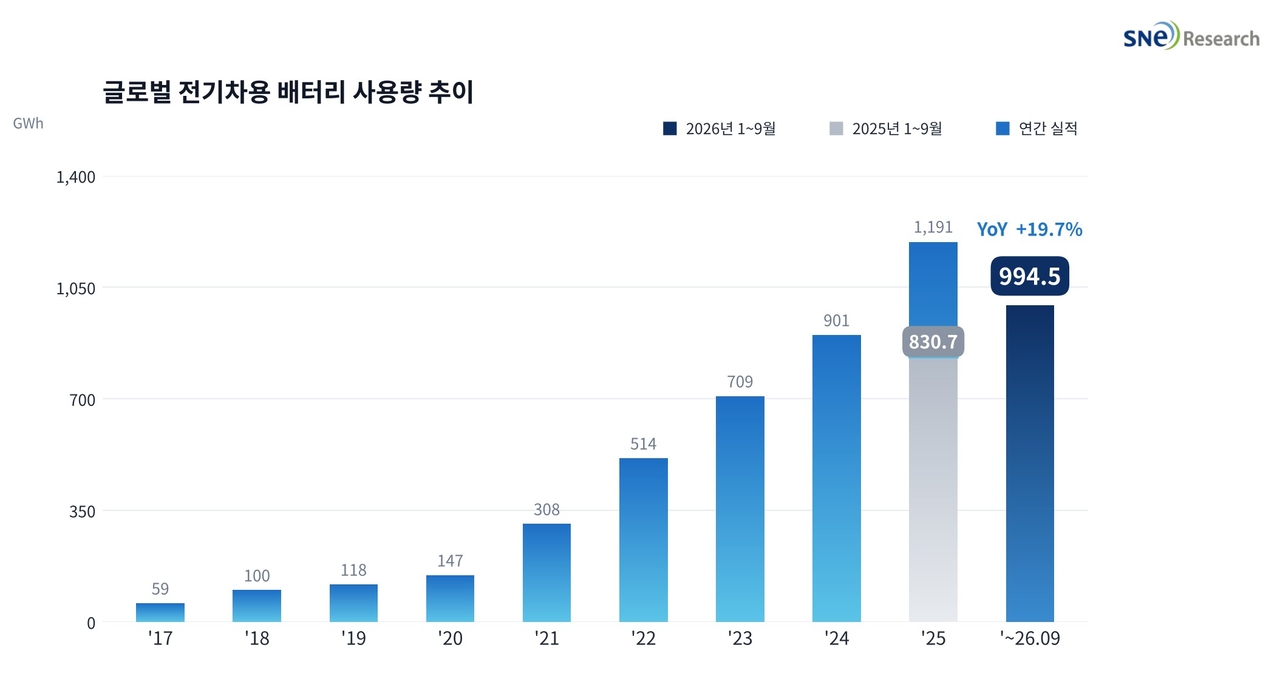
Battery use in electric vehicles registered worldwide from January through September totaled 994.5 GWh, up 19.7 percent from the same period last year, market research firm SNE Research said Monday. Over that period, seven Chinese battery makers combined for a 73.0 percent market share, up 3.5 percentage points, while South Korea's three major battery makers fell to a combined 12.6 percent, down 4.1 percentage points.
SNE Research tracks battery use across electric vehicles, plug-in hybrid electric vehicles and hybrid electric vehicles.
Monthly use in September alone reached 145.1 GWh, a record high for a single month, though the year-on-year growth rate of 15.8 percent came in below August's 18.3 percent. The cumulative growth rate also fell just short of 20 percent.
CATL held onto first place with 389.2 GWh, up 24.9 percent, lifting its market share from 37.5 percent to 39.1 percent. Second-ranked BYD posted 150.9 GWh, up 7.4 percent, but its share slipped 1.7 percentage points to 15.2 percent from 16.9 percent. The two companies' combined share of 54.3 percent was nearly unchanged from 54.4 percent a year earlier. SNE Research said the growth gap between CATL, which has consistently expanded its roster of overseas automaker customers, and BYD, whose output remains tied to its own vehicle sales, widened to 17.5 percentage points.
Among South Korean manufacturers, LG Energy Solution ranked third with 81.9 GWh, up 0.7 percent. The company continued supplying Tesla, General Motors, Hyundai Motor Group and Volkswagen, but its growth fell well short of the overall market rate, pushing its share down 1.6 percentage points to 8.2 percent. Use in Europe rose 13.2 percent and in Asia 49.4 percent, but a 44.9 percent drop in North America offset most of those gains.
SK On slipped to eighth place with 28.3 GWh, down 18.1 percent, and its share fell 1.4 percentage points to 2.8 percent. The company supplies batteries to Hyundai Motor Group, Ford, Volkswagen and Mercedes-Benz, but North America use fell sharply from 14.2 GWh to 7.6 GWh, a 46.7 percent decline. SK On is working to diversify beyond electric vehicles by converting part of its Georgia factory to a lithium iron phosphate line for energy storage systems and signing a 9 GWh supply deal with a US ESS company.
Japan's Panasonic fell one spot to seventh place with 35.6 GWh, down 0.8 percent. North American deliveries to Tesla, which account for the bulk of its volume, edged down to 34.9 GWh, trimming its share 0.7 percentage points to 3.6 percent. SNE Research said Panasonic's results are heavily dependent on Tesla's North American sales given the concentration of its customer base. Panasonic is working to stabilize output at its Kansas factory while also exploring a shift of some production lines to batteries for AI data centers.
Chinese challengers posted strong growth across the upper rankings. Gotion surged 48.1 percent to 50.3 GWh, narrowly overtaking CALB to claim fourth place. CALB grew 27.1 percent to 50.1 GWh. EVE rose 60.4 percent to 36.0 GWh, moving past Panasonic into sixth place.
The seven Chinese makers' combined share rose to 73.0 percent from 69.5 percent a year earlier. SNE Research attributed the gains to their strong domestic base and cost competitiveness in LFP chemistry, which has allowed them to expand into commercial vehicles, ESS and overseas automakers.
BYD's slower growth stemmed from a 32.9 percent drop in electric vehicle sales within China. Outside China, however, its battery use rose 66.8 percent from 27.5 GWh to 45.9 GWh. Overseas vehicle sales in September reached about 180,000 units, more than double the year-earlier figure, accounting for nearly 40 percent of total sales.
Regional divergence widened. China grew 16.2 percent to 567.8 GWh, Europe rose 33.1 percent, Asia excluding China climbed 74.1 percent and South America rose 176.8 percent. North America, by contrast, fell 24.3 percent to 85.9 GWh. The share of LFP batteries rose 5.2 percentage points to 57.7 percent, and average battery capacity per electric vehicle expanded 11.2 percent from 35.7 kWh to 39.7 kWh.
SNE Research noted that CATL's third-quarter net profit growth of 14.5 percent fell far short of its 58.6 percent sales growth, a sign that pricing pressure has begun to weigh on profitability.
The firm added that China plans to impose a 2 percent consumption tax on domestically sold lithium-ion batteries starting in September and to scrap the value-added tax rebate on battery exports in January 2027, while in the United States, South Korean manufacturers are rapidly converting North American EV lines to ESS production. SNE Research said pricing strategies and the pace of customer diversification among suppliers would determine the competitive landscape through the end of the year.
eyre@heraldcorp.com




