
Full customs automation with 4 X-ray units
Two-way clearance system for air cargo imports and exports
Incheon airport logistics center now fully operational
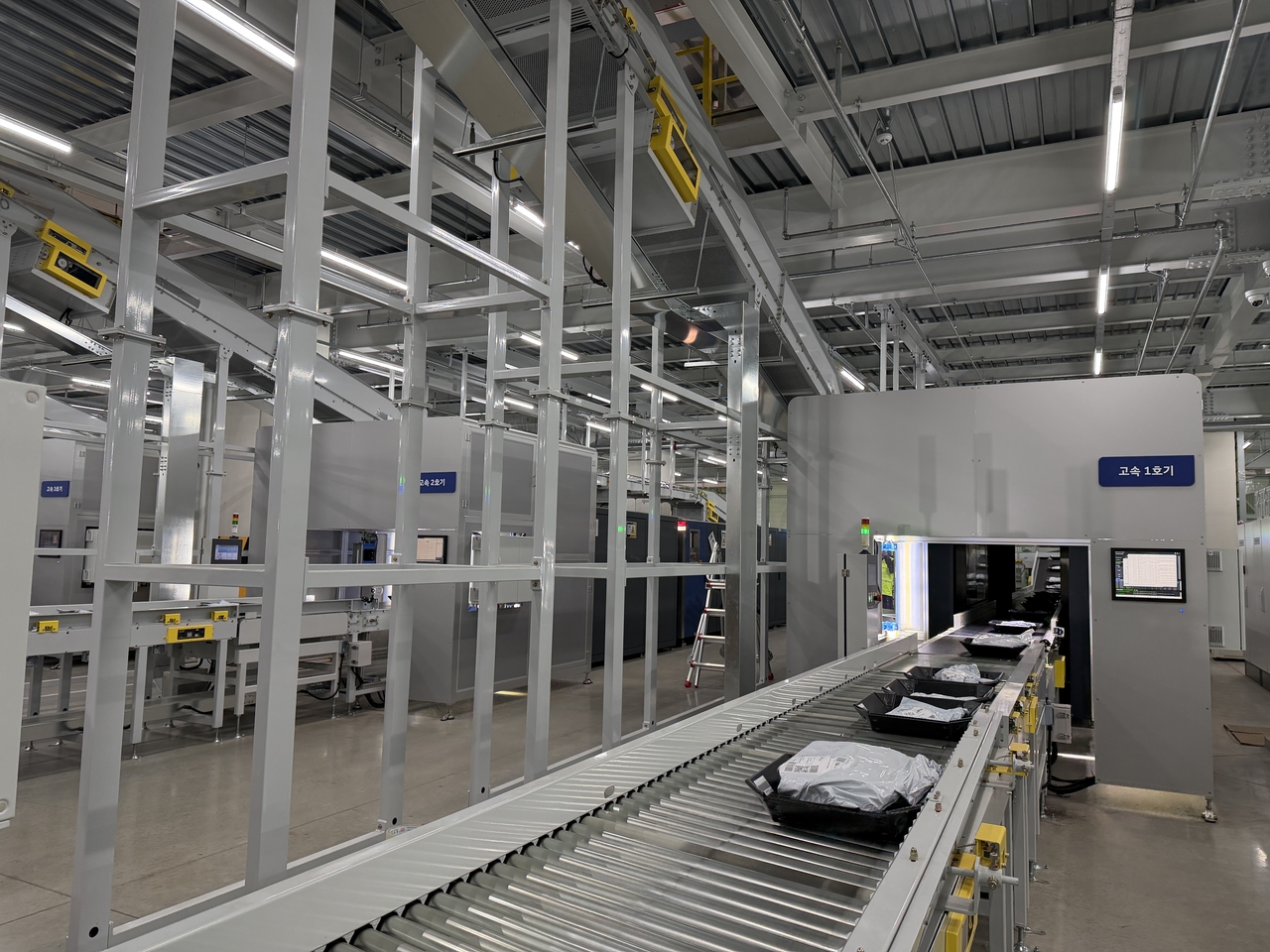
Hyundai Glovis said Monday its Incheon Airport Logistics Center has received official approval from the Korea Customs Service to operate as an express import customs clearance facility, completing a two-way clearance system that now covers both exports and imports.
E-commerce cargo entering South Korea must pass through customs clearance procedures set by the Korea Customs Service. Clearance facilities — the gateways through which this process takes place — are operated either by the government or by private companies that have met strict regulatory standards.
The Hyundai Glovis clearance facility, located on the first floor of the logistics center, can handle more than 1 million express shipments per month. Automated equipment has been installed across the entire pre-clearance process to boost speed and efficiency. Four high-speed X-ray units — the core tools for cargo screening — process 5,000 items per hour and transmit real-time data on the shape and composition of scanned goods directly to Incheon Airport Customs. Items prohibited from import, including narcotics, firearms and explosives, are flagged through detailed analysis and sorted immediately.
The third and fourth floors handle reverse cross-border e-commerce, supporting exports of K-beauty products, health supplements and entertainment merchandise — categories that have drawn strong demand in Japan, Europe and Latin America. Twenty sorting conveyors are designed to instantly separate global orders by destination country, region and delivery carrier.
Once an overseas consumer places an order, robot-assisted picking enables same-day dispatch and packaging before cargo is transferred to an airline terminal. The company expects the center's location — just 3 kilometers from Incheon Airport's cargo terminal — to cut global delivery times.
Hyundai Glovis has been expanding its air freight forwarding business on the expectation that the global e-commerce boom will drive growth in the sector. The development of the Incheon Airport Logistics Center, which began in 2023, is part of that push. The center, which entered full operation this year, is a five-story, 44,420-square-meter facility within the Second Airport Logistics Complex. Hyundai Glovis plans to make the center the cornerstone of its air logistics operations, concentrating investment and expertise there while broadening its service offering beyond maritime freight to give customers more options.
"With this customs approval, the Incheon Airport Logistics Center has completed a fully integrated two-way clearance system covering both exports and imports," a Hyundai Glovis official said. "We will combine our air forwarding expertise, state-of-the-art automation and the geographic advantage of being close to the airport cargo terminal to serve as a global cross-border e-commerce hub."
"We will do our utmost to help leading Korean brands, including K-beauty labels, expand globally and to raise the competitiveness of Korean products by providing fast and reliable logistics services to consumers around the world," the official added.
Meanwhile, Hyundai Glovis posted sales of 9.05 trillion won ($6.78 billion) and operating profit of 566.5 billion won in the third quarter of this year, up 23.1 percent and 8.1 percent, respectively, from the same period last year. Both figures were the highest ever recorded for a single quarter, with an operating profit margin of 6.3 percent.
eyre@heraldcorp.com




