61.3% of those born 1961–1964 who find new jobs land in temporary or daily work
Lower earners receive less pension too; researchers call for retirement age extension, partial pension

Returning to work and cutting spending are not enough to bridge the income gap between retirement and the start of national pension payments, a new analysis has found. Re-employment tends to be concentrated in temporary and daily work, and more than seven in 10 low-income households still run deficits despite already keeping consumption low. Researchers say employment periods should be extended to align with the pension eligibility age, and that separate income-support measures are needed for those who cannot find new work.
According to a report released Monday by the Korea Institute for Health and Social Affairs — titled "Income Crevasse Among Middle-Aged and Older Workers: Current Status and Policy Responses" — the employment rate among those born between 1961 and 1964 during the income-gap period was 66.5 percent, down 7.3 percentage points from 73.8 percent when the same cohort was aged 55 to 59, before the standard retirement age. The primary driver of the decline was the loss of stable, regular employment.
Even those who successfully found new work could not match the job quality of those who stayed in their previous positions. Among members of this birth cohort who entered new jobs after age 60, 61.3 percent were in temporary or daily work. The share of full-time regular employees among wage workers who re-entered the labor market was 22.1 percent, far below the 59.0 percent recorded among wage workers who remained in their existing jobs.
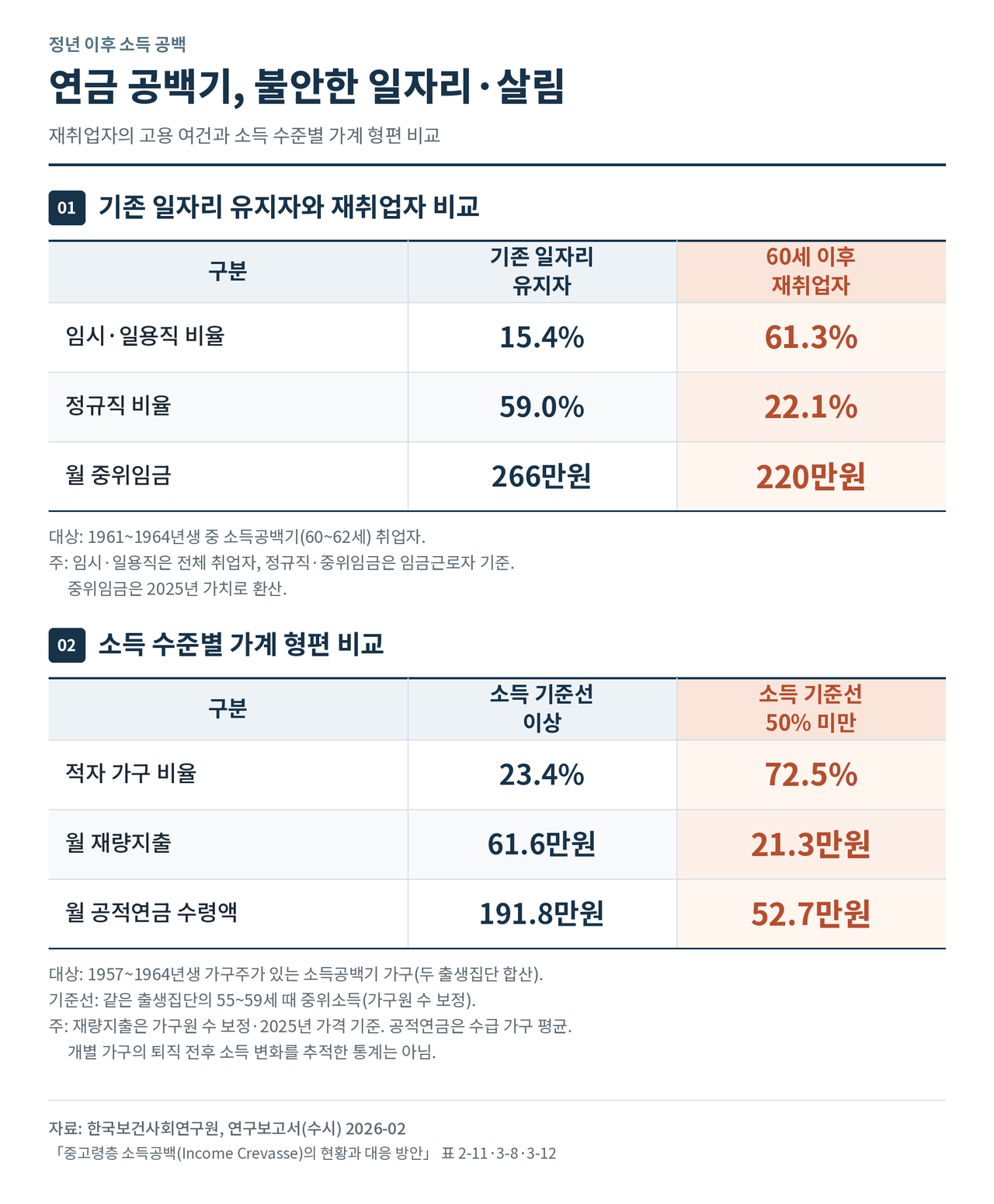
The median monthly wage for salaried workers who entered new jobs was 2.2 million won ($1,650), compared with 2.66 million won for those who stayed in their existing positions — figures adjusted to 2025 values. Re-employment, in other words, rarely secured both job stability and adequate pay at the same time.
Yet labor income remained the primary source of household support before pension payments began. For households headed by someone born between 1961 and 1964, earned income from work and self-employment accounted for 83.0 percent of total current income during the gap period. Efforts to offset the household head's income loss — such as a spouse taking on additional work — showed little measurable effect.
Financial hardship was concentrated among lower-income households. Researchers analyzed households headed by someone born between 1957 and 1964 during the income-gap period, using the median income of the same birth cohort at ages 55 to 59 — before standard retirement — as a benchmark. Between 15.6 and 17.2 percent of households, depending on birth cohort, had per-capita adjusted income below half that benchmark.
Combining both birth cohorts, 72.5 percent of these vulnerable households ran deficits — far exceeding the 23.4 percent deficit rate among households whose income was at or above the benchmark. This classification does not mean the same household's income fell by half after retirement; rather, it identifies households whose income level was low relative to the pre-retirement median of their respective birth cohort.
Vulnerable households also spent less on more easily adjustable items such as dining out, leisure and clothing. Their per-capita adjusted monthly discretionary spending was 213,000 won, roughly one-third of the 616,000 won recorded among households above the income benchmark. The data show that even after cutting consumption, these households struggled to cover essential expenses such as food, housing and medical care.
Pension income also failed to make up the shortfall for vulnerable households. Among households receiving public pension payments, the average monthly benefit for the vulnerable group was 527,000 won ($395), compared with 1.92 million won for those above the income benchmark. The report also noted that as of 2023, only 1.4 percent of people aged 60 to 64 were receiving occupational pension payments.
The income gap could grow longer in the years ahead. The standard national pension eligibility age is 63 for those born between 1961 and 1964, 64 for those born between 1965 and 1968, and 65 for those born in 1969 or later — creating a gap of three to five years between a standard retirement at 60 and the start of pension payments.
Mandatory national pension enrollment ends at age 60, though a voluntary continued enrollment system allows individuals to keep contributing beyond that age. The problem researchers identified is not that enrollment is impossible after 60, but that there are insufficient employment and income-support mechanisms to bridge the gap between the end of mandatory enrollment and the start of regular pension payments.
The researchers recommended extending the mandatory retirement age in line with the pension eligibility age, while also expanding employment duration for workers at small and medium-sized enterprises and in non-regular positions through rehiring arrangements. They also proposed gradually raising the upper age limit for national pension enrollment, starting with workplace subscribers whose income is easier to verify.
Additional recommendations included introducing a partial pension system that would allow recipients to draw a portion of their pension when needed, and temporarily relaxing eligibility requirements for basic livelihood security benefits and unemployment insurance for vulnerable groups during the income-gap period. For those unable to return to private-sector employment, the researchers said public-sector jobs should be expanded to provide a livelihood until pension payments begin.
fact0514@heraldcorp.com