
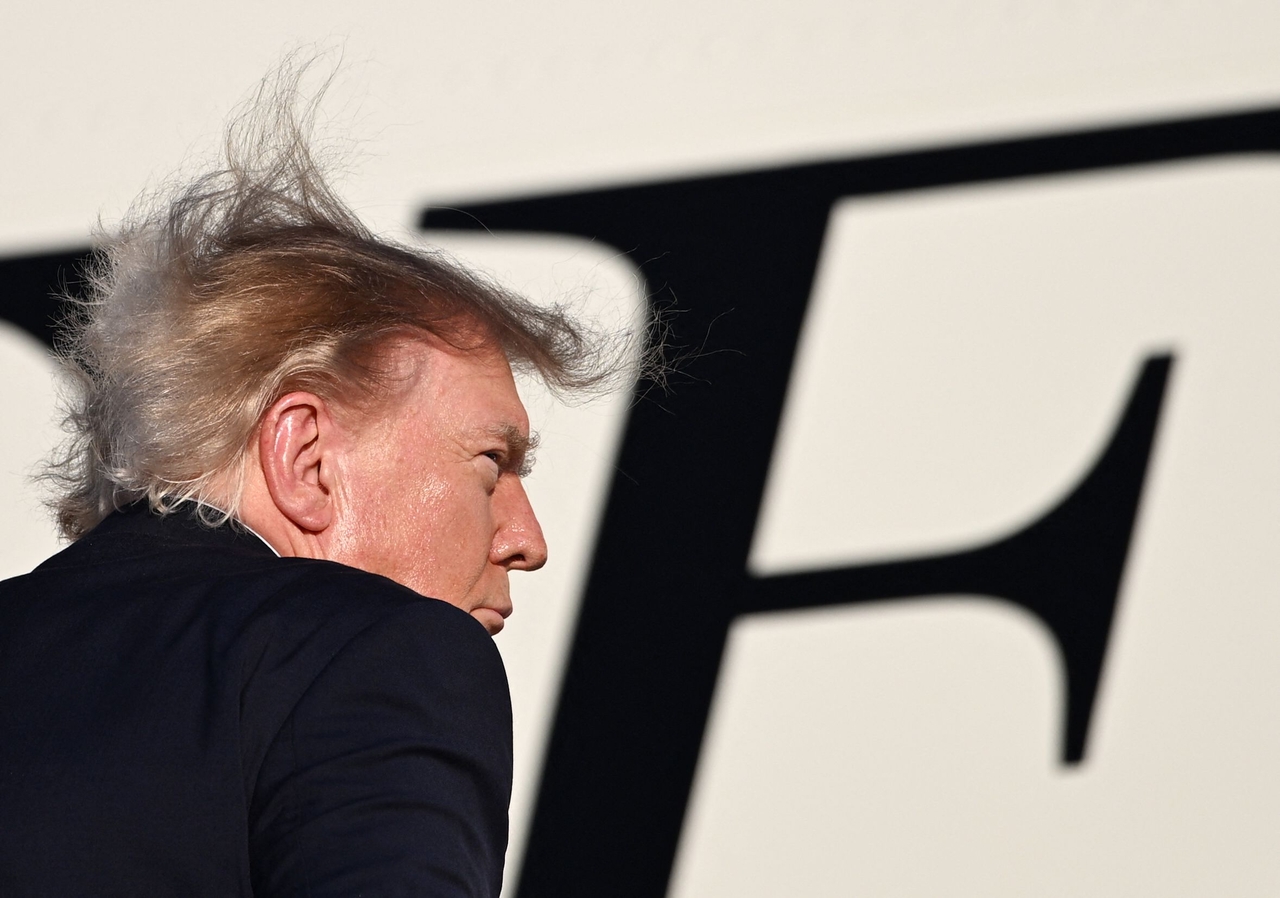
Short-range air defense missile systems have been deployed near President Donald Trump's Mar-a-Lago Club in Palm Beach, Florida, even as the United States has burned through more than half its high-performance interceptor stockpile in the war with Iran.
The deployment comes as Gulf states in the Middle East report damage to key facilities from Iranian and Iran-backed missile and drone strikes — and warn of critical shortages of interceptor missiles.
Local broadcaster WPTV reported that on Monday, two barges carrying air defense missile systems were spotted on the water near the Mar-a-Lago Club in Palm Beach.
The Palm Beach Daily News had earlier reported that two US Army Avenger air defense systems were observed on a barge floating in the Lake Worth Lagoon west of Mar-a-Lago on Thursday.
The same air defense systems were also reported deployed at Palm Beach International Airport, not only near the president's residence.
The North American Aerospace Defense Command and US Northern Command confirmed they had deployed air defense and counter-drone assets around Mar-a-Lago at the request of the Secret Service.
Military authorities did not disclose the specific reasons for the deployment or operational details. It has not been confirmed whether the move was prompted by intelligence about a specific threat.
The Avenger is a mobile air defense system that mounts Stinger short-range surface-to-air missiles on a US Army Humvee. It is used to counter threats from low-altitude aircraft, helicopters and drones.
This is not the first time the Avenger has been deployed to protect Trump.
In August, an Avenger air defense system was spotted near Trump's golf club in Bedminster, New Jersey, while Trump was playing golf there.
What draws particular attention is that the United States is grappling with interceptor missile shortages on a global scale.
Carlton Hailick, a researcher at the Center for a New American Security, said in a report released Oct. 7 that the war with Iran had consumed more than half of the US stockpile of high-performance interceptor missiles.
The Congressional Budget Office also estimated in a Sept. 15 report that replenishing the air defense interceptor missiles expended through Aug. 1 would cost $13.1 billion.
Some interceptor missiles were projected to take at least five years to restock even with expanded production capacity.
The Center for Strategic and International Studies estimated in a July 27 report that the remaining US stockpile of Patriot interceptor missiles stood at fewer than 1,000 rounds at the time, with Terminal High Altitude Area Defense, or THAAD, interceptors at roughly 250.
Vulnerabilities in air defense networks have also been exposed by strike incidents in Middle Eastern Gulf states.
On Oct. 10, King Khalid International Airport in Riyadh, Saudi Arabia, was struck by missiles and drones fired by Yemen's Iran-backed Houthi rebels.
According to the Associated Press, the attack killed at least 13 people and wounded more than 300. Saudi authorities launched an investigation into why the air defense network failed to stop the attack.
Investigators found that the Houthis first launched a large number of drones before following up with a mix of cruise missiles and ballistic missiles. Some of the missiles were reportedly fitted with maneuvering warheads capable of changing course mid-flight, making them harder to intercept for existing air defense systems such as the Patriot.
The Stimson Center said in a recent report that the interceptor missile shortfall was only one factor, and that early warning systems, the flight characteristics of attacking weapons, and the dispersal of air defenses across a vast territory all needed to be examined together.
CBS News reported March 11, citing multiple sources, that Gulf states had conveyed their interceptor missile shortages to the White House.
At the time, Gulf states were said to have told Washington they faced a situation in which they had to choose which incoming objects to shoot down and which to let through, due to insufficient interceptor stocks.
Even US-backed nations have found themselves unable to respond to every attack.
The US government, however, maintains that its air defense capabilities remain sufficient. Defense Secretary Pete Hegseth said the military would prioritize defending US forces while also supporting allies in restocking their missiles.
why37@heraldcorp.com




