
227. Vasily Vereshchagin
A war painter trained at a naval academy
He witnessed the horrors of battle firsthand
Rifles and bayonets held no romance, no myth
Editor's note
The Huam-dong Art Museum is the original home of long-form cultural storytelling suited to the boundless digital space. Subscribe to the reporter to enjoy a new art story every weekend. Articles are written as narrative storytelling grounded in historical fact, with some imaginative embellishment.
'The apotheosis of war'
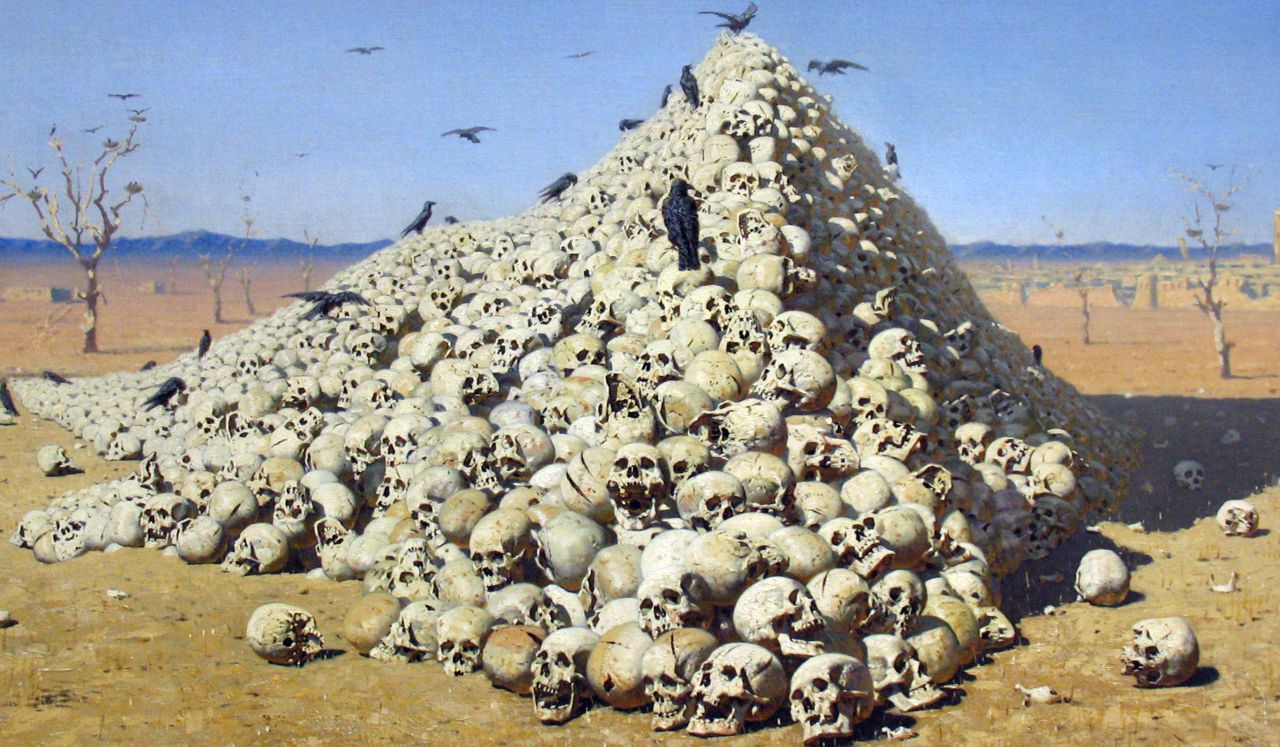
Skulls.
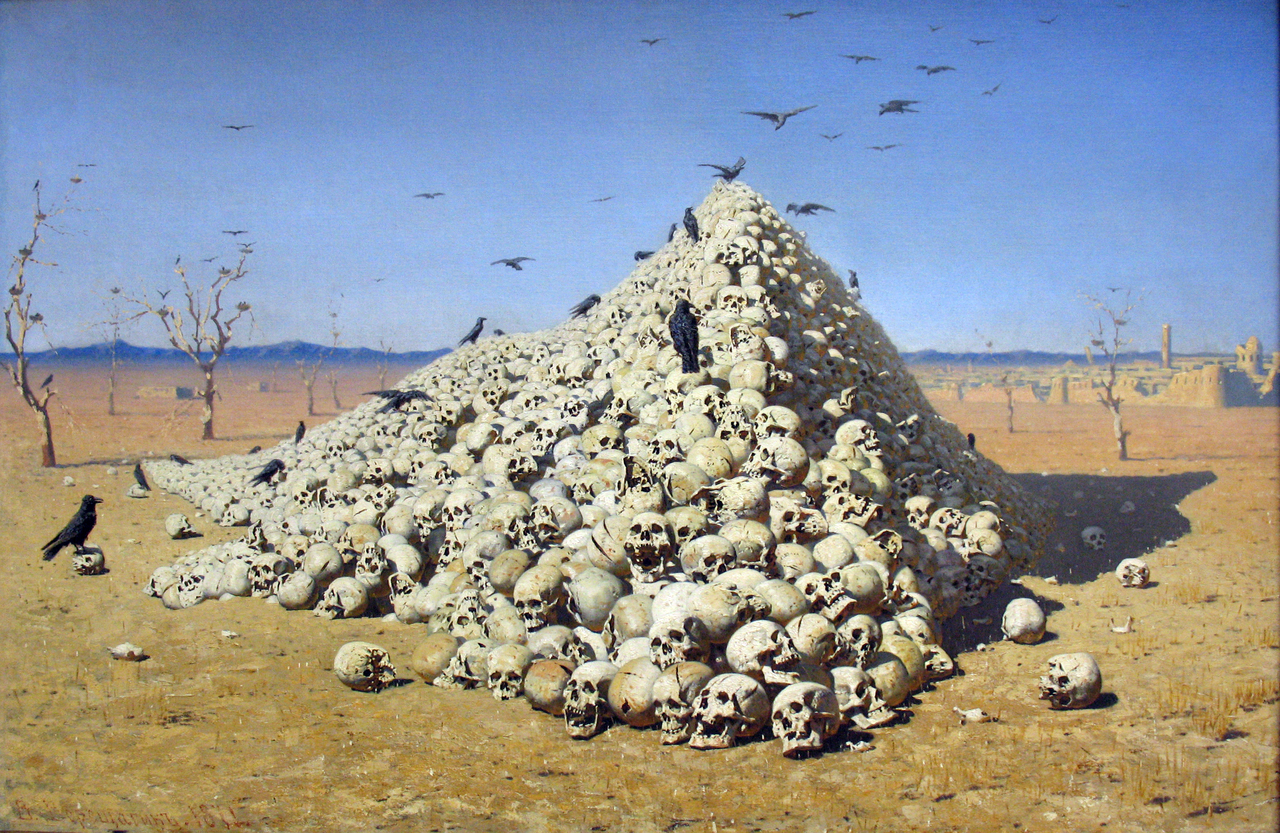
Skulls with mouths clamped shut and vacant stares. Skulls with mouths agape, frozen mid-scream. Bone fragments with split crowns, unhinged jaws, faces pressed into the dirt. Someone has gathered them and stacked them into a pyramid — no ceremony, no care, just tossed and trampled and rammed into place. Crows swarm the mound, jabbing their beaks into the gaps, pecking at the last hardened clots of blood. Each of these skulls was once a father, perhaps. A mother cradling an infant. A young person who came to the city with dreams. A child who met the world with wide eyes. Generals and foot soldiers, poets and bakers, lovers and neighbors. Thousands of bones, thousands of sorrowful stories. Every possibility, every unrealized potential, stops here — not paused, but extinguished forever. Among the crumbled walls, the parched earth, the brittle grass and withered trees, there is no flower left to bloom.
A cheap provocation that insults the pride of our people.
( ... )
The painter is either a beast unfit for decent company,
or a man who has completely lost his mind.
These were the words of Alexander Alexandrovich Romanov, the Russian imperial crown prince who would later become Tsar Alexander III. He reportedly delivered this scathing verdict while touring the exhibition where the painting held pride of place. Upon hearing the news, the painter is said to have slashed and burned three of his own works on similar themes — not out of fear at having drawn the crown prince's ire, but out of despair that even the crown prince could think no differently. The painter was Vasily Vereshchagin. The work that provoked the royal fury was titled The Apotheosis of War. Carved into the frame were the words: "Dedicated to all great conquerors, past, present and future." Dedicated with what? With this tower of skulls.
'Does war have two faces?'
A commander bellowing the charge. A cavalry unit surging forward with a battle cry. The high ground seized after rescuing, recapturing and overwhelming the enemy.
It was an era when war could be cast as romance, as myth, as something worthy of celebration. War painting meant golden medals, cunning strategy, sweat and sand, great drums and trumpets — that was simply what the genre demanded.
But what was the reality? Could rifles and bayonets truly be made to seem sweet?
Vereshchagin was, before he was a painter, a soldier.
Vereshchagin had ridden into battle, military cap on his head. The more of that experience he accumulated, the deeper his convictions shifted — away from those who championed war and toward those who opposed it. At first glance a paradox, but on reflection not a paradox at all.
That was simply what war was.
Vereshchagin had watched comrades die — men he had shared a meal with moments before. He had seen limbs torn from fellow soldiers with appalling ease, and had stood beside men whose breathing stopped with a swiftness that felt almost insulting. Those who sat in velvet palace chairs tracing lines on maps could not know it, but for the soldier in the mud, war offered nothing but one more vision of hell.
Does war have two faces?
Can it wear both a pleasant, alluring expression
and an ugly, repulsive one?
It cannot. War is only one thing.
Killing and wounding as many people as possible,
taking them prisoner.
The stronger adversary crushing the weaker
until the weaker begs for mercy.
This is the only expression — the only truth — that war can show.
This passage is attributed to Vereshchagin's own writings. It reads like something set down after he had felt to his bones that what war ultimately leaves behind is not glory but skulls and corpses — the end of countless lives.
In his eyes, this was the true nature of all the world's wars that had been "apotheosized." Not something fit for heroic verse, noble song or elegant speeches — only a heap of bones.
From naval officer to painter
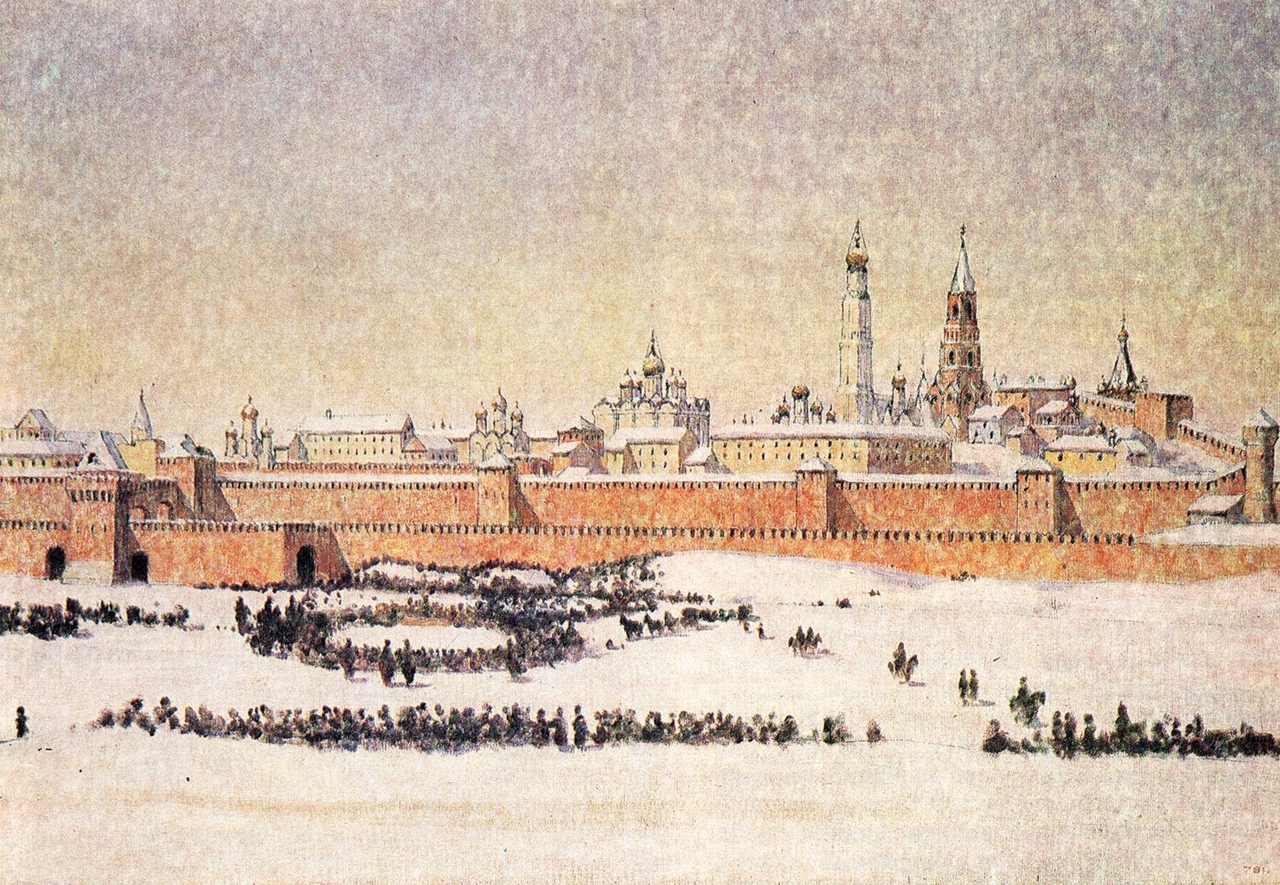
Vereshchagin was born in 1842 in Cherepovets, Novgorod Oblast, Russia.
His father was a landed nobleman; his mother was of common birth. At eight, Vereshchagin enrolled in a military preparatory school, and three years later entered the Naval Academy in St. Petersburg. Vereshchagin sailed on active duty, serving aboard a frigate with postings in Denmark, France and elsewhere, and graduated with distinction in 1860 at the still-young age of eighteen. A continued naval career seemed the natural path — but Vereshchagin abruptly resigned his commission, defying his parents' wishes. The path chosen led to the St. Petersburg Academy of Arts. Vereshchagin had long been drawn to painting, an interest that appears to have taken root when art was encountered as part of the general curriculum at the military preparatory school.
No one thought to nurture my talent
and guide me toward a career as a professional painter.
( ... )
They would have seen it as madness —
abandoning the secure path of a naval officer
for the uncertain life of a painter.
Vereshchagin committed that act of madness anyway. His father, on hearing the news, promptly cut off his allowance.
Vereshchagin paid it no mind and set out on a journey to discover what to paint and how.
He began by studying history painting at the academy, but quickly grew tired of its prescriptive approach — the insistence on painting toward a predetermined answer. Seeking "a broader, freer place" and wishing "to learn from nature," he spent time in the Caucasus. Later he traveled to Paris, where he studied under the academic painter Jean-Léon Gérôme. Vereshchagin chafed again at the rigid instruction, yet Gérôme's obsessive attention to detail left a considerable mark on him.
Witnessing the carnage firsthand
Would you come with us to the front?
In 1867, Vereshchagin received an invitation from Konstantin von Kaufman, then governor-general of Russian Turkestan. Kaufman wanted Vereshchagin to document the campaign as an embedded war artist. Vereshchagin accepted without hesitation. Having trained as a cadet, he was no stranger to combat in theory — but that knowledge had come mostly from reading, writing and listening at a desk. A real battlefield was something else entirely. Some illusions may still have lingered. "I wanted to know firsthand what war truly was — what I had only read about in books and heard described countless times." Vereshchagin wrote as much himself.
The illusions shattered quickly.
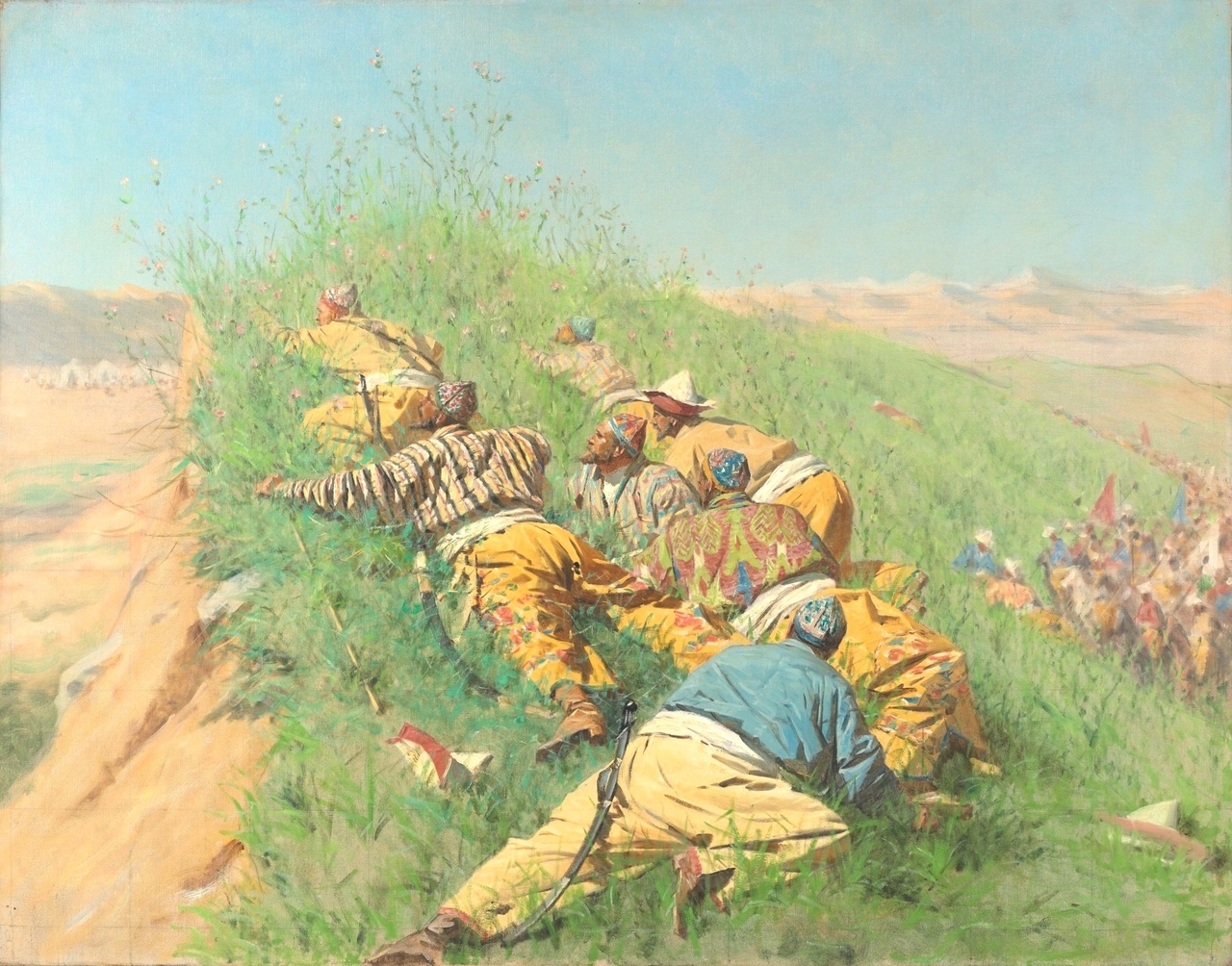
Vereshchagin fought his first real engagement at a fortress — the defense of Samarkand, as it came to be known. The Russians held the territory, but a fierce enemy counterattack had left them encircled. It was, in short, an extremely dangerous moment.
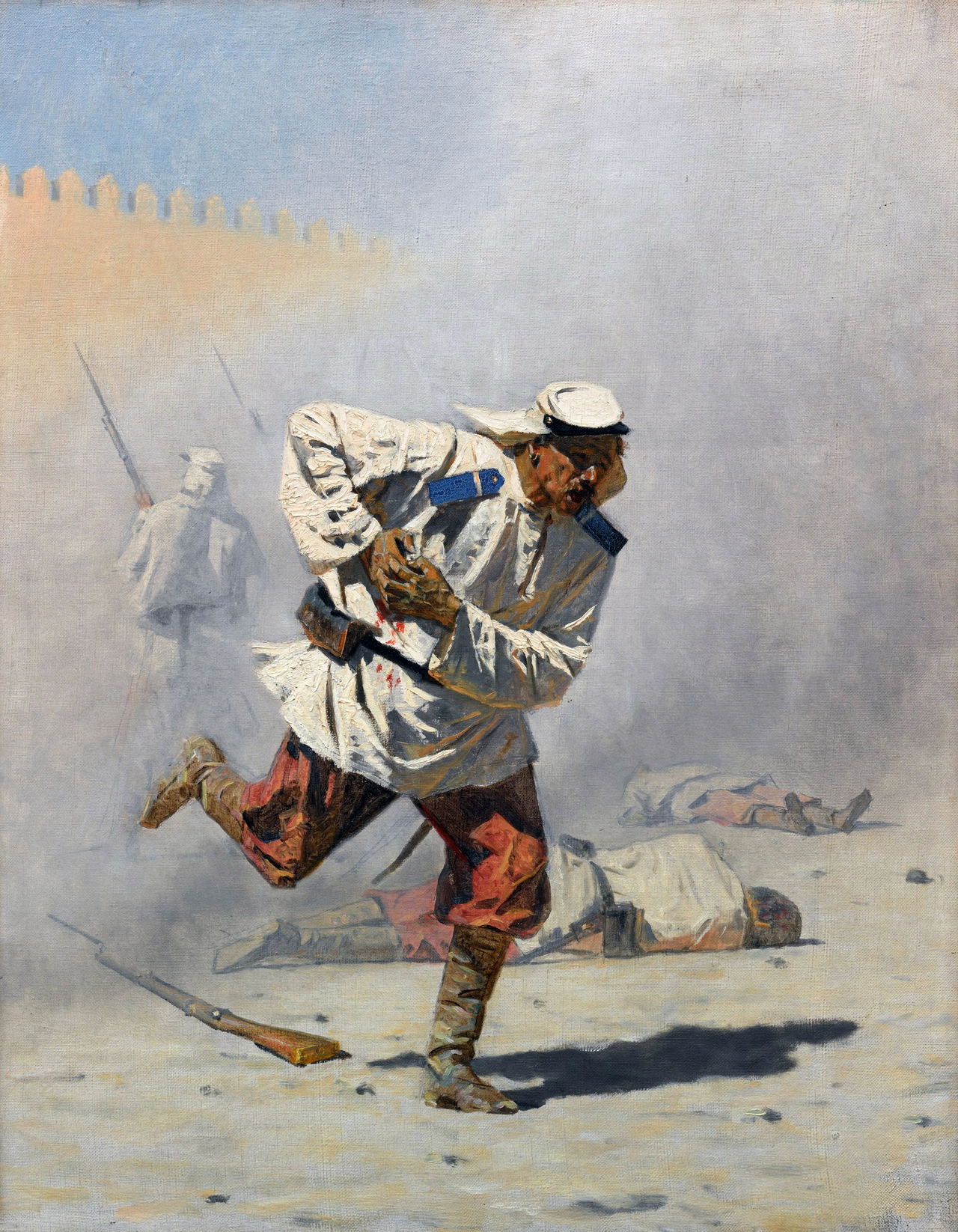
Noble resolve? Heroic sacrifice? The protagonists that bards had always placed at the center of their stories were nowhere to be found. What ruled the scene was fear and dread. Most of the soldiers seemed to spend every night weeping, trembling, groaning. Words like "glory" and "dedication" would have been absent from the diaries they kept. Outside, cannon fire never ceased. Incomprehensible taunts flew back and forth; acrid dust and pulverized stone hung in the air. Each day felt like a month. They held out for eight days. Unlike the many painters who relied solely on officers' accounts or studio staging, Vereshchagin understood with absolute clarity what needed to be painted. And Vereshchagin did not merely tremble. At times a rifle was seized and Vereshchagin charged out to bolster the garrison's morale. For that role in the defense, Vereshchagin was awarded the Order of St. George, Fourth Class. But the gleaming medal was not all carried away from that fortress.
From that point on, Vereshchagin threw himself into painting war with everything he had.
Not the romanticized scenes others sang into being, but the landscapes he himself had seen and survived.
At the wall: let them in
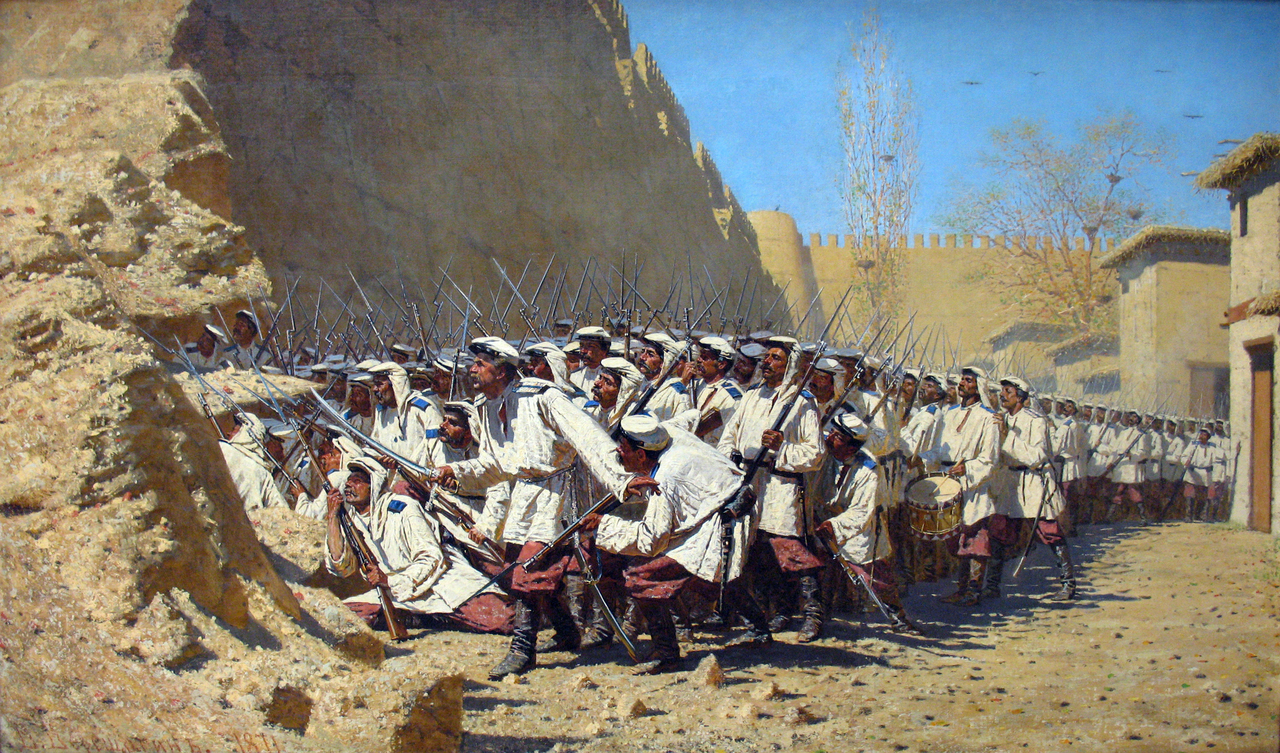
A group of soldiers in white uniforms — roughly a company in strength.
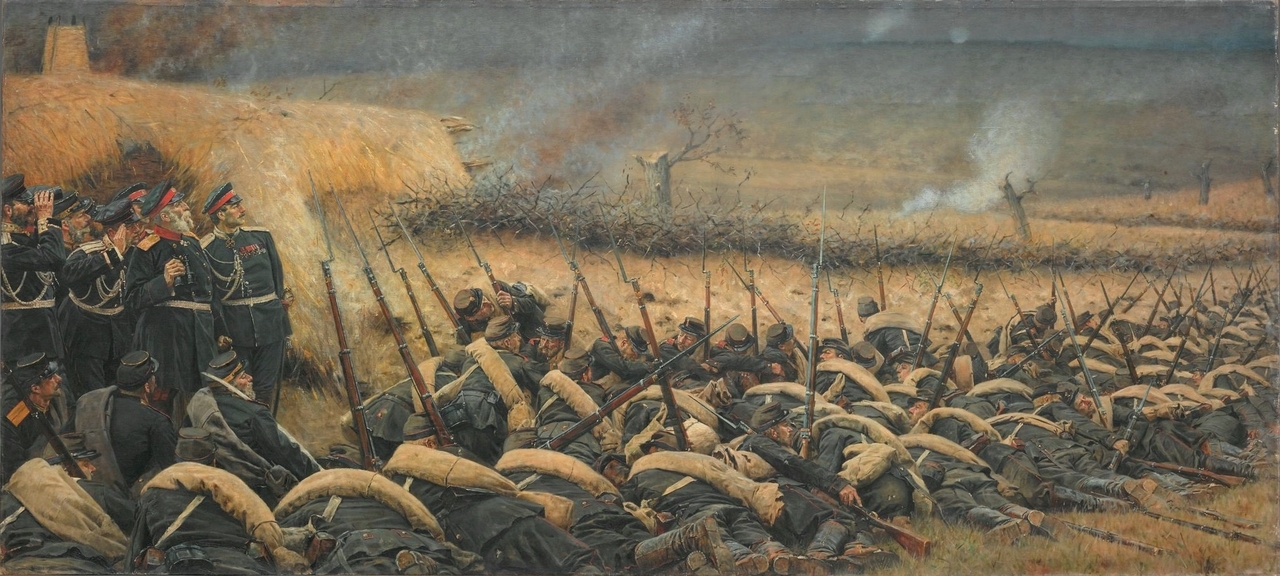
Armed and moving in careful silence along the walls of Samarkand. The sun beats down. The uniforms are white, but the skin beneath is burned red. The rifles and bayonets are long and heavy, yet every body is hunched and braced. All of them are worn out from the bombardment — frightened, tense. One soldier grips a comrade's shoulder as though his legs might give way. There is no proud march. No triumphant gunfire, no dramatic victory. What registers is only fear and fatigue. This is Vereshchagin's painting At the Walls of the Fortress: Let Them In.
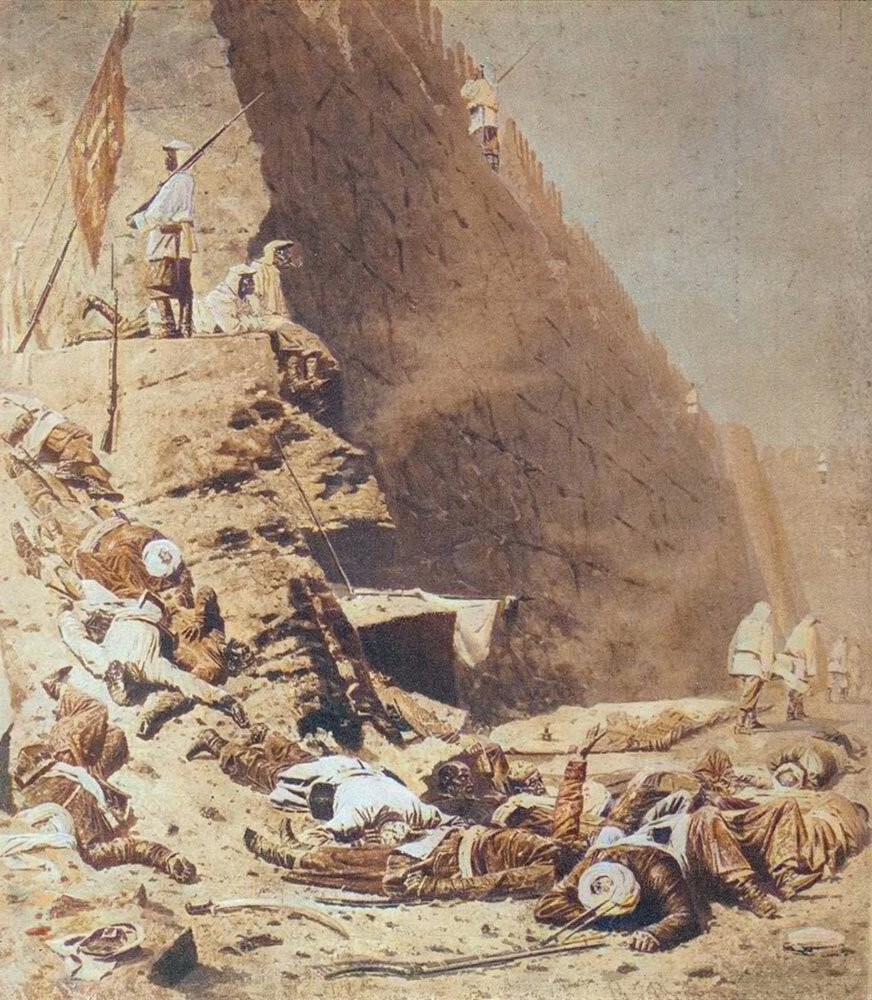
And when the fighting ends, what follows?
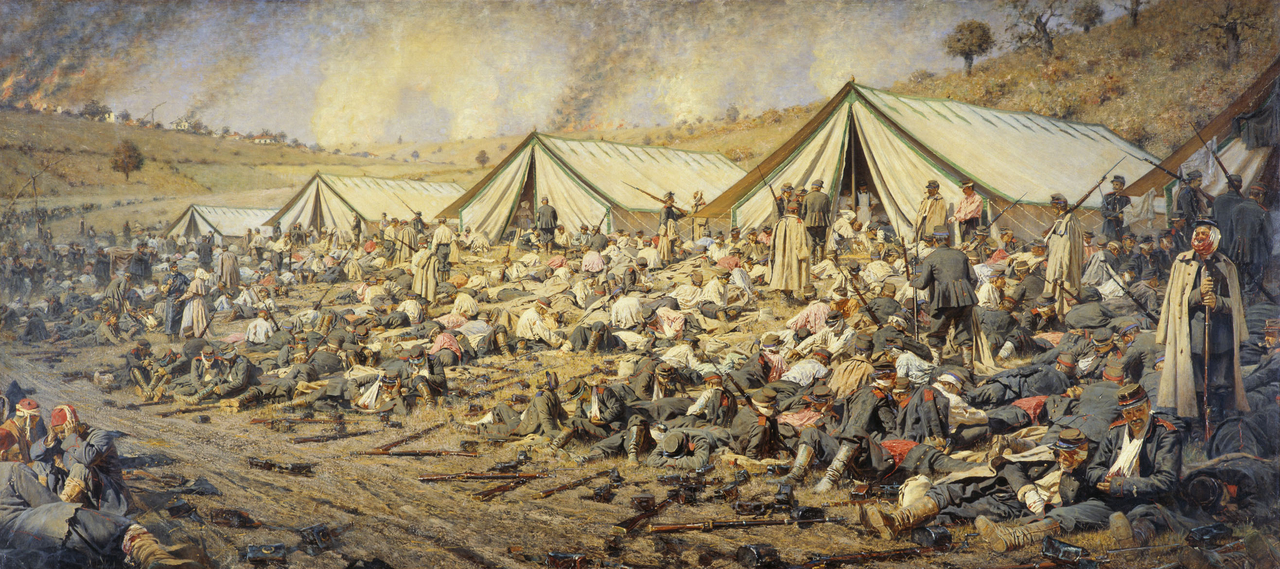
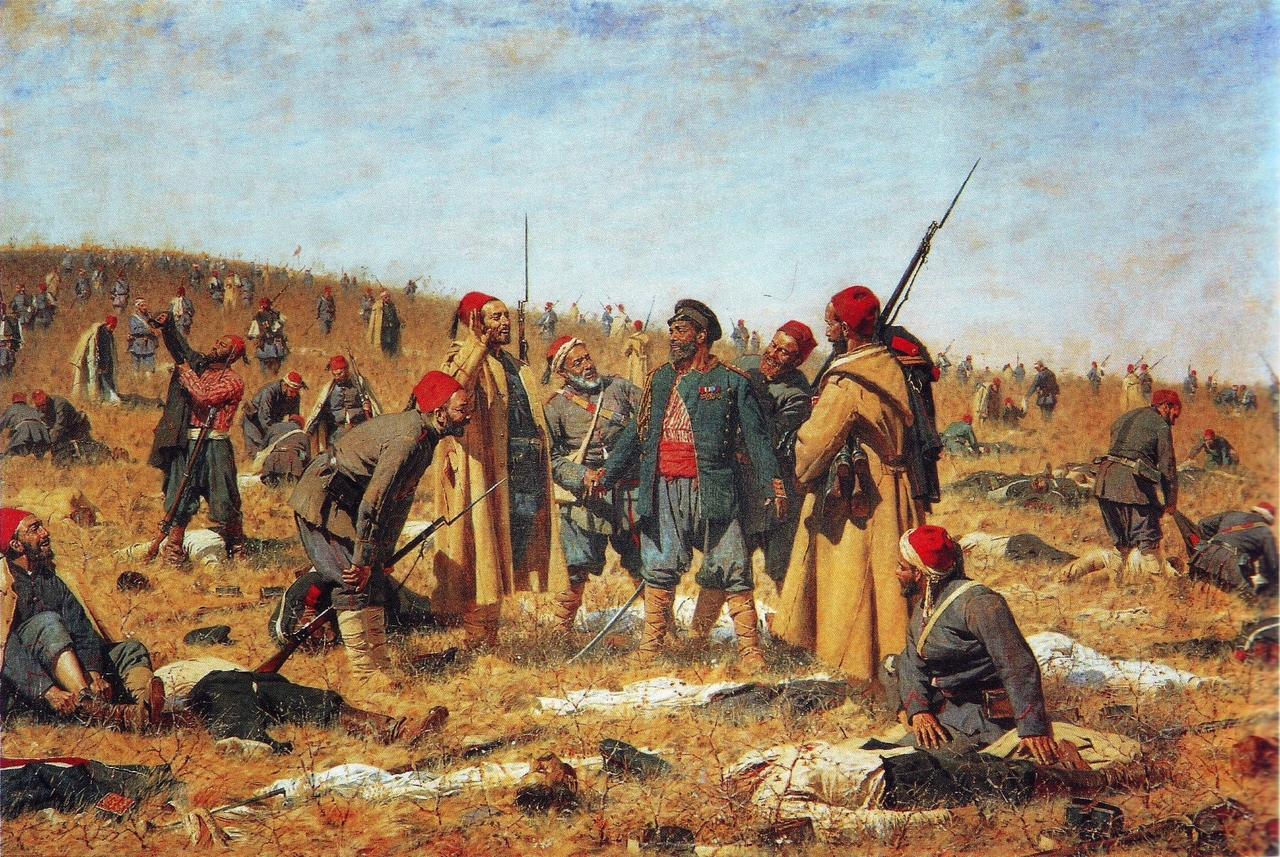
Death, in vast numbers. Friend and enemy alike, limbs tangled together, lives extinguished. Blood becomes as familiar as water; the final screams erase every casual conversation that came before. Neither the dead nor the survivors can hold their heads up. Flags and trumpets are a luxury these people cannot afford. This is the painting Vereshchagin made next: At the Walls of the Fortress: They Have Entered.
Truth mistaken for propaganda
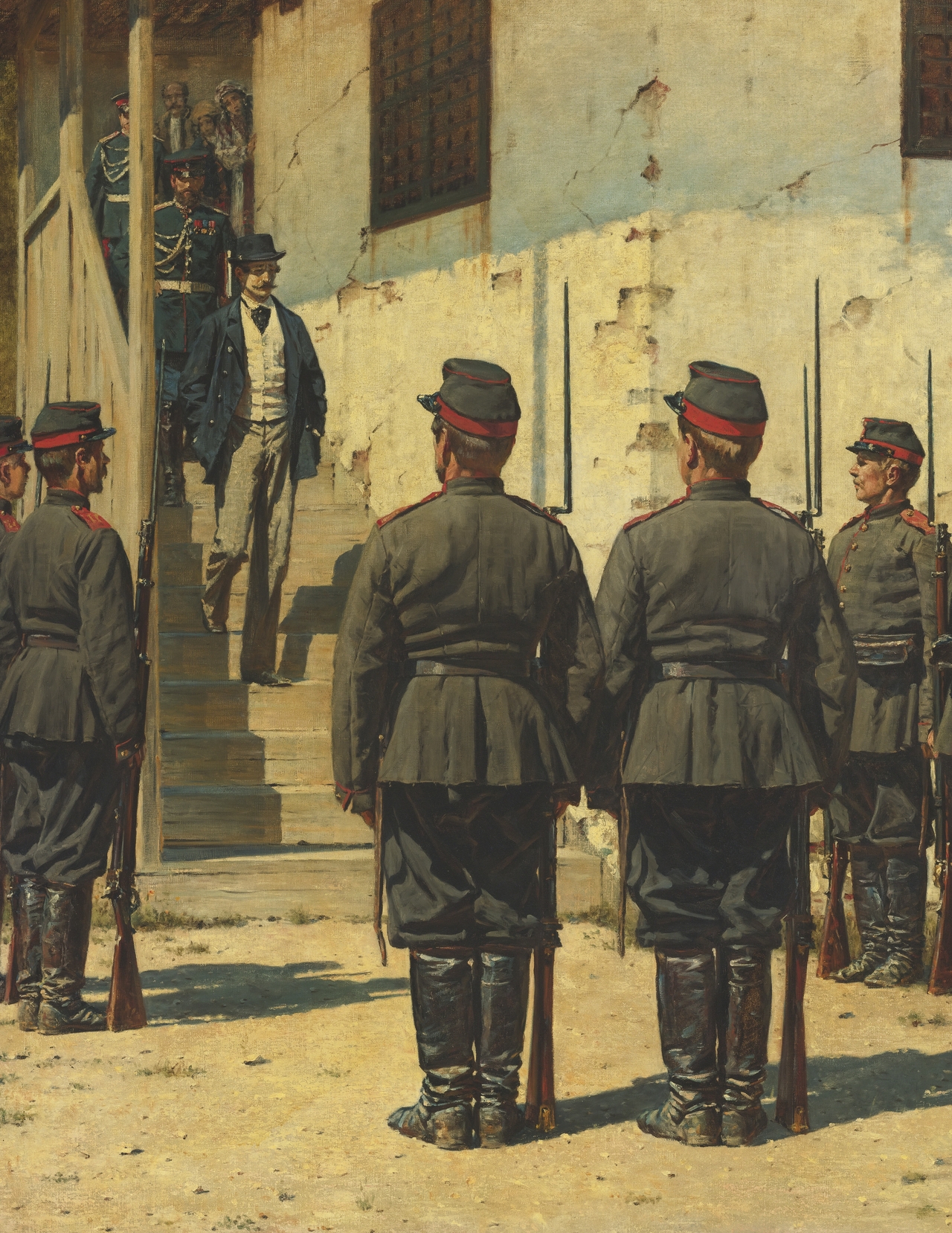
This, at least, was the battlefield Vereshchagin had seen. This was what war had amounted to, in his experience.
In the spring of 1874, Vereshchagin mounted a solo exhibition in St. Petersburg and hung these paintings for the public. The Apotheosis of War was among them. The crown prince reportedly stood before the work and called the painter a "beast" and "a man who has lost his mind." Critics soon joined the chorus. Depicting the brave soldiers of the empire and its honorable wars in such a manner, they said, was tantamount to a crime. Most of those critics had never once stood among soldiers on a real battlefield, never felt the wind carrying the smell of blood.
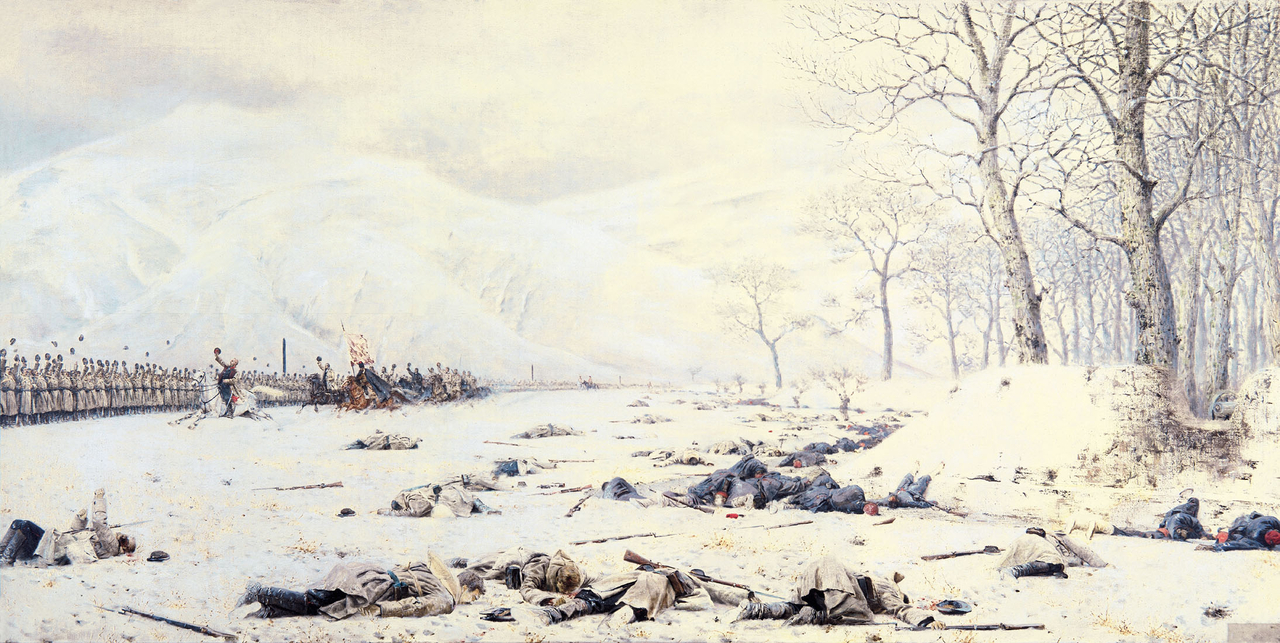
Meanwhile, word circulated that Alexander II, the reigning tsar at the time, had also expressed anger over the paintings.
That would make for a compelling addition to the narrative of Vereshchagin's persecution, but the claim is far from certain. The journalist Fyodor Bulgakov, for instance, left a record stating: "( … ) this rumor was entirely false. The emperor expressed admiration and praise. ( … ) The imperial private secretariat also confirmed that the emperor had shown not the slightest displeasure." In fact, that same year the Academy of Arts offered Vereshchagin a professorship. Still, it is true that many influential figures of the day received his paintings as propaganda and distortion. That atmosphere almost certainly explains why Vereshchagin cut works including At the Walls of the Fortress: They Have Entered from their frames and destroyed them. The professorship? That offer, too, was flatly refused.
War without end
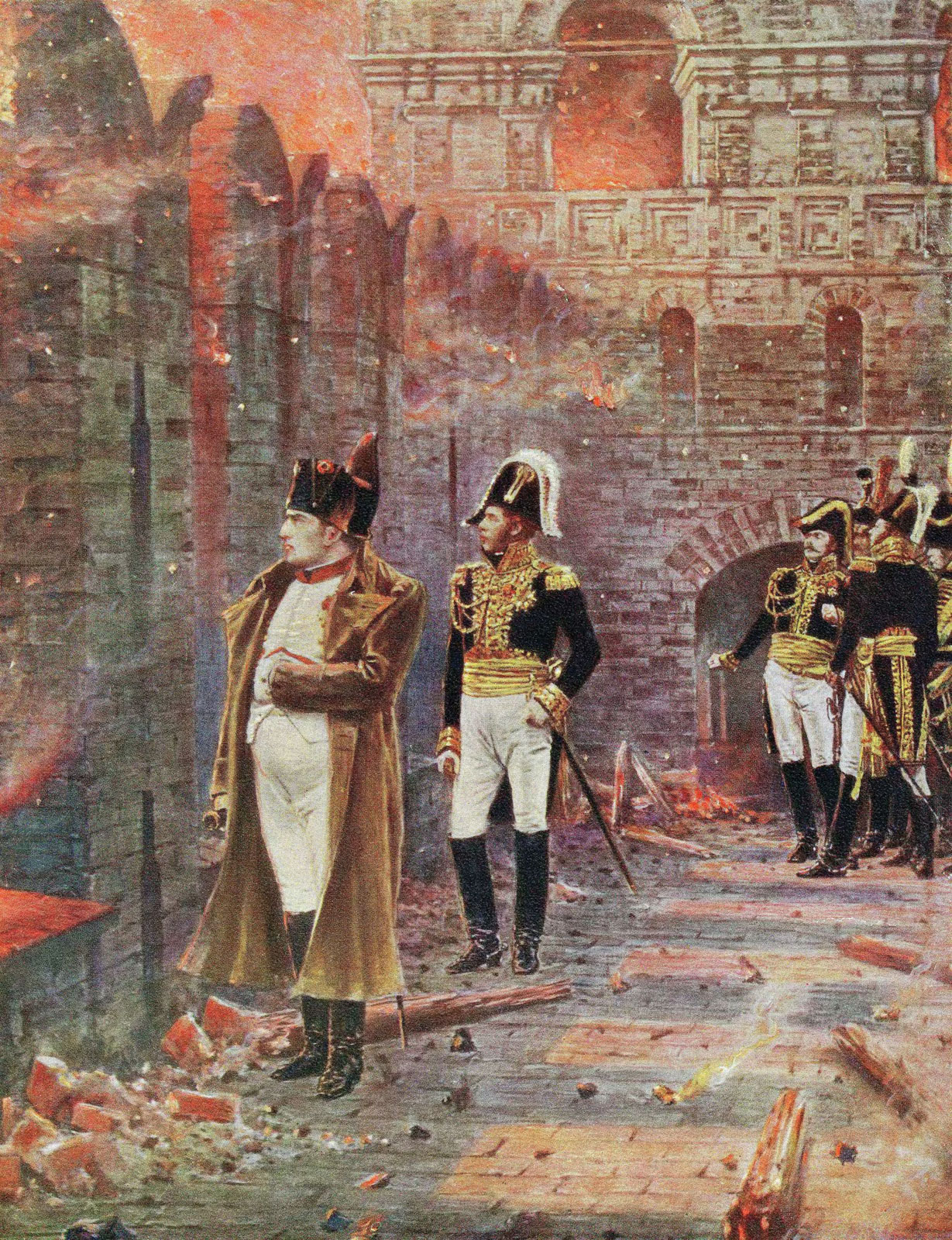
Vereshchagin traveled the world.
He crossed continents without hesitation — Europe, Mongolia, Tibet, the Himalayas, British India. He returned to war zones as well, driven by a need to once again "endure cold and hunger" and "face the risk of injury and death" before putting brush to canvas. The conflict he next sought out was the Russo-Turkish War of 1877–1878. Whether he truly wished for it is impossible to say, but this time he was shot. "A dull blow struck my thigh. It felt as though I had been hit with the flat of an axe." That was how Vereshchagin recalled it. The wound was more serious than it first appeared; had treatment come any later, the outcome could have been irreversible. Vereshchagin survived. A younger brother, who had gone to war alongside him as an officer, did not — killed in combat. The entire regiment could honor the brother's valor, but it was too late. The dead receive nothing.
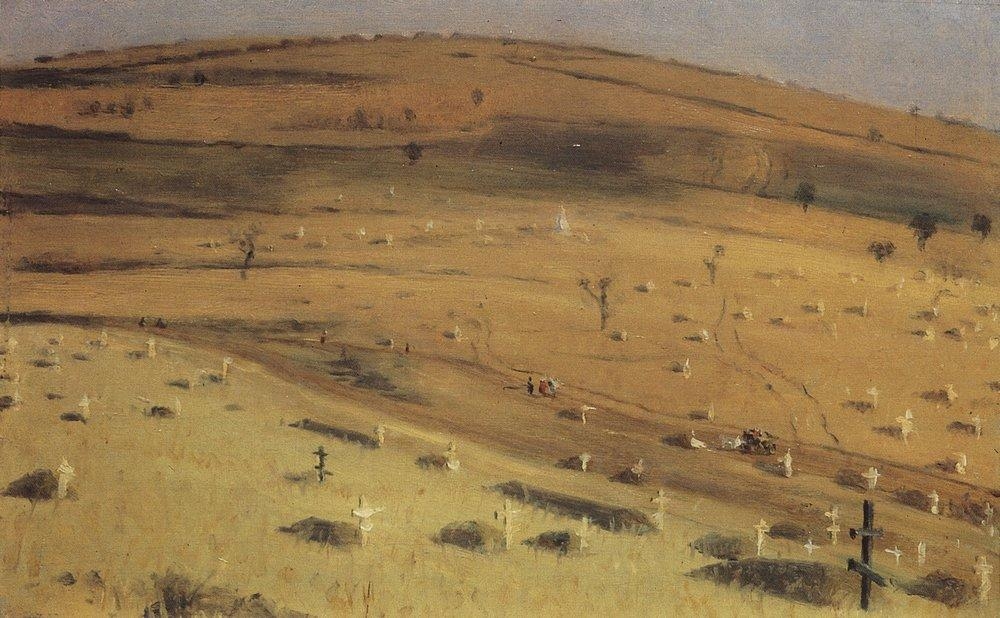
As I wandered the world and reflected on life,
I was struck deeply by the fact that even now
human beings are killing one another
by every conceivable pretext and means.
Mass slaughter is still called war,
( ... )
and a ruthless cult of brute force and self-contradiction holds sway...
What shocked Vereshchagin most of all was that even as the age had advanced into the modern era, war remained the most readily reached-for instrument. "Even nations invoking the name of a God who taught love and peace are waging such things." That was no exaggeration. The record left from those years does not lie.
The greatest violence
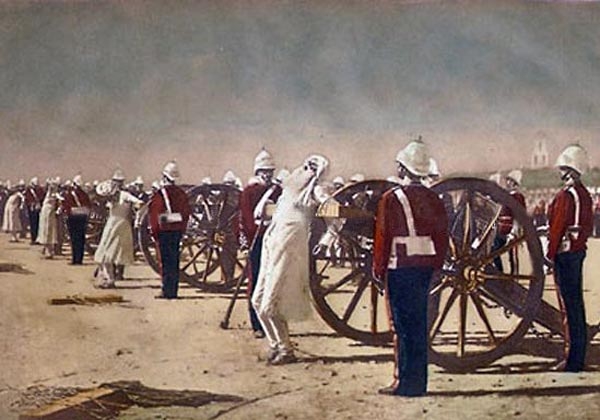
Vereshchagin's gaze widened. He now seemed to think beyond his homeland, toward continents and humanity as a whole. The work unveiled around 1884, Blowing from a Gun in British India, was part of that turn.
British soldiers have bound an Indian man to the mouth of a cannon — a method of execution known as "blowing from a gun." The trigger is about to be pulled. The body will be blown to pieces beyond any hope of recovery. The backdrop was the Sepoy Mutiny of 1857, when British forces crushed an uprising led by Indian sepoy soldiers with merciless force. Britain had been ruling India as a colony under the banner of the East India Company, and the rebellion was a direct consequence of its brutal exploitation and exclusionary policies. And this was how the war ended — once again, the greatest violence visited first and hardest upon the weakest. Most British viewers disliked the painting, particularly the fact that the soldiers in it wore contemporary uniforms. "This depicts something that happened nearly thirty years ago," the complaint ran, "yet the painting makes it look as though we are still doing such things." Vereshchagin responded in a contribution to The Magazine of Art: "If another rebellion were to break out, the British would without doubt resort to this method again."
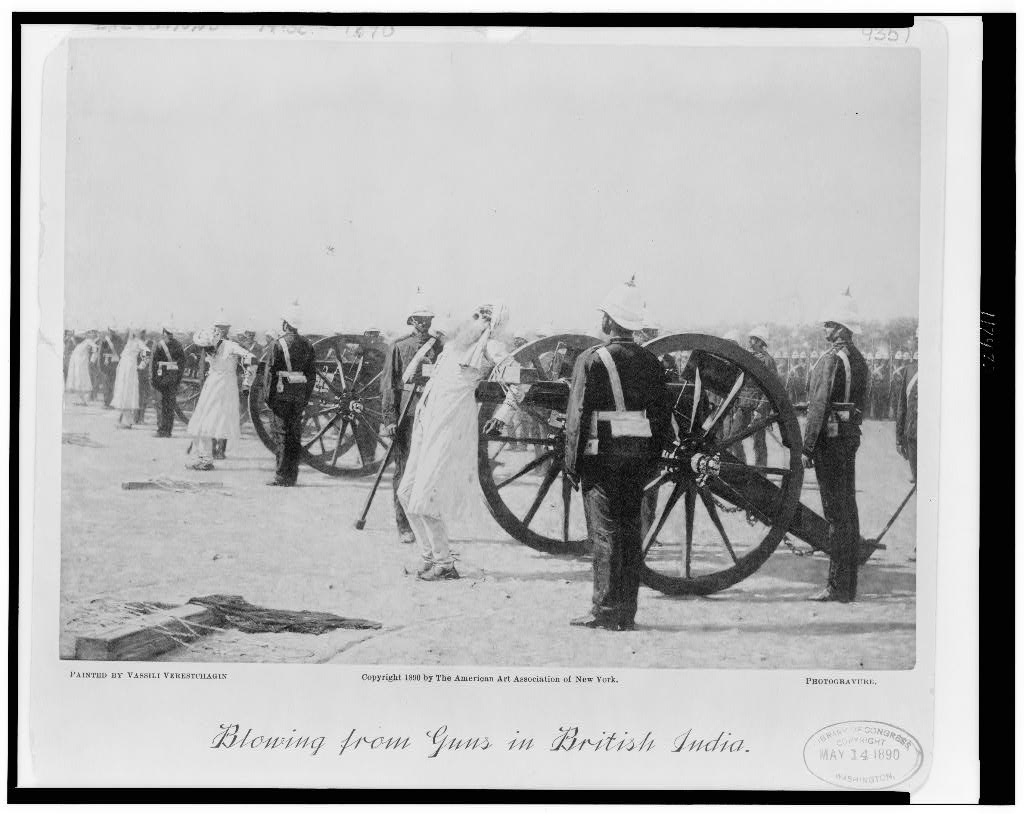
The painting Blowing from a Gun in British India was in fact based on the Kuka Massacre of 1872.
In that incident, British forces executed around sixty-six Sikh men by cannon for protesting and resisting the slaughter of cattle. That so many British viewers immediately thought of the Sepoy Mutiny upon seeing the painting was, in a common phrase, a case of a guilty conscience betraying itself. Britain's ruling class must have known, at least somewhere in the back of their minds, the true face of war — that no matter what justification is layered over it or what noble purpose is used to dress it up, what it produces in the end is only scenes like this. For the painter, that was no bad thing. A single canvas could show two brutal outcomes at once. The original no longer exists. According to what sounds almost like legend, a British buyer purchased it in the United States and burned it personally. No firm evidence survives.
'The goddess of vengeance pursued me'
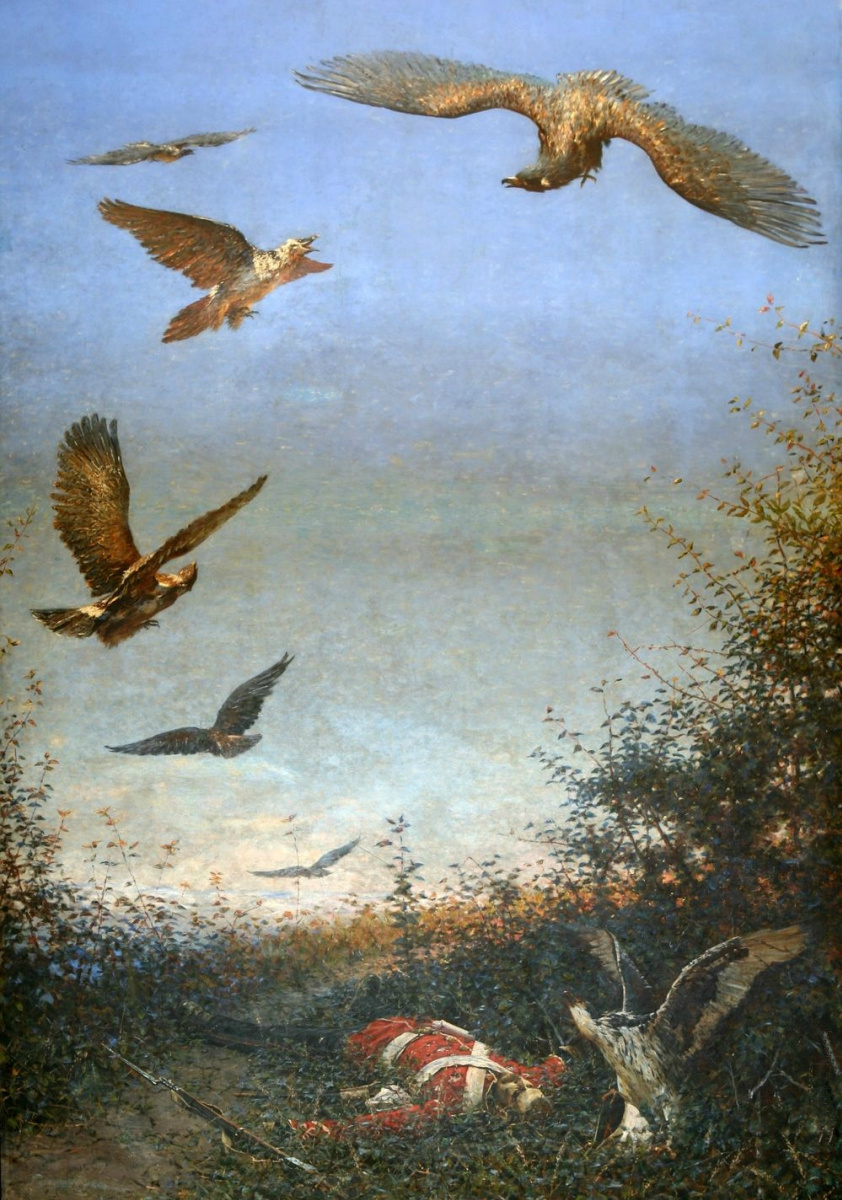
Vereshchagin, a war painter in every sense of the phrase, met his death on the battlefield as well.
It was April 13, 1904. The Russo-Japanese War — fought over dominance in East Asia — was at its height. Vereshchagin was aboard the battleship Petropavlovsk, flagship of Admiral Stepan Makarov, once again in the role of embedded war artist. Near the anchorage at Port Arthur, the ship struck two mines and exploded. Vereshchagin died in the blast at the age of sixty-two. The admiral perished alongside him, and of the roughly 700 crew members, between 620 and 650 were killed. In his final moments, Vereshchagin had reportedly been calmly sketching the scene of a strategy meeting presided over by Admiral Makarov. When the wreck was later searched, only six bodies could be recovered. More than 600 had died, yet barely one percent of the remains could be retrieved. War, to the very end, did not change its face.
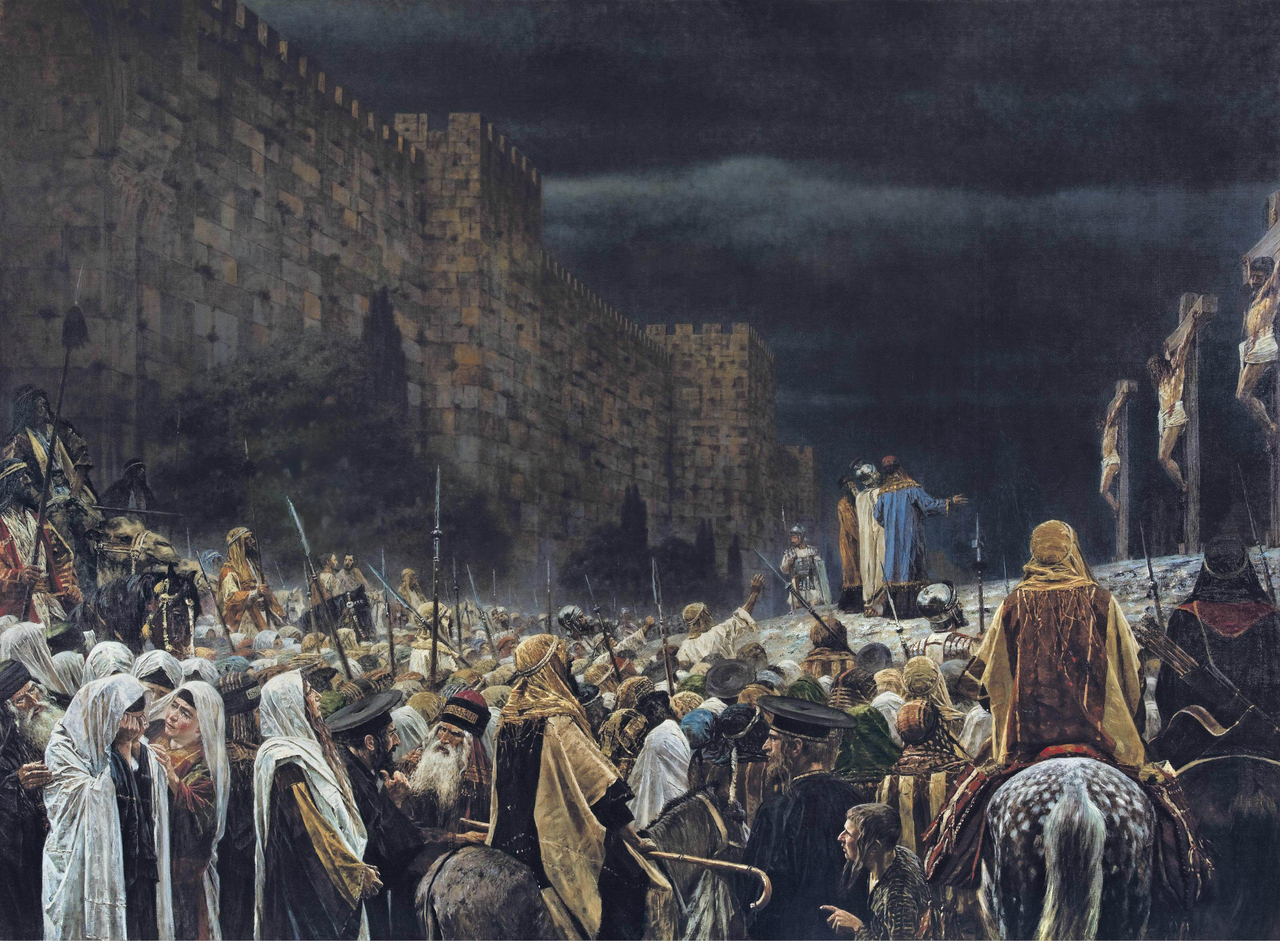
All my life I loved the sun, and I wanted to paint the sun.
After living through war and giving voice to what I felt about it,
I was overjoyed when I thought I could at last return myself to the sun.
But war —
that goddess of vengeance — pursued me without end.
Vereshchagin once laid bare innermost feelings in these words. "I no longer wanted to paint war. ( … ) I took what I painted too deeply into my heart. I had to weep for each wounded and dead person, one by one." Vereshchagin is also said to have expressed the same sentiment in words to this effect on another occasion.
Undeniably a war painter — one who produced so many war paintings that rumors circulated of a hidden assistant — Vereshchagin's ultimate dream was to stop painting war. More precisely, it was for a world to arrive in which there was no war left to paint.
That dream remains unfulfilled. There is no sign it will be fulfilled anytime soon. At a moment when the world should be seeking forgiveness from the goddess of vengeance, it seems only to provoke her again and again. That is a sorrowful thing.
References
Vasily Vereshchagin, Essays, Sketches, Reminiscences, Publishing Technologies / Palmira
Vassili Verestchagin, On Progress in Art, New York: American Art Galleries
Barooshian, Vahan D., V.V. Vereshchagin: Artist at War. Gainesville, University Press of Florida
Leonard D. Abbott, Verestchagin, Painter of War, The Comrade (New York), vol.1, no.7
yul@heraldcorp.com




