
October average rate at 1,335.7 won — down 192 won from June
Rate hit consecutive yearly lows for 5 sessions before late-month spike
Semiconductor export inflows vs. retail investors' overseas stock demand
Last time rate was in 1,200s: Dec. 28, 2023
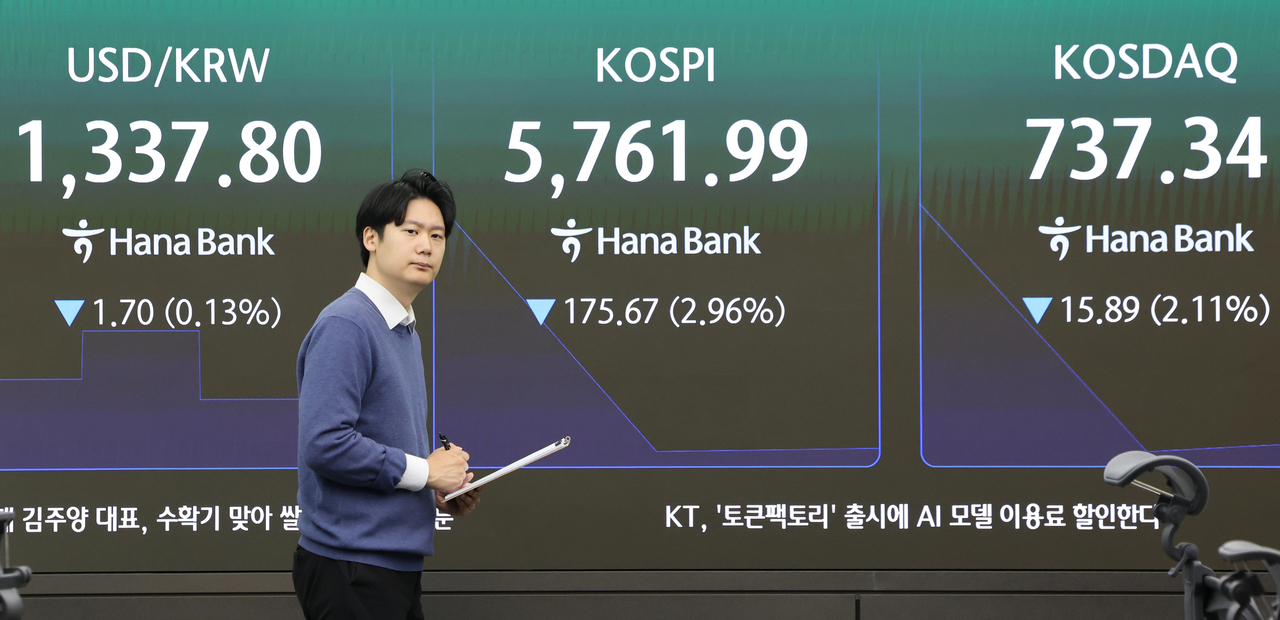
After hovering in the 1,500-won range, the won-dollar exchange rate has fallen for four consecutive months and is now trading in the low-to-mid 1,300s. Despite a brief rebound, analysts expect the rate to continue declining gradually, driven largely by semiconductor export earnings. Some observers say the won could test the 1,200-won level in the first half of next year.
According to the Bank of Korea, the monthly average won-dollar rate in October — based on weekly closing prices — stood at 1,335.7 won. The rate peaked at 1,527.95 won in June before falling in each of the four subsequent months: 1,488.92 won in July, 1,404.35 won in August and 1,358.75 won in September.
The rate dropped sharply from mid-October. It hit a yearly low of 1,331.4 won on Oct. 16 on a weekly closing basis, then set fresh yearly lows for five consecutive sessions through Sunday, reaching 1,324.2 won. It edged up slightly before falling further to 1,323.1 won on Monday.
The trend reversed at month's end, however. The rate closed at 1,337.7 won on Wednesday, up 14 won from the previous session — the largest single-day gain in more than five months since May 12, when it rose 17.5 won. Offshore investors bought back dollars ahead of the Federal Open Market Committee meeting and amid a surge in global oil prices, pushing the rate higher.
Market participants say the late-month spike has unwound speculative positioning that had been skewed toward won strength, returning it to a more neutral stance. Exporters have been consistently selling dollars on the back of strong semiconductor shipments, capping the rate's upside. On the other side, import settlement demand and currency conversion for overseas equity investment are providing a floor.
According to the Korea Securities Depository, domestic investors' net purchases of overseas securities — stocks and bonds combined — jumped 71.5 percent in October to $7.09 billion, up from $4.13 billion in September. Net purchases refer to buying that exceeds selling.
The market consensus is that the won-dollar rate will continue a gradual decline, even as upward and downward pressures remain roughly balanced.
The biggest driver pulling the rate lower remains "semiconductor dollars." According to the Korea Customs Service, average daily exports from Oct. 1 to Oct. 20 hit a record $4.74 billion. Semiconductors accounted for 44.7 percent of that total, up 16.2 percentage points from a year earlier. The cumulative current account surplus for January through August reached $279.2 billion, more than double last year's full-year surplus of $123.1 billion.
With dollar inflows from exports outpacing outflows from overseas investment, the global strong-dollar trend has had limited impact on South Korea.
"Given the historical scale of the won-dollar correction and wariness over the National Pension Service suspending its currency hedging, the 1,320-won level could serve as near-term resistance," said Lee Jeong-hun, a researcher at Daishin Securities. "But reflecting the strength of supply-demand dynamics and an expected dollar weakening in the first half of next year, the rate will likely attempt to break into the 1,200-won range during that period."
The last time the won-dollar rate — based on the Seoul foreign exchange market's closing price — traded in the 1,200-won range was Dec. 28, 2023, when it closed at 1,288.0 won.
Upward pressures remain significant, however, and are expected to slow the pace of any decline. If concerns grow over the return on AI investment by US big-tech companies, expectations for the semiconductor sector could sour, and foreign selling of domestic equities could push the rate back up. Foreign investors were net sellers of 1.64 trillion won ($1.22 billion) worth of Kospi-listed shares in October.
The US midterm elections are another wildcard. Some in the market expect the dollar to strengthen if the Republican Party wins.
"The medium-term direction for the won-dollar rate is downward, but the pace of decline will be gradual," said Lee Min-hyeok, an economist at KB Kookmin Bank. "Domestic equity market corrections and foreign net selling of stocks could add upward pressure on the rate, but given the large-scale dollar supply from strong semiconductor exports, any rebound should be limited."
Monetary authorities also believe there is considerable room for the rate to fall further, given economic fundamentals. Bank of Korea Governor Shin Hyun-song, at a press briefing following the monetary policy decision on Thursday, said the won remains weaker than in previous years when measured on a real effective exchange rate basis.

kimstar@heraldcorp.com




