
Special keynote address at Ho Chi Minh City international economic forum
Keynote stresses 'PaaS' model — charging usage fees instead of selling products
'Can boost corporate competitiveness and supply chain stability,' Kim says
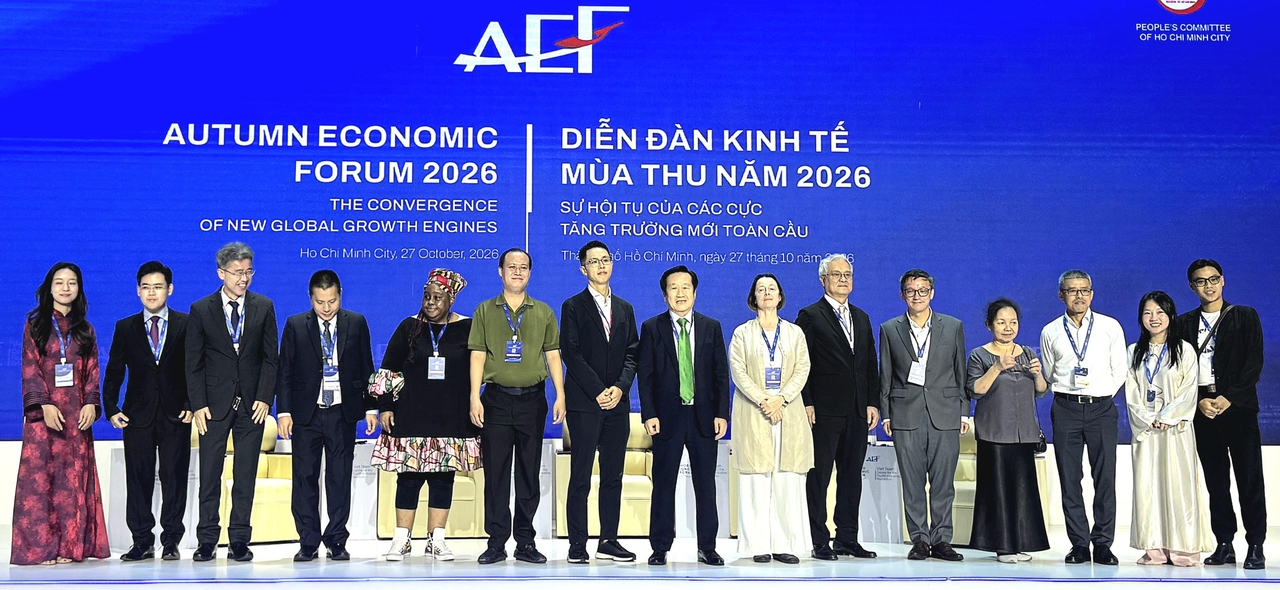
A business model in which companies retain ownership of their products and charge usage fees — rather than selling outright — has been put forward as a growth strategy for the ESG (environmental, social and governance) era. The argument is that transitioning to a "circular economy," which accounts for the full lifecycle of a product from production and consumption through recovery and recycling, can simultaneously boost corporate profitability and supply chain stability.
Kim Jae-hong, standing adviser to the Korean ESG Society and standing chairman of the ESG Practice Citizens' Alliance, made the case in a special keynote address at the "ESG and the Circular Economy" session of the 2026 Autumn Economic Forum, held Tuesday in Ho Chi Minh City, Vietnam.
In the address, Kim assessed that humanity's economic and industrial structure is evolving from a "linear economy" — in which resources are extracted, consumed and discarded — through a "recycling economy" that recovers and reuses waste, and onward toward a full circular economy.
"The linear economy, which extracts resources, produces and consumes them, and then discards them, was an industrial structure that polluted and destroyed the natural environment," Kim said. "The recycling economy emerged as a result of the environmental protection movement, but it was a transitional effort with inherent limits when it came to guaranteeing sustainable development and a viable future."
Kim added that "a circular economy is now emerging — one that goes beyond the after-the-fact processing of simple resource recovery and recycling, and instead encompasses resource planning, product design, the production process, distribution, consumption, and the reintroduction of materials back into the production process."
Kim particularly highlighted "Product-as-a-Service" (PaaS) as a new business model for realizing the circular economy.
Under PaaS, a company retains ownership of its products rather than transferring it to consumers through a sale, and instead charges users a fee for access. Because the company remains responsible for maintenance, repair and recovery of the product, it has a strong incentive to design for durability and ease of repair and remanufacturing.
"In the circular economy production model, a new form of retail is taking hold — one in which companies do not simply sell a product and walk away, but instead retain ownership while collecting usage fees from consumers," Kim said.
Kim went on to say that "this circular economy paradigm makes it possible not only to protect the environment, but also to create new revenue models for companies and minimize supply chain risk."
Kim also called on governments and businesses to play their respective roles in establishing the circular economy. Governments, Kim argued, should build standardization frameworks for recycled resources and eco-friendly materials, and expand the use of circular-economy-certified products in public procurement. For businesses, Kim proposed that resource circularity be incorporated into management strategy from the earliest stages of product planning.
The address drew attention from local media as well. The Korean ESG Society said VTV4, the international channel of Vietnam's state broadcaster VTV, covered the PaaS model Kim highlighted, noting its potential to encourage designs that improve product durability and facilitate repair and remanufacturing.
Vietnamese outlet Tuoi Tre reported on Kim's remarks urging companies to view ESG standards not as a mere regulatory burden but as a management capability for securing competitiveness in international markets, citing the EU's Corporate Sustainability Reporting Directive (CSRD) as a reference point.
The discussion also touched on broader efforts to strengthen ESG capabilities among Vietnamese businesses. Local participants raised concerns that small and medium-sized enterprises are struggling to access green finance due to a lack of ESG-related data and assessment and certification capacity. In response, Ho Chi Minh City announced a cooperative program to support small and medium-sized enterprises in transitioning to ESG practices and preparing for green finance.
Kim has long emphasized ESG not merely as corporate environmental activity but as a practical agenda for improving sustainability across society as a whole.
In an interview with The Herald Business in September 2024, Kim said, "The fundamental concept of ESG is sustainability," adding that "if companies, the government and local authorities properly practice human rights, labor rights, fair trade and environmental protection — the things they are supposed to do — that constitutes social reform, and introducing this into education is innovative education."
At the 5th World ESG Forum held in Jeju in March this year, Kim proposed the establishment of an "Asian Disaster Safety Cooperation Council," presenting joint disaster response among Asian nations as an international cooperation agenda under the ESG framework.
The Vietnam address gave concrete form to Kim's longstanding message on ESG sustainability, translating it into specific proposals for reforming corporate production and distribution structures and revenue models.
Kim previously served as a member of the 17th National Assembly and as president of Seoul Digital University. Currently, Kim serves as standing adviser to the Korean ESG Society, standing chairman of the ESG Practice Citizens' Alliance, and chairman of the board of Zenith Group.
pooh@heraldcorp.com




