
Korea Developer Association, real estate research institute envision region's future
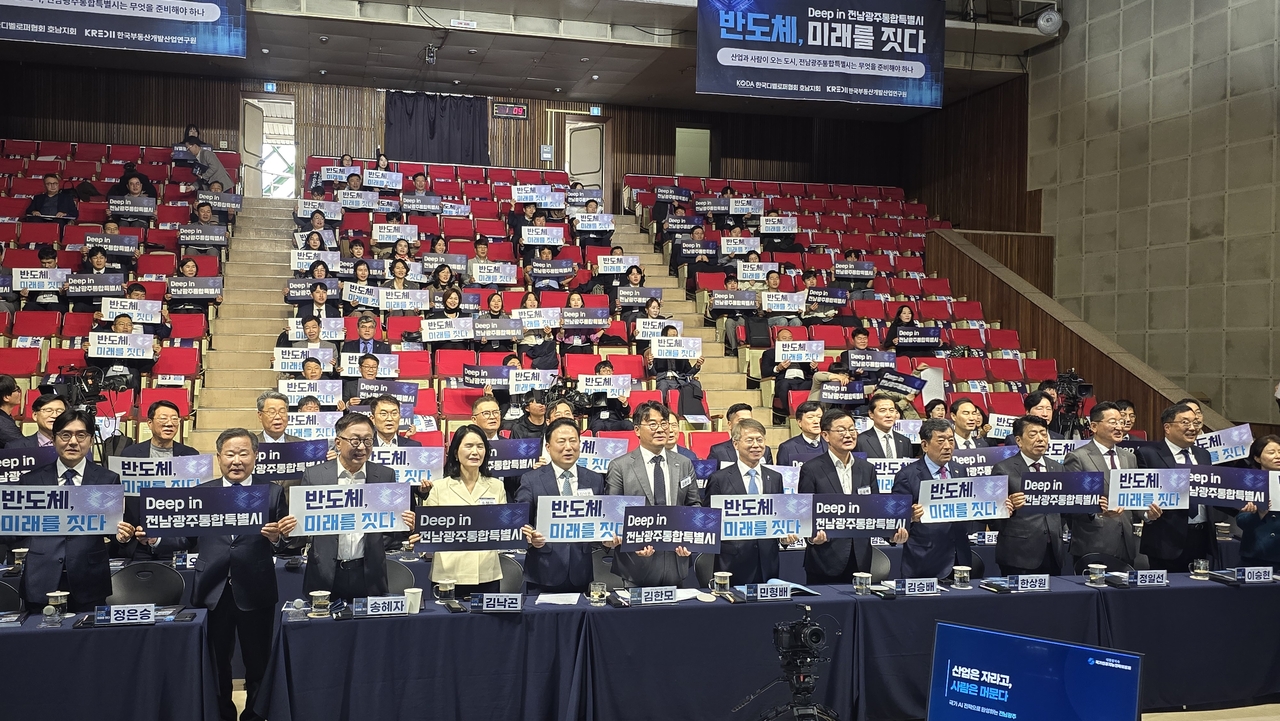
An international conference drawing attention to the future vision of a proposed integrated South Jeolla-Gwangju special city — shaped by the growth of an 800 trillion won ($599 billion) semiconductor industry in the Honam region — drew considerable interest Friday.
The Honam chapter of the Korea Developer Association and the Korea Real Estate Development Industry Research Institute held the conference, themed "Semiconductors: Building the Future," at the Gwangju MBC Public Hall on Friday afternoon.
The event centered on the question of how semiconductor development would change everyday life, exploring directions for building livable communities — covering housing, transportation, education and culture — driven by industrial growth, corporate investment and the resulting influx of population.
Song Hye-ja, chair of the regional special committee under the Presidential National AI Strategy Committee, delivered the opening keynote, forecasting that by 2030 the South Jeolla-Gwangju area would enter the ranks of AI capitals and the world's top 100 startup cities. Song cited the development of a world-class renewable energy-based AI data center in the Haenam Solaseado opportunity development zone, AI transformation facility investment at the Gwangyang steelworks, and the construction of a mega-project semiconductor fab in the Honam region as the drivers of that transformation.
Song added that the hardware foundation was already in place, and that the region now needed to complete the six quality-of-life conditions for an AI city — jobs, housing, education, healthcare, transportation and public safety — citing overseas smart city cases such as Kalasatama in Finland.
As a future strategy for the South Jeolla-Gwangju area, Song proposed creating more than 100,000 quality jobs in AI and semiconductors, building a smart integrated residential platform, developing specialized education centered on the Gwangju Institute of Science and Technology and the AI Convergence Industry Agency, fully introducing AI diagnostics and telemedicine, piloting autonomous driving, and establishing an AI-based early disaster warning and public safety network.
Kim Seong-jin, chairman of the Korea Power Exchange, said a single semiconductor fab requires as much electricity as one nuclear power plant produces, and that semiconductor production hubs around the world are choosing locations with reliable power supply. Kim said the South Jeolla-Gwangju region's nuclear and renewable energy infrastructure has sufficient capacity to supply power for four semiconductor fabs.
Kim also noted that unlike the power-saturated Greater Seoul area, the South Jeolla-Gwangju region had seen its power generation capacity grow 2.8 times over the past 25 years while its grid expanded only 1.4 times. Kim called for a stable, uninterrupted power supply plan to be carried out in two phases — the first involving the construction of a new transmission line and substation between Sinjangseong and Singwangju, and the second involving the sequential expansion of substation facilities and supply lines.
Kim also outlined the infrastructure needed to meet future demand assuming nine fabs: two to three gas cogeneration units, around two nuclear reactors, small modular reactors, two 345-kilovolt transmission lines and additional interconnection lines.
Jeong Eun-seung, chair of the semiconductor strategy committee for the South Jeolla-Gwangju city, said semiconductors can replicate or create anything the human mind imagines, and that human imagination itself never stops. Jeong said the region would transform into a semiconductor triangle encompassing production, energy, and materials, parts and equipment.
Jeong recalled that in 1985, a rural village in Giheung, Gyeonggi Province, with a single factory had unpaved roads laid out like a spider's web. That footprint then expanded to Hwaseong, Dongtan, Pyeongtaek and Asan. A research workforce that started at 200 people has since grown to a concentration of 5,000 top-tier researchers.
Jeong particularly noted that more than 200 second- and third-tier suppliers had emerged, giving rise to a materials, parts and equipment industry, and predicted that a vast number of Samsung and SK hynix partner companies would similarly pour into the South Jeolla-Gwangju region. Medical facilities, including in-house hospitals and university hospitals, would follow naturally, Jeong said, pointing to the rapid development of Dongtan and China's Shenzhen as earlier semiconductor hub cities.
Park Jong-hyun, head of urban strategy think tank 2GOOD and a former urban planner at Mori Building in Japan, presented the case of Kumamoto, Japan, and how the city changed and built livable communities in response to semiconductor industry growth. Professor Montserrat Pareja shared Barcelona's urban innovation experience and outlined strategies for the parallel growth of industry and cities.
A roundtable following the keynote addresses discussed population influx, changes in living zones and ways to revitalize the local economy.
Special City Mayor Min Hyeong-bae said in a congratulatory address that the semiconductor cluster was an opportunity to reshape the entire industrial map and redraw the future for young people and the region. Min said the key question now was how quickly the vision could be realized given that full-scale implementation had begun, and expressed hope that the conference would bring the path forward for the South Jeolla-Gwangju region into sharper focus.
sij@heraldcorp.com




