
Kospi tumbles sharply, closes at 5,730
Samsung Electronics shareholder return plan disappoints; big-tech cash flow concerns weigh
US midterm elections on Nov. 3 (local time); oil prices, interest rates in focus
Korea trade data, US jobs report due next week
NH Investment & Securities sees Kospi range of 5,700–6,500
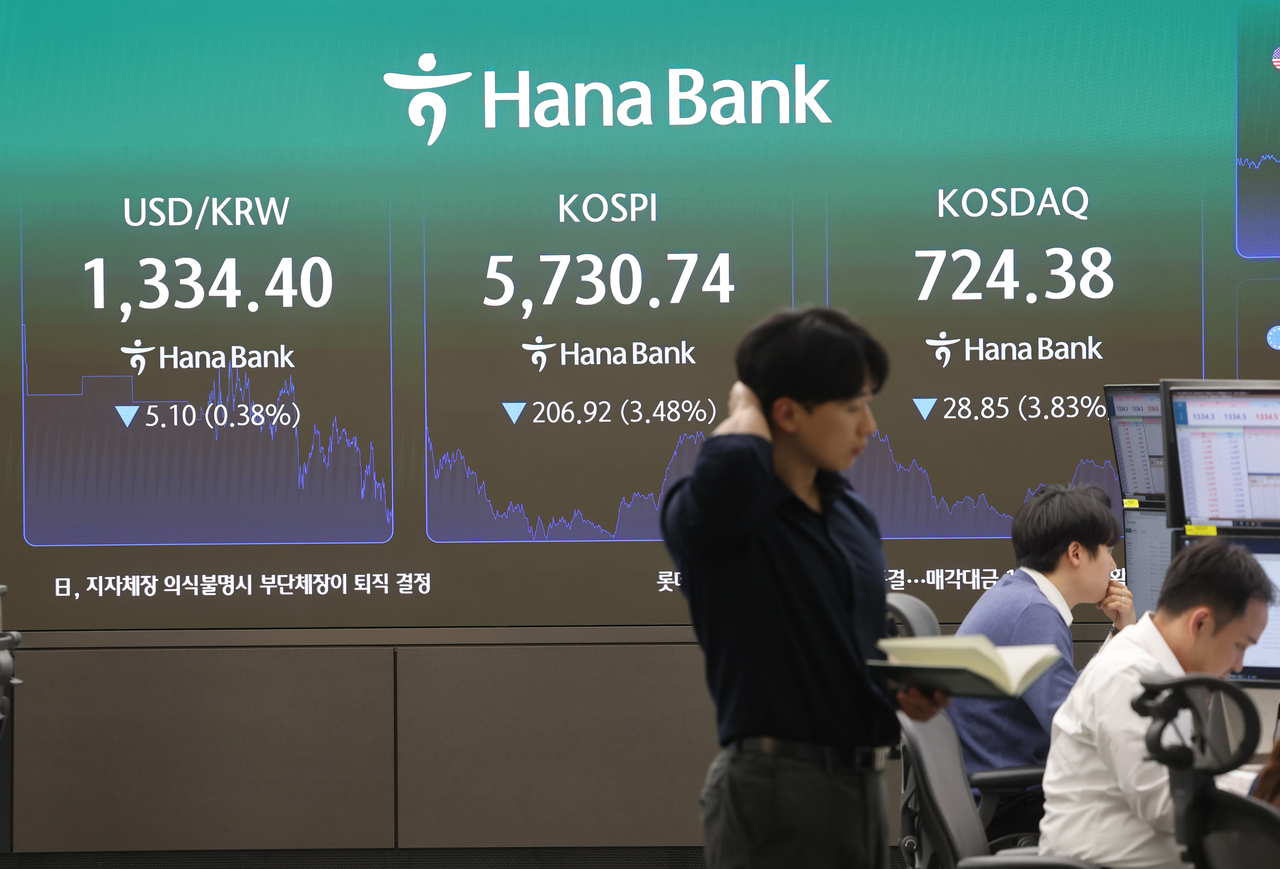
The Kospi, which had recovered the 6,000 mark on the back of SK hynix's record-breaking earnings and a large-scale shareholder return announcement, retreated to the 5,700 range amid disappointment over Samsung Electronics' shareholder return plan and concerns about deteriorating cash flows at major US technology companies. With the US midterm elections and key employment data releases due next week, international oil prices and interest rate movements are seen as the main variables for the market.
According to Korea Exchange, the Kospi closed Friday at 5,730.74, down 206.92 points, or 3.48 percent, from the previous session. The Kosdaq fell 28.85 points, or 3.83 percent, to finish at 724.38. For the week of Oct. 26 through Friday, the Kospi gained 3.25 percent while the Kosdaq lost 3.63 percent.
The Kospi had reclaimed the 6,000 level Wednesday, closing at 6,012.44, but gave back much of that gain within two sessions. On Friday, a sell-side sidecar was triggered and the index fell as low as 5,599.42 during trading.
Jo A-in, a researcher at Samsung Securities, said Alphabet's third-quarter sales came in below market expectations while heavy AI infrastructure investment pushed its free cash flow to a deficit of about $9.1 billion. Amazon also posted a free cash flow deficit of roughly $33.5 billion due to a surge in AI infrastructure spending, Jo added. "Uncertainty is growing over whether the cash flows generated by big-tech companies' core businesses can adequately keep pace with rising AI capital expenditure," Jo said, adding that this could weigh on the medium- to long-term demand outlook for domestic semiconductor companies.
However, expectations are emerging that SK hynix's resumption of its buyback program could cushion further market declines. Kang Jin-hyeok, a researcher at Shinhan Securities, noted that Kospi intraday volatility averaged 2.8 percent during the period from Aug. 20 to Oct. 21, when Samsung Electronics and SK hynix were conducting buybacks, but rose to 3.8 percent after the purchases ended. "SK hynix's resumption of its 20 trillion won ($15 billion) buyback is expected to again serve as a buffer," Kang said.
The biggest market variable next week is the US midterm elections, scheduled for Nov. 3 (local time). According to US prediction markets Kalshi and Polymarket, as of Friday the probability of the Democratic Party winning majorities in both the Senate and the House stood at 64 percent and 66 percent, respectively. While the election outcome could produce divergent stock performance across sectors, the possibility of military conflict between the United States and Iran after the vote is seen as a larger risk factor.
Lee Kyung-min, a researcher at Daishin Securities, said President Donald Trump may resume strikes against Iran after the midterm elections. "If military conflict escalates, it could push up international oil prices and interest rates, amplifying market volatility," Lee said.
A series of major domestic and international economic indicators are also due next week. Korea's October trade data, to be released Sunday, will be watched for signs of whether semiconductor export growth is holding up. NH Investment & Securities forecast that October exports would rise in the high-70-percent range year-on-year, supported by an increase in working days, though it projected that the semiconductor export growth rate would gradually slow after peaking in the third quarter.
In the United States, the Institute for Supply Management's manufacturing purchasing managers' index is due Monday (local time), followed by the Job Openings and Labor Turnover Survey on Tuesday, the ISM services PMI on Wednesday and the jobs report on Friday. Markets expect nonfarm payrolls to have risen by 65,000 in October, with the unemployment rate holding at 4.2 percent. Stronger-than-expected employment and manufacturing data could dampen expectations for Federal Reserve rate cuts and weigh on equities.
Earnings releases from major US technology companies are also on the calendar, with Apple, Palantir, AMD and Qualcomm among those set to report. Investors will be watching whether concerns about the profitability of AI investment show any signs of easing.
On Monday, Korea Exchange will also publish a list of companies with low price-to-book ratios. Na Jeong-hwan, a researcher at NH Investment & Securities, warned of a stigma effect in which companies named on the low-PBR list could suffer reputational damage. "Companies are expected to step up shareholder return policies, including expanding dividends, conducting buybacks and disclosing corporate value enhancement plans," Na said.
NH Investment & Securities set its Kospi forecast range for next week at 5,700 to 6,500 points, citing strong third-quarter corporate earnings and expanded shareholder returns as upside factors and geopolitical risks as a downside risk. Na said investors in a market rebound should focus not simply on stocks that are rising, but on those rising alongside growing trading volume. "Stocks with a clear influx of trading funds tend to sustain their rebounds longer and are more likely to emerge as new market leaders," Na said.
hajun825@heraldcorp.com




