
Seoul National University admits rise from 1 to 5, Yonsei from 12 to 24; next-generation NEIS absence raises concerns over student paperwork burden
Tokyo Korean School in Japan has been consistently producing graduates admitted to leading universities in both South Korea and Japan, demonstrating strong academic competitiveness. However, as South Korean university admissions increasingly rely on digital systems, critics say the school's high school division has yet to adopt the next-generation National Education Information System, known as NEIS, leaving room for improvement in admissions administrative support.
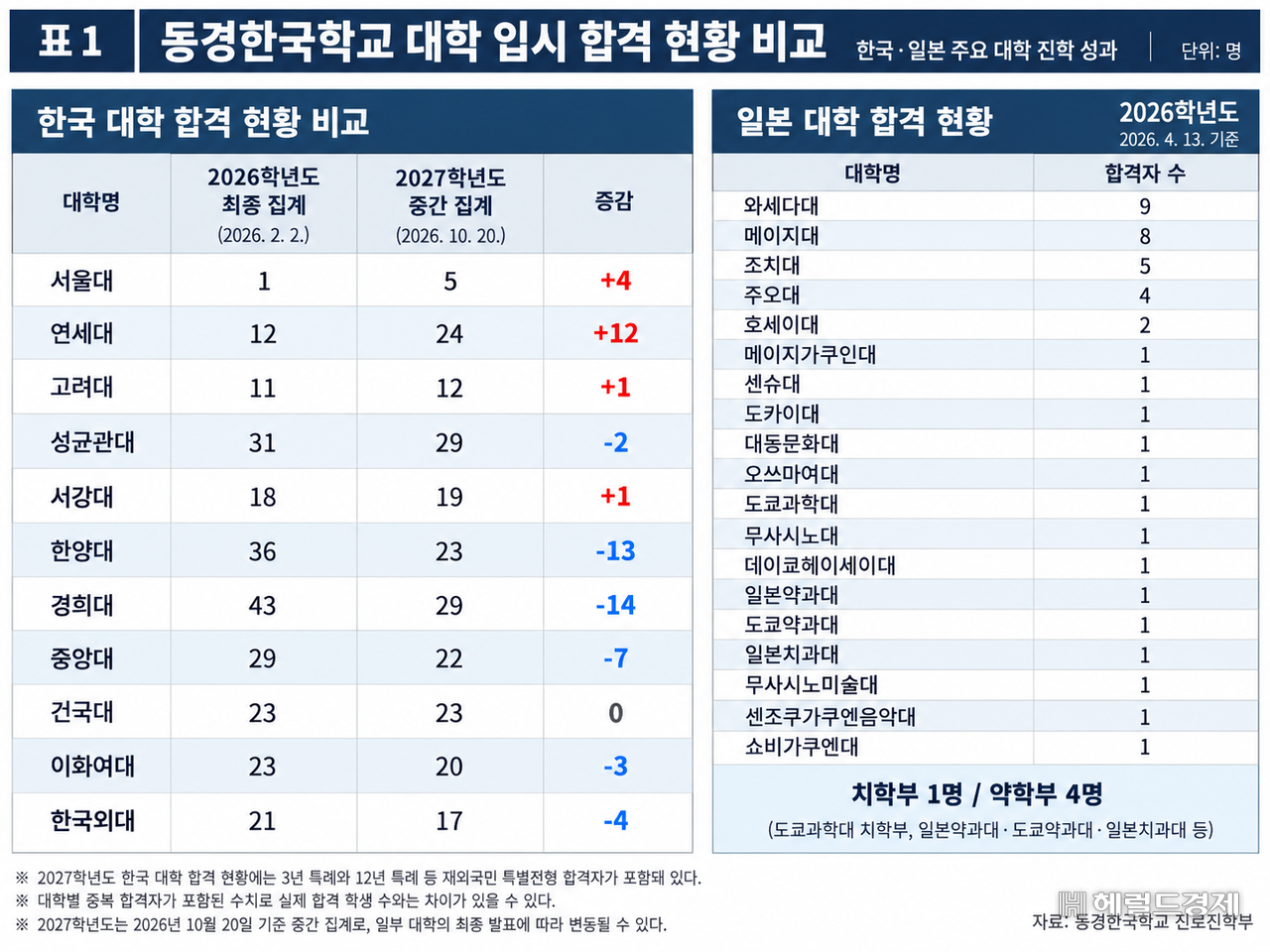
Tokyo Korean School university admissions comparison: past two academic years [Created using AI]
According to university admissions data released by Tokyo Korean School for the 2027 academic year, the school produced five admits to Seoul National University, 24 to Yonsei University, 12 to Korea University, 29 to Sungkyunkwan University, 29 to Kyung Hee University, 23 to Hanyang University, 23 to Konkuk University, 22 to Chung-Ang University, 20 to Ewha Womans University and 19 to Sogang University.
Compared with last year's final figures, Seoul National University admissions rose from one to five, while Yonsei University doubled from 12 to 24. Korea University also edged up from 11 to 12. Combined admissions to the three universities climbed from 24 last year to 41 this year. The figures include students admitted through the so-called "three-year special admissions" and "12-year special admissions" tracks reserved for overseas Koreans.
The school has also posted results in Japanese university admissions. According to 2026 academic year data released by the school, nine students were admitted to Waseda University, eight to Meiji University, five to Sophia University, four to Chuo University and two to Hosei University. The school also produced admits to Tokyo University of Science and to pharmacy and dentistry programs at other Japanese institutions.
The school's ability to consistently send graduates to top universities in both countries — while navigating two distinct admissions systems — is widely regarded as one of its core strengths. The fact that students growing up in Japan can study the Korean language and curriculum while retaining the option to pursue higher education in either country is seen as a key advantage of overseas Korean schools.
Yet separate from its admissions record, questions are being raised about the administrative infrastructure underpinning the university application process.
The school's high school division does not use the next-generation NEIS, raising concerns that students applying to South Korean universities may face additional administrative burdens — including manual paperwork — when managing school records and submitting application materials.
NEIS is the digital system South Korean schools use to manage student records, attendance, academic performance and extracurricular activities. As accurate management and submission of school records have become particularly important in special admissions tracks for overseas Koreans, critics say the admissions administrative system at overseas Korean schools is itself a component of academic competitiveness.
That said, the absence of the next-generation NEIS alone does not necessarily mean students face direct disadvantages in South Korean university admissions. Depending on each university's requirements, students may still apply by submitting documents through alternative means.
However, if the process of issuing and verifying school records and submitting application materials becomes more complicated than it is for students at domestic schools, there is a risk that the burden will fall on students, parents and college-guidance teachers. Tokyo Korean School has also drawn criticism over equity concerns, as it reportedly does not record students' external competition awards in their school records — a practice that other overseas Korean schools, including those in the United States and China, are said to allow.
Particularly given that the school is sending a significant number of graduates to top South Korean universities through the three-year and 12-year special admissions tracks, voices are growing that the administrative systems supporting those outcomes must keep pace with the school's academic ambitions.
On admissions results alone, Tokyo Korean School is performing competitively in both South Korea and Japan. The remaining challenge is to build a stable administrative support structure — covering school records management and university application submissions — so that those results no longer depend solely on the efforts of individual students and teachers.
Strong admissions outcomes are an indicator of a school's academic competitiveness. At the same time, how conveniently and reliably a school supports students through the administrative side of university applications is becoming an equally important measure of an overseas Korean school's overall educational quality.
sjkim@heraldcorp.com




