
HD Hyundai Heavy Industries develops first AI coating inspection technology in Korea's shipbuilding industry
Automated defect analysis to boost quality competitiveness
Technology extends vessel lifespan and cuts fuel costs
'A revolution in coating work, which accounts for 10% of shipyard labor'
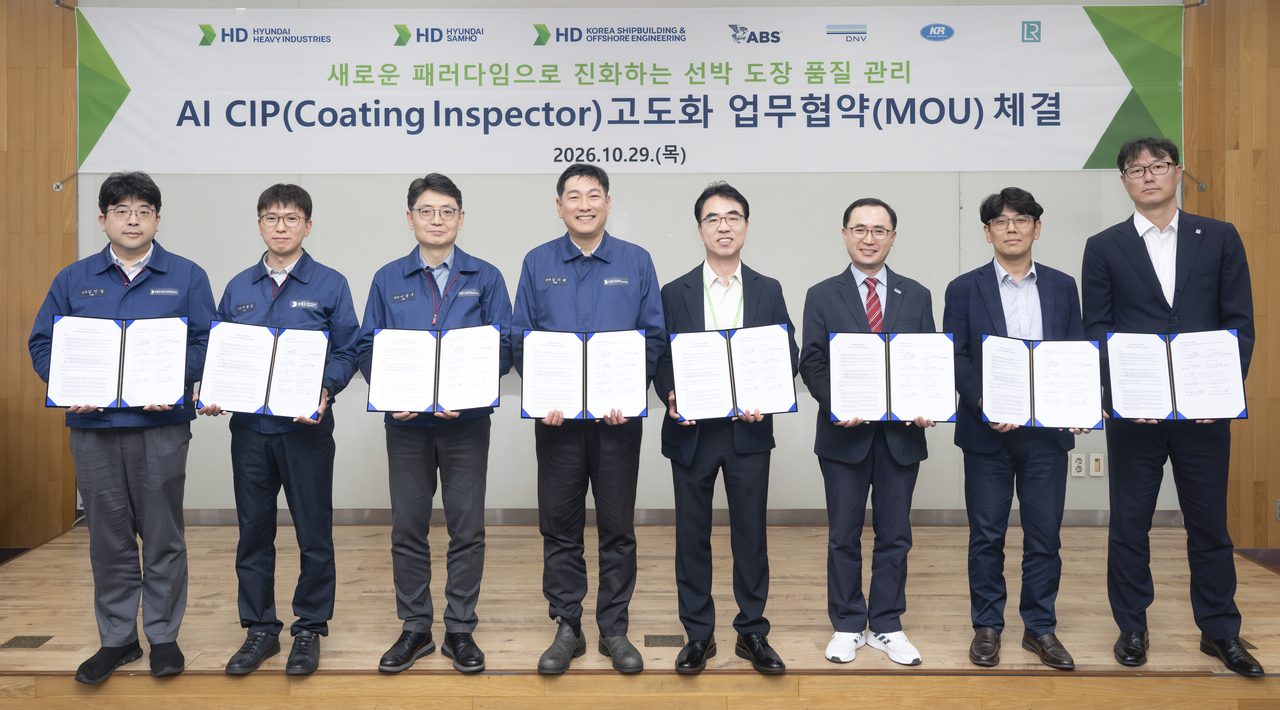
The shipbuilding industry is on the verge of applying artificial intelligence to ship coating inspection — a process long dependent on the naked eye — opening the door to vessels that are more resistant to corrosion and more fuel-efficient.
HD Hyundai Heavy Industries has developed what it says is the first AI-powered quality inspection system in the Korean shipbuilding industry capable of automatically identifying and analyzing coating defects on ships.
To establish standardized inspection procedures for use at actual worksites, the company signed an MOU Thursday with HD Korea Shipbuilding & Offshore Engineering and HD Hyundai Samho, along with four classification societies — Lloyd's Register of the United Kingdom, the American Bureau of Shipping, DNV of Norway and the Korean Register — under the title "MOU for the Advancement of AI Technology."
Ship coating is a critical quality process that determines vessel longevity by protecting against the corrosive saltwater to which ships are exposed over long periods, fuel efficiency through the friction between the hull and seawater, and maintenance costs.
A ship's paint is like human skin. When saltwater damages the surface, the steel plates rust and the vessel's lifespan shortens; when the hull roughens, water resistance increases and propulsion energy costs rise. The maximum economic lifespan of a crude oil tanker is 25 years, but securing coating quality can extend that lifespan while reducing propulsion costs.
Despite the importance of coating work, quality inspections after painting have until now relied entirely on inspectors' visual judgment and experience. This has meant that assessments of identical defects could vary depending on an inspector's skill level.
To address this, HD Hyundai Heavy Industries began working with HD Korea Shipbuilding & Offshore Engineering's AX Center in 2024 to establish objective, data-driven quality standards. The company applied vision AI and deep learning technology — computer-based AI that analyzes images — and ultimately developed what it calls the AI CIP (AI Coating InsPector). The system trains AI on vast amounts of coating quality data accumulated at shipbuilding sites to automatically identify and analyze coating defects.
Specifically, the system uses cameras to capture and analyze six categories of coating quality indicators: surface pre-treatment such as rust removal; environmental conditions including temperature and humidity; coating thickness; appearance defects — among them blistering, pinholes, cracking and missed coating areas; adhesion strength; and curing status. The analysis reduces the risk of coating quality failures.
With this technology, HD Hyundai Heavy Industries said it can shift coating quality inspections away from subjective human judgment toward an objective and consistent method, strengthening the company's coating quality competitiveness.
HD Hyundai Heavy Industries had secured orders for 134 vessels worth 25 trillion won ($18.7 billion) through September this year. Given that the company builds about 100 ships annually and that coating work accounts for roughly 10 percent of shipyard labor, the positive impact of the AI inspection technology is expected to be substantial.
Under the agreement signed Thursday, HD Korea Shipbuilding & Offshore Engineering will enhance the AI program's performance and verify its compatibility with various paints and systems, while the classification societies will conduct technical reviews and develop standard inspection procedures to ensure the reliability of AI-based coating inspection results.
"This technology development is significant in that it improves the objectivity and consistency of inspection results and enables quantitative quality analysis based on accumulated data," an HD Hyundai Heavy Industries official said.
cityblue@heraldcorp.com




